Neuralink LINK Trial: FDA Clears First Pivotal Brain Implant Study
The FDA has cleared the first pivotal trial of an implantable brain-computer interface. Here is what the LINK study will test, how the N1 implant works and what the approval does — and does not — mean.
- Written by
- Health Daily Advice
- Published
- Reading time
- 5 minutes
- Sources
- 8 cited

In this guide
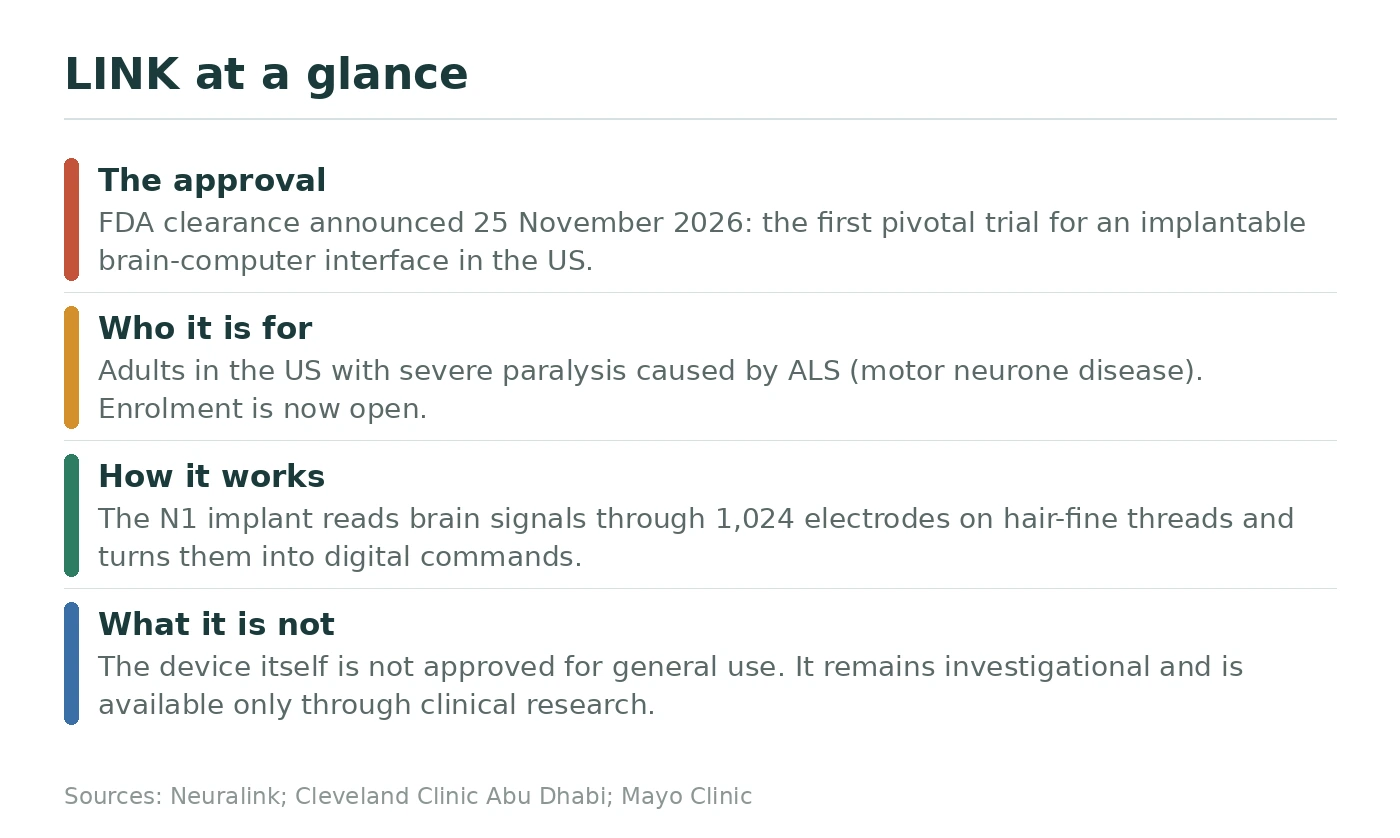
On 25 November 2026, the US Food and Drug Administration (FDA) cleared Neuralink to launch the LINK Pivotal Study, the first pivotal trial of an implantable brain-computer interface in the United States. The study will test whether the company’s N1 implant can help adults with severe paralysis caused by motor neurone disease (ALS) control digital devices using thought alone.
What is the LINK Pivotal Study?
The LINK Pivotal Study is a clinical trial designed to evaluate the safety and effectiveness of Neuralink’s brain-computer interface (BCI) system in people with severe paralysis due to amyotrophic lateral sclerosis (ALS). Participants will be asked to use the implant to control digital devices through thought, with the focus on practical results that improve independence in everyday life — such as communicating, using a computer or managing daily tasks without physical controls.
The study will run at several clinical sites across the United States, and it will also keep tracking the long-term safety and reliability of the system. Enrolment is now open through Neuralink’s Patient Registry. The company has not published a target number of participants or a completion date.
The trial builds on Neuralink’s earlier feasibility studies in the United States, Canada and the United Kingdom, in which more than 30 people have received implants and together contributed thousands of hours of real-world use. Participants in those studies have used their implants to pursue higher education, express their creativity, play video games and communicate with loved ones.
How does the N1 implant work?
A brain-computer interface reads electrical signals from the brain and turns them into commands for an external device. In Neuralink’s system, the N1 Implant is a small, fully implantable, wireless device placed in the skull. Ultra-thin threads, each finer than a human hair, are inserted into the brain’s motor cortex — the region that plans movement — using the company’s R1 surgical robot. The threads carry 1,024 electrodes that record the brain activity linked to intended movement or speech.
Those signals are sent wirelessly to an external app, which decodes them into digital commands. In practice, that means a person can move a cursor, type or operate a device simply by thinking about the movement. The implant does not read thoughts in general: it detects the patterns of brain activity that correspond to a specific intended action.
The first person with ALS to receive a Neuralink implant, Bradford Smith, was able to communicate using brain signals alone, and described the device as giving him “freedom, hope, and faster communication”.
Why is the trial focused on ALS?
ALS, also known as motor neurone disease or Lou Gehrig’s disease, is a progressive condition in which the nerve cells that control voluntary movement — motor neurones — gradually deteriorate and die. It often begins with muscle twitching and weakness in a limb, or slurred speech, and eventually affects the muscles needed to move, speak, eat and breathe. There is no cure, and the most common cause of death is breathing failure. The Mayo Clinic notes that most people live 3 to 5 years after symptoms begin, although some live 10 years or longer.
ALS affects about 7 in every 100,000 people worldwide, according to MedlinePlus. Because the disease takes away movement while the mind usually stays sharp, a device that turns intended movement into computer commands could restore communication and a measure of independence — which is why people with severe paralysis from ALS are the first group in this pivotal trial.
What does “pivotal” mean — and what it does not mean
A pivotal trial is a later-stage study designed to gather the evidence a regulator needs to decide whether a device is safe and effective enough for wider use. It is a step beyond the small early feasibility studies, with a formal protocol, more sites and a focus on outcomes that matter to patients.
What the announcement does not mean is that the implant itself has been approved. The FDA’s clearance covers the trial, granted on an experimental basis. The N1 Implant remains an investigational device: it is available only through authorised clinical research and has not been approved for general medical use. If the trial shows the system is safe and effective, Neuralink could then apply for further trials and, eventually, for the device to be sold more widely.
Who can take part?
The LINK Pivotal Study is recruiting adults living in the United States with severe paralysis caused by ALS. Neuralink has not published the full eligibility criteria, so anyone interested should apply through the company’s Patient Registry, where the trial team assesses each person individually. Taking part involves an initial assessment and brain imaging, surgery to place the implant, and then training to control a cursor using thought, with follow-up over roughly two years.
Brain surgery carries real risks, including infection, bleeding and complications from anaesthesia, and the long-term reliability of implanted electrodes is still being studied. These are questions the trial itself is designed to answer, and they should be discussed in detail with the trial team and your own doctor before deciding.
What happens next?
With enrolment open, the coming months will show how quickly the study fills and how the first pivotal-trial participants get on. Results are likely to take years rather than months: pivotal trials are designed to follow people over time, and the study also aims to assess the system’s long-term safety and reliability. For now, the clearance is a milestone for brain-computer interfaces — the first time a trial of this kind has reached the pivotal stage in the US — but it is the beginning of the evidence-gathering, not the end of it.
For background on how Neuralink reached this point, see our earlier article on the first approval for human trials.
When to see a doctor
Muscle weakness, twitching, slurred speech or trouble swallowing that is new, worsening or spreading should be checked by a doctor rather than assumed to be tiredness or age. ALS is diagnosed through symptoms, examination and tests that rule out other conditions, and an early assessment matters because it opens the door to support, planning and, where appropriate, clinical trials.
If you or someone you care for has ALS and is interested in research, talk to your doctor or neurologist about whether a trial could be suitable, and what the risks and commitments would involve. In an emergency call 911 (US), 999 (UK) or 112 (EU).
Frequently asked questions
What is Neuralink's LINK study?
LINK is the first pivotal clinical trial of an implantable brain-computer interface in the United States, cleared by the FDA on 25 November 2026. It will test whether Neuralink's N1 implant can help adults with severe paralysis caused by ALS control digital devices using thought alone, focusing on practical results that improve independence in daily life. The study will also track the system's long-term safety and reliability across several US clinical sites.
Is the Neuralink implant approved by the FDA?
No. The FDA has cleared the LINK trial, not the device itself. The N1 implant remains investigational and is available only through authorised clinical research. The trial is designed to gather the evidence regulators need to decide whether the system is safe and effective enough for wider use. Only if the results support it could Neuralink apply for further trials and eventually for the device to be sold more widely.
How does a brain-computer interface work?
A brain-computer interface reads electrical signals from the brain and turns them into commands for a device. Neuralink's N1 implant uses 1,024 electrodes on ultra-thin threads placed in the motor cortex, the brain region that plans movement. When a person thinks about moving, the implant records that activity, sends it wirelessly to an app, and the app decodes it into a digital command such as moving a cursor.
Who can join the LINK trial?
The study is recruiting adults living in the United States with severe paralysis caused by ALS. Neuralink has not published the full eligibility criteria, so anyone interested should apply through the company's Patient Registry, where the trial team assesses each person individually. Taking part involves assessment and brain imaging, surgery to place the implant, and training to control a cursor using thought.
What is ALS?
ALS, or motor neurone disease, is a progressive condition in which the nerve cells controlling voluntary movement gradually die. It often starts with muscle twitching or weakness in a limb, or slurred speech, and eventually affects the muscles used to move, speak, eat and breathe. There is no cure. Most people live 3 to 5 years after symptoms begin, though some live 10 years or longer.
Sources
- Neuralink: Receives FDA Approval to Launch LINK Pivotal Study neuralink.com
- Cleveland Clinic Abu Dhabi: Brain-Computer Interfaces: The Future of Neurological Care www.clevelandclinicabudhabi.ae
- Mayo Clinic: Amyotrophic lateral sclerosis (ALS) – Symptoms and causes www.mayoclinic.org
- Engadget: Neuralink receives FDA approval for 'pivotal' brain implant trial in ALS patients www.engadget.com
- Digital Trends: FDA clears Neuralink to start the first pivotal US trial of an implantable brain-computer interface www.digitaltrends.com
- MedlinePlus: Amyotrophic lateral sclerosis (ALS) medlineplus.gov

Try the tool
Not sure if it can wait?
Common causes and warning signs for 16 everyday symptoms.
Open the symptom guide