FDA Withdraws Oxbryta: What the Sickle Cell Drug Decision Means
The FDA is formally withdrawing approval of the sickle cell drug Oxbryta from 30 November 2026, two years after Pfizer pulled it from sale worldwide.
- Written by
- Health Daily Advice
- Published
- Reading time
- 4 minutes
- Sources
- 7 cited
In this guide
The FDA is formally withdrawing approval of Oxbryta (voxelotor), a sickle cell disease tablet, with the withdrawal taking effect on 30 November 2026. The agency concluded it could not identify a group of patients for whom the drug’s benefits outweighed its risks of painful crises and death. Pfizer had already pulled the drug from sale worldwide in September 2024.
What happened?
The US Food and Drug Administration is withdrawing approval of Oxbryta (voxelotor), the sickle cell disease tablet made by Pfizer subsidiary Global Blood Therapeutics. A Federal Register notice was filed for public inspection on 27 November 2026 and is set for publication on 30 November, when the withdrawal takes effect. The notice, issued under docket FDA-2026-N-13663, withdraws approval of two new drug applications: NDA 213137 for Oxbryta 300 mg and 500 mg tablets, and NDA 216157 for Oxbryta 300 mg tablets for suspension.
Once the notice is published, distributing Oxbryta without an approved application is illegal under US law. Global Blood Therapeutics asked for the withdrawal and waived the expedited withdrawal procedures, according to the notice.
Why did the FDA withdraw Oxbryta?
Oxbryta was approved in 2019 under the FDA’s accelerated approval pathway, which allows a drug for a serious condition to reach patients early based on a surrogate measure — in this case a rise in haemoglobin — that is reasonably likely to predict real benefit. In return, the company had to run a postmarketing confirmatory trial to prove that benefit.
That trial, known as HOPE Kids 2, was a Phase 3 study in 236 children with sickle cell disease. The FDA also weighed data from a second Phase 3 trial, RESOLVE, which tested voxelotor for leg ulcers. At a meeting on 2 July 2026, the FDA told the company that the modest reduction in transcranial Doppler flow velocity — a measure of blood flow in the brain linked to stroke risk — seen with Oxbryta compared with placebo did not outweigh the risks of vaso-occlusive crises and death. The agency recommended that the company request a voluntary withdrawal, and the company submitted its request on 31 July 2026.
The notice records that Global Blood Therapeutics still believed Oxbryta addressed a significant unmet medical need with a positive benefit-risk balance for adults and adolescents, but it accepted the FDA’s determination that no population could be identified in which the benefits outweigh the risks.
The story so far: from approval to withdrawal
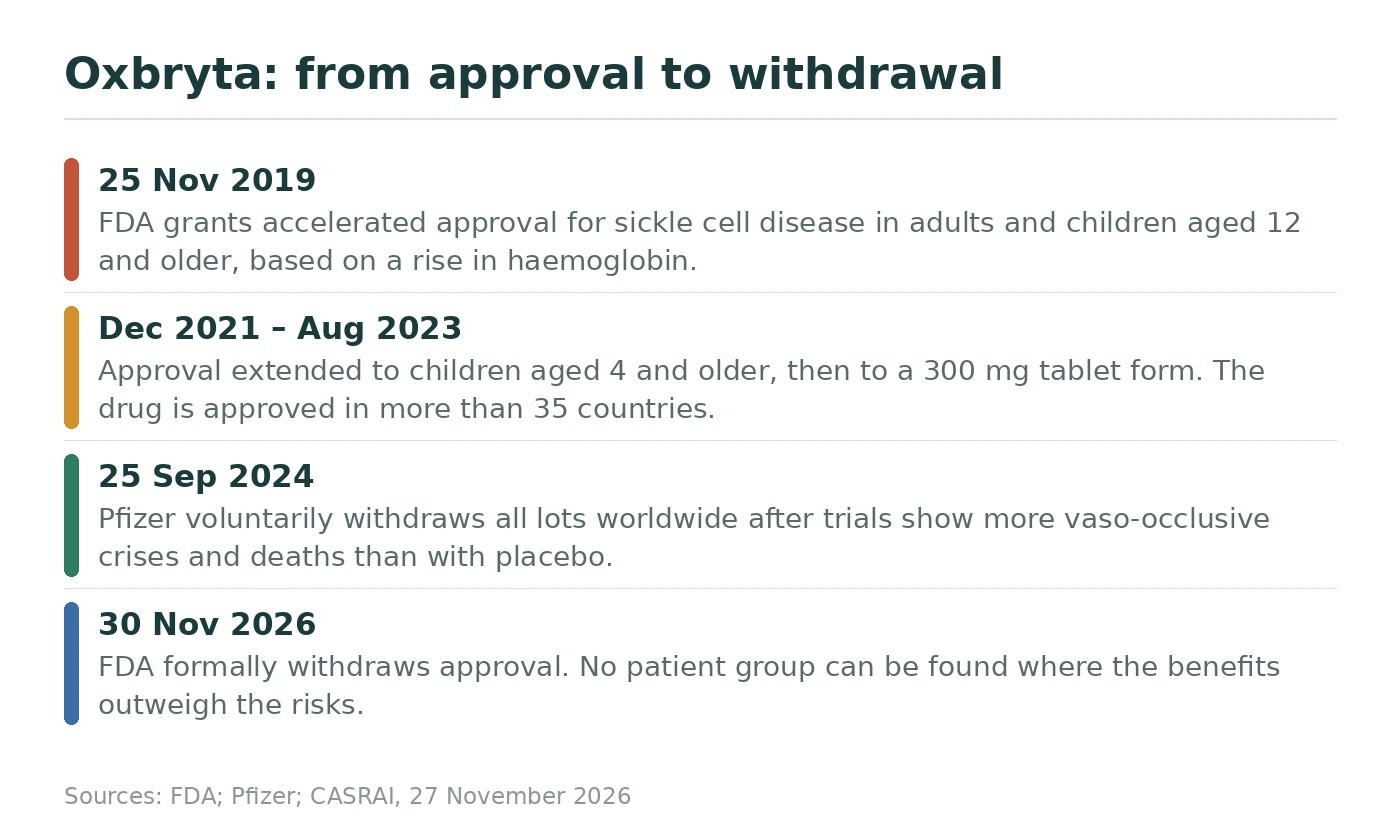
Oxbryta’s rise and fall spans seven years. The FDA first approved the 500 mg tablet on 25 November 2019 for sickle cell disease in adults and children aged 12 and older. Approval was extended to a 300 mg tablet for suspension in December 2021 for patients aged 4 and older, and to a 300 mg tablet in August 2023. The drug went on to be approved in more than 35 countries.
The turn came in September 2024. On 25 September, Pfizer announced it was voluntarily withdrawing all lots of Oxbryta worldwide, ceasing distribution and discontinuing all active voxelotor clinical trials and expanded access programmes. The company said the totality of clinical data indicated the overall benefit no longer outweighed the risk, citing an imbalance in vaso-occlusive crises and fatal events. The next day, the FDA issued its own alert, telling health care professionals to stop prescribing Oxbryta and patients to contact their health care professional about stopping it and starting another treatment option. European regulators likewise recommended suspending the drug’s marketing authorisation.
The November 2026 notice closes the regulatory record: the approval itself is now being withdrawn, two years after the drug left the market.
What is sickle cell disease?
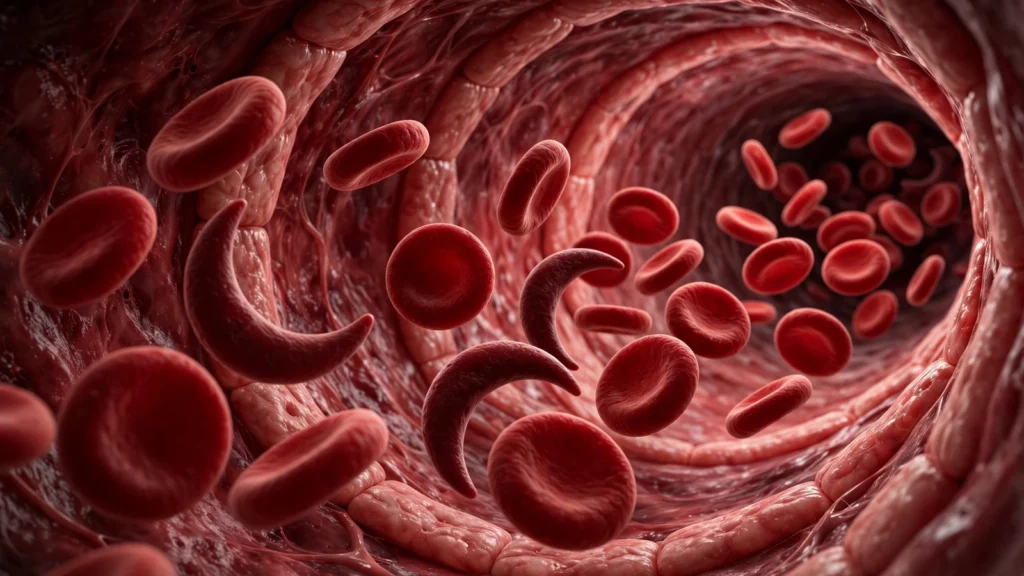
Sickle cell disease is an inherited condition that affects red blood cells. Faulty haemoglobin makes the cells hard, sticky and crescent-shaped, so they can block blood vessels and die too quickly. The main symptoms are painful episodes called sickle cell crises, anaemia and a higher risk of serious infections. Crises can last hours, days or weeks, and can be triggered by dehydration, sudden temperature changes and stress, according to the NHS.
About 100,000 Americans live with sickle cell disease, according to the CDC, and the most severe forms can shorten life by 20 to 30 years. Globally, about 4.5 million people live with the condition and more than 45 million carry the sickle cell trait. It is a lifelong condition, but treatments can help manage it, and stem cell and bone marrow transplants and gene therapy can cure it in some people.
What should people who took Oxbryta do now?
Anyone who was taking Oxbryta should contact their doctor or sickle cell team to discuss stopping it and starting another treatment option, as the FDA advised when the drug was withdrawn from sale in 2024. Do not change your treatment on your own. The FDA has said other approved medicines for sickle cell disease are available, and your care team can advise which options fit your situation. Side effects can be reported to the FDA through its MedWatch programme.
When to see a doctor
See a doctor or your sickle cell team if you need help with sickle cell disease symptoms, or if you were taking Oxbryta and have not yet discussed an alternative treatment. The NHS advises calling 999 if you think you are having a sickle cell crisis with severe pain, breathing difficulties or vomiting, if you have sickle cell disease and a high temperature, or if you have an erection that is painful or does not go away. In an emergency call 911 (US), 999 (UK) or 112 (EU).
Frequently asked questions
Why is the FDA withdrawing Oxbryta?
The FDA concluded it could not identify any group of patients for whom Oxbryta's benefits outweigh its risks. The confirmatory HOPE Kids 2 trial showed only a modest reduction in blood flow velocity in the brain, which did not justify the higher rates of vaso-occlusive crises and deaths seen in postmarketing studies. The formal withdrawal takes effect when the notice is published in the Federal Register on 30 November 2026.
What is Oxbryta and what did it do?
Oxbryta, also known as voxelotor, was a once-daily tablet for sickle cell disease. It worked by helping haemoglobin hold on to oxygen, which was meant to stop red blood cells from sickling and breaking apart. The FDA approved it in 2019 under accelerated approval, based on a rise in haemoglobin, with a confirmatory trial required to prove real clinical benefit.
Was Oxbryta already off the market?
Yes. Pfizer voluntarily withdrew all lots of Oxbryta from sale worldwide on 25 September 2024, stopped distribution and ended all voxelotor clinical trials and expanded access programmes. The FDA issued its own alert the next day, telling health care professionals to stop prescribing it. The November 2026 notice formally withdraws the drug's approval, closing the regulatory record.
What is sickle cell disease?
Sickle cell disease is an inherited condition in which red blood cells become hard, sticky and crescent-shaped, so they can block blood vessels and die too quickly. The main symptoms are painful crises, anaemia and a higher risk of serious infections. It affects about 100,000 Americans, and the most severe forms can shorten life by 20 to 30 years, according to the CDC.
What should I do if I took Oxbryta?
Contact your doctor or sickle cell team to discuss stopping Oxbryta and starting another treatment option, as the FDA advised in 2024. Do not make changes to your treatment on your own. Other FDA-approved medicines for sickle cell disease exist, and your care team can advise which options fit your situation.
Are there other treatments for sickle cell disease?
Yes. The NHS lists painkillers, antibiotics to prevent serious infections, vaccinations, a medicine called hydroxycarbamide, and blood transfusions among the treatments used to manage sickle cell disease. Stem cell and bone marrow transplants and gene therapy can cure the condition in some people, but they are not suitable for everyone. Your specialist team can explain the options.
Sources
- CASRAI: FDA Withdraws Approval of Sickle Cell Drug Oxbryta casrai.org
- FDA: FDA is alerting patients and health care professionals about the voluntary withdrawal of Oxbryta from the market due to safety concerns www.fda.gov
- Pfizer: Pfizer Voluntarily Withdraws All Lots of Sickle Cell Disease Treatment OXBRYTA (voxelotor) From Worldwide Markets www.pfizer.com
- NHS: Sickle cell disease www.nhs.uk
- CDC: CDC Grand Rounds: Improving the Lives of Persons with Sickle Cell Disease (MMWR 2017) www.cdc.gov

Try the tool
Not sure if it can wait?
Common causes and warning signs for 16 everyday symptoms.
Open the symptom guide