Kayem Foods Meat Recall: 1.58m Pounds and What to Check
More than 1.5 million pounds of hot dogs, bacon and deli meat were recalled after a warehouse cooler failed. Here is how to check your fridge — and why some packs are dated to February 2027.
- Written by
- Health Daily Advice
- Published
- Reading time
- 5 minutes
- Sources
- 6 cited
In this guide
Kayem Foods has recalled about 1,584,361 pounds of ready-to-eat meat and poultry — hot dogs, bacon, deli ham and sausages — after a warehouse cooler failed to hold a safe temperature. The US food safety agency announced the recall on 17 October 2026, and some packs have use-by dates running to February 2027, so check your fridge and freezer.
What was recalled and why
The recall covers ready-to-eat (RTE) meat and poultry products made between about 31 March and 7 October 2026 at Kayem Foods’ Chelsea, Massachusetts, plant, and shipped to shops and food-service outlets across the United States and in Hong Kong. Ready-to-eat means the food is meant to be eaten without further cooking, so there is no cooking step at home to kill any germs that may have grown.
The problem came to light on 1 October 2026, when a retail customer complained that products felt warm when they were delivered. Kayem investigated and found that a warehouse cooler where the products were stored had experienced temperature deviations — in plain terms, the meat spent time warmer than it should have been. The company said the cause was a cooling system malfunction at one of its warehouses, and that it has since fixed the problem.
The FSIS placed the recall in Class I, its highest-risk category, which it uses when there is a reasonable probability that eating the product could cause serious health consequences or death. As of the 17 October announcement, there were no confirmed reports of illness linked to the recalled products.
Which products and brands are affected
The recall list runs to more than 100 products sold under eight brand names: Kayem, Al Fresco, McKenzie, Triple M, Deutschmacher, Jordan’s, Essem and Winnisimmet St. Butchery. Some reports also list Genoa. Affected items include:
- Hot dogs and franks: Kayem beef and pork hot dogs, Fenway Franks, Old Tyme franks and cocktail franks
- Bacon: Kayem double-smoked and applewood-smoked thick-cut bacon, McKenzie sliced bacon
- Deli meats: ham, turkey breast, bologna, corned beef, brisket, kielbasa, liverwurst and meat loaves
- Chicken products: Al Fresco chicken sausages, chicken meatballs and breakfast patties
The FSIS has published the full list of products, with UPC codes and photos of the labels, on its recalls page. The agency has also said it will post lists of the shops that received the products once they are available.
How to check your fridge in 4 steps
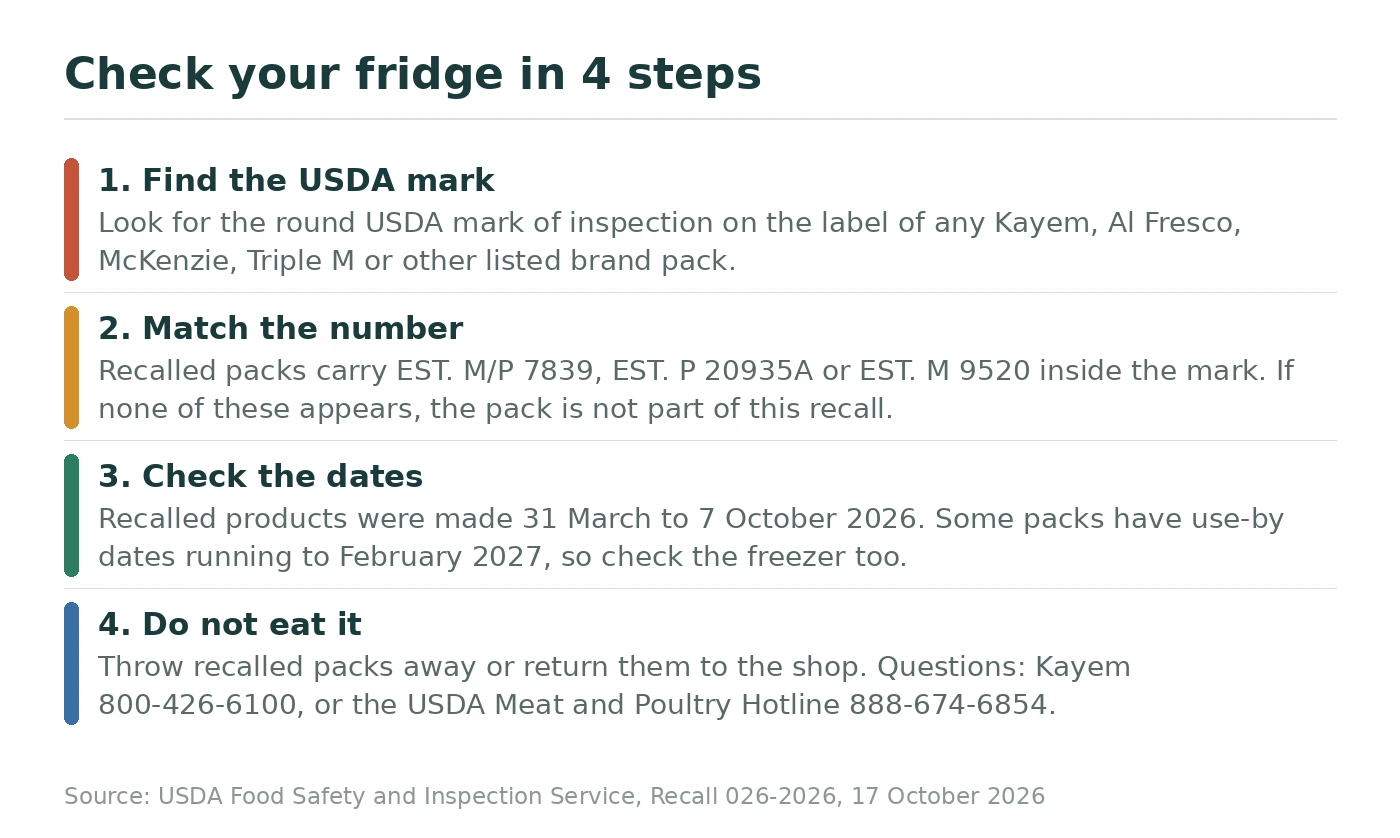
Because the products were sold nationwide and some have long shelf lives, the FSIS is concerned that packs may still be in people’s refrigerators or freezers. Work through the steps in the chart above, and check the freezer as well as the fridge — frozen packs are still part of the recall.
Why temperature abuse matters
Keeping food cold matters because bacteria grow fastest between 40°F and 140°F (4°C and 60°C), a range the USDA calls the “danger zone”. The USDA FSIS fact sheet says bacteria in this range can double in number in as little as 20 minutes, and that perishable food should never be left out of refrigeration for more than two hours.
One germ that matters here is Listeria. Unlike most food-poisoning bacteria, Listeria can keep growing on food held in the refrigerator, which is why it is a particular concern with ready-to-eat deli meats and hot dogs. The CDC advises that Listeria is especially harmful if you are pregnant, aged 65 or older, or have a weakened immune system. In pregnancy it can cause pregnancy loss, premature birth or a life-threatening infection in a newborn. Symptoms usually start within two weeks of eating contaminated food, but can start as early as the same day or as late as 10 weeks after.
That risk is also why the FSIS advice is blunt: do not eat the recalled products, even if they look and smell fine, and do not try to make them safe by cooking them — the recall notice says to throw them away or return them to the place of purchase. If you are pregnant, 65 or older, or immunocompromised, the CDC’s standing advice for deli meat and hot dogs generally is to eat them only after heating to 165°F (74°C) or until steaming hot.
Why the recall is trending again now
The recall was announced in mid-October, but searches for it surged again over the Thanksgiving weekend, with Google Trends showing more than 200,000 searches. The timing makes sense: the holiday is the one weekend of the year when millions of American fridges are at their fullest, and shoppers are clearing out leftovers and checking what is still safe to eat. Our earlier guide to the Butterball turkey recall drew the same lesson — a recall announced weeks earlier can still be live in your kitchen months later when the use-by dates stretch into the new year.
For UK readers, the products were also shipped to Hong Kong as well as across the US, but the recall is a US FSIS action and the affected brands are American; if you bought Kayem or Al Fresco products while travelling in the US, the same checks apply.
What to do if you find a recalled pack
- Do not eat it. Throw it away or return it to the shop where you bought it.
- Clean the fridge shelf, drawer or container it touched, because Listeria can spread to other foods and surfaces.
- If you already ate some and feel unwell, contact a healthcare provider and mention the recall. Keep the packaging if you still have it, as the establishment number and UPC help identify the product.
- Questions about the recall: Kayem Foods Customer Service on 800-426-6100 or info@kayem.com; food-safety questions: the USDA Meat and Poultry Hotline on 888-674-6854.
When to see a doctor
Most food poisoning settles at home with rest and fluids, but get medical advice promptly if you develop a fever, muscle aches and tiredness after eating a recalled product, or — in anyone — a headache, stiff neck, confusion or loss of balance, which can be signs of invasive listeriosis. Pregnant women should contact their doctor or midwife sooner rather than later, even with mild flu-like symptoms, because early treatment matters. In an emergency call 911 (US), 999 (UK) or 112 (EU).
Frequently asked questions
Which Kayem products are recalled?
More than 100 ready-to-eat products under eight brands — Kayem, Al Fresco, McKenzie, Triple M, Deutschmacher, Jordan's, Essem and Winnisimmet — including hot dogs, bacon, deli ham, turkey breast, sausages, bologna and kielbasa. The full list, with UPC codes and label photos, is on the USDA FSIS recalls page. Products were made between 31 March and 7 October 2026.
How do I know if my pack is part of the Kayem recall?
Look for the round USDA mark of inspection on the label and check the establishment number inside it. Recalled packs show EST. M/P 7839, EST. P 20935A or EST. M 9520. Then match the product name and UPC against the FSIS list. If the number is not one of those three, the pack is not part of this recall.
Is recalled Kayem meat safe if I cook it?
No. The USDA says not to eat the recalled products at all — throw them away or return them to the shop. Cooking is not listed as a fix for this recall, because the products spent time at unsafe temperatures during storage, and some packs may still be in fridges and freezers months later.
What is temperature abuse in food?
It means food was held at a temperature that lets bacteria grow. The USDA calls 40°F to 140°F (4°C to 60°C) the danger zone, where bacteria can double in as little as 20 minutes. In the Kayem case, a warehouse cooler malfunction left ready-to-eat meats warmer than they should have been during storage.
Has anyone fallen ill from the recalled Kayem meat?
No confirmed reports of illness had been linked to the recalled products when the FSIS announced the recall on 17 October 2026. The recall is precautionary, based on the temperature problem found during storage. Anyone who ate a recalled product and feels unwell should contact a healthcare provider.
Sources
- USDA FSIS: Kayem Foods Inc. Recalls Meat and Poultry Products Due to Possible Temperature Abuse content.govdelivery.com
- Food Safety News: More than 1.5 million pounds of hot dogs, bacon, sausage, turkey breasts and more meat products recalled www.foodsafetynews.com
- USDA FSIS: “Danger Zone” (40°F–140°F) www.govinfo.gov
- CDC: Listeria Outbreak Linked to Meats Sliced at Delis www.cdc.gov
- Taste of Home: More Than 1.5 Million Pounds of Meat Recalled www.tasteofhome.com

Try the tool
Not sure if it can wait?
Common causes and warning signs for 16 everyday symptoms.
Open the symptom guide