Butterball Turkey Recall: Is Your Thanksgiving Turkey Safe?
No, there is no Butterball turkey recall — but inspectors found salmonella in a large share of ground turkey samples. Here is what the data really says, and how to cook your bird safely.
- Written by
- Health Daily Advice
- Published
- Reading time
- 8 minutes
- Sources
- 7 cited
In this guide
No, there is no Butterball turkey recall in 2026. Federal records show no active recall for Butterball whole turkeys or ground turkey. Searches surged after a November 25 investigation found salmonella in just under 43% of ground turkey samples at four Butterball plants, but none in whole birds. Cook turkey to 165°F and it is safe to eat.
No recall — so what set off the searches?
If you typed “butterball turkey recall” into Google this Thanksgiving, you joined a lot of people doing the same thing. The search spiked on Thanksgiving Day 2026, and the timing made it feel urgent: millions of families were about to sit down to a turkey dinner.
But the surge was not triggered by a recall. It followed an investigation published on November 25 by The Guardian and SourceMaterial, based on federal inspection data. The story reported high salmonella levels in some Butterball ground turkey — and social media did the rest, with old recall stories and recycled videos piling on until it looked like a nationwide recall was underway.
A check of active federal records on November 25 confirmed the reality: Butterball has no active recalls or public health alerts in 2026, and no whole Thanksgiving turkey from any major brand is under recall. The confusion is understandable, but the bird in your oven is not part of a recall.
What the inspection data actually showed
The investigation analyzed inspection data from the U.S. Department of Agriculture’s Food Safety and Inspection Service (FSIS) for fiscal years 2025 and 2026, covering four Butterball slaughterhouses. Here is what the numbers said:
| What was tested | Result |
|---|---|
| Ground or chopped turkey, all four Butterball plants | Just under 43% of samples contained salmonella |
| Ground or chopped turkey, Mount Olive, North Carolina plant | Salmonella in 16 of 45 samples — 36% |
| Whole birds and ready-to-eat products | No contamination found |
| Ground or chopped turkey at Jennie-O, for comparison | 7% of samples tested positive |
| USDA’s acceptable limit for a single plant | 13.5% |
The Mount Olive plant matters because of its scale: it is the country’s biggest turkey slaughterhouse, processing 285,000 birds a week, and its raw ground turkey, burgers and sausages are sold nationwide, including through Walmart, Costco and Kroger. That is a lot of product moving through a plant where more than a third of ground turkey samples tested positive.
It is also worth noting what the data did not show. Inspectors found no salmonella in Butterball’s whole birds — the kind of turkey most families roast on Thanksgiving — or in its ready-to-eat products.
Why high test results did not trigger a recall
This is the part that surprises most people. The USDA sets a limit of 13.5% for salmonella in ground or chopped turkey at an individual plant. Butterball’s plants were well above it. Yet no fine was issued and no product was pulled from shelves.
That is because the limit works differently from how most shoppers assume. A plant that goes over the limit is not fined and does not have to recall anything. Instead, the USDA requires it to explain how it is addressing the problem. The finding becomes a corrective-action conversation, not an enforcement action.
Butterball, for its part, is taking part in an FSIS pilot program looking at the causes of foodborne illness, and has argued that the agency should measure how much salmonella is in a sample rather than simply whether any is present. A company spokesperson said food safety is critically important to Butterball and that it keeps investing in new technology and working with food safety experts to reduce pathogens, including salmonella.
Consumer advocates are not satisfied with that answer. Sarah Sorscher of the Center for Science in the Public Interest said less contamination is better than more — but the better outcome is none at all. The USDA has asked Butterball to explain its plan, and that response will shape whether this stays a news story or becomes a bigger fight over how the agency polices poultry plants.
The 2019 recall behind the old headlines
Much of what you will find when you search “Butterball turkey recall” is not from 2026 at all. It is from a real recall in March 2019 — and it is easy to mistake for current news, because the details look fresh and alarming.
On March 13, 2019, Butterball recalled about 78,164 pounds of raw ground turkey that may have been contaminated with a strain called Salmonella Schwarzengrund. The ground turkey had been produced on July 7, 2018, carried a sell-or-freeze-by date of July 26, 2018, and was sold under the Butterball, Kroger and Food Lion names. It was linked to five illnesses in two states, and the bacteria found in patients matched the bacteria in the turkey.
That recall is long over, but the articles about it never went away, so search engines keep surfacing them every Thanksgiving. A second source of confusion is a similarly named company: on November 6, 2026, the USDA issued a public health alert for Betterballen Foods LLC, a specialty importer of Dutch-style frozen snacks — a completely different business, and an alert about mislabeled allergens, not salmonella in turkey.
One more thing circulating online is a viral video that looks like a breaking-news report about a Butterball recall. It is archive footage from a 2006 investigation, not current reporting.
What salmonella illness looks like
Salmonella is a group of bacteria that lives in the intestines of people and many animals, and it is one of the most common causes of foodborne illness in the United States. The CDC estimates it causes about 1.2 million illnesses and 450 deaths in the U.S. every year.
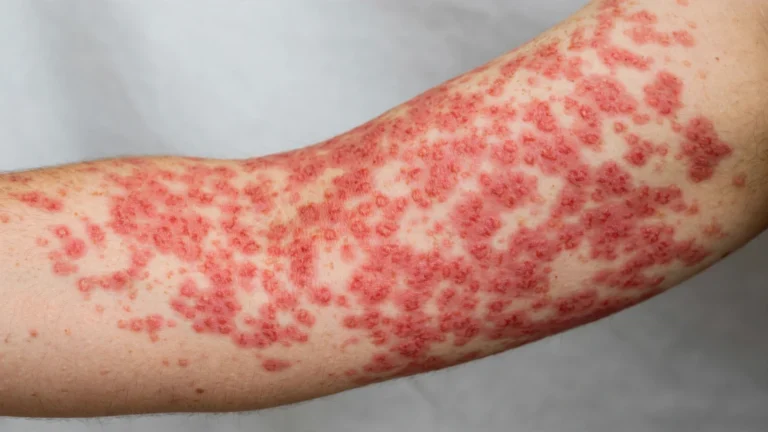
Most people who get sick develop symptoms 12 to 72 hours after exposure: diarrhea, fever and abdominal cramps. The illness usually lasts 4 to 7 days, and most people recover without antibiotics. In some cases the diarrhea is severe enough to need hospital care, and in rare cases the infection spreads from the intestines into the bloodstream, where it can become life-threatening without prompt treatment.
Anyone can catch salmonella, but some people are more likely to become seriously ill: children younger than five, older adults, and people with weakened immune systems. That includes people with HIV or diabetes and people going through cancer treatment. If someone in one of those groups develops symptoms after eating turkey, they should talk to a doctor sooner rather than later.
It is worth remembering that salmonella is not unique to one brand. Raw poultry of any kind can carry it, which is why safe handling and thorough cooking matter with every bird, recall or no recall.
Cooking your Thanksgiving turkey safely
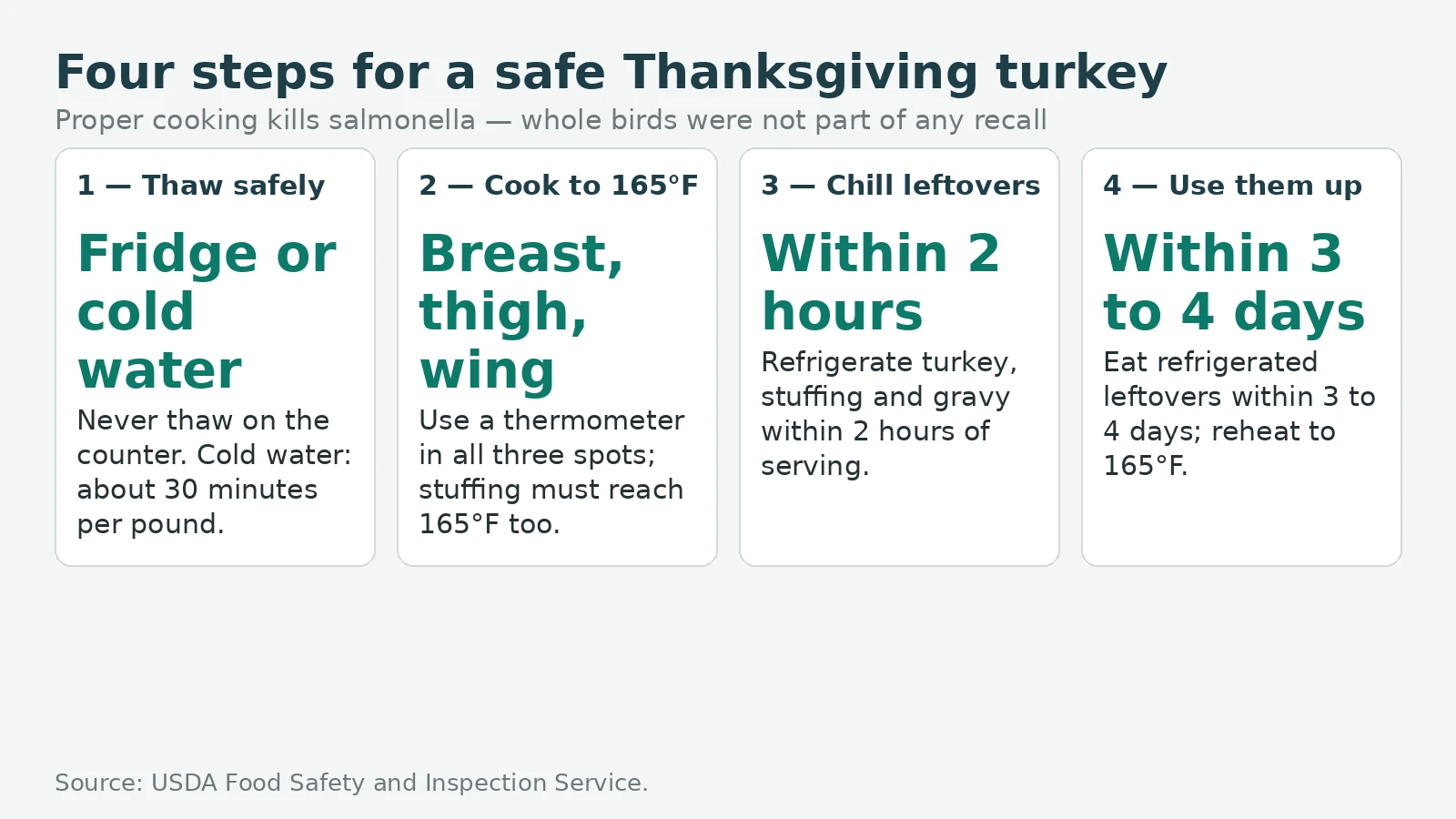
The good news is that proper cooking kills salmonella. The USDA’s rule is simple and specific: cook turkey to a safe minimum internal temperature of 165°F, measured with a food thermometer in the thickest part of the breast, the innermost part of the thigh and the innermost part of the wing. If the turkey is stuffed, the stuffing in the center must also reach 165°F.
A pop-up timer is not a substitute for a thermometer. Color is not reliable either — turkey can look done before it is safe, and pink meat can still be fine if it has reached 165°F. Check all three spots, keep the thermometer away from bone, and let the bird stand for 20 minutes before carving.
A few more habits make a real difference on the day:
- Thaw safely. Never thaw a turkey on the counter. In the fridge, allow about 24 hours for every 4 to 5 pounds. If you are short on time, submerge the wrapped bird in cold tap water — about 30 minutes per pound, changing the water every 30 minutes — and cook it immediately once thawed.
- Do not wash the turkey. Rinsing raw poultry spreads bacteria around the sink and countertops. Cooking to 165°F is what makes it safe.
- Keep raw turkey away from everything else. Use separate cutting boards and utensils for raw meat, and wash hands, boards and counters with soap and water after they touch raw turkey or its juices.
- Watch the clock on leftovers. Bacteria multiply fastest between 40°F and 140°F, so get turkey, stuffing and gravy into shallow containers in the fridge within 2 hours of serving. Use refrigerated leftovers within 3 to 4 days, and reheat them to 165°F.
If you run into trouble on the day, the USDA Meat and Poultry Hotline is staffed from 8 a.m. to 2 p.m. Eastern Time on Thanksgiving Day at 1-888-674-6854. Butterball’s own Turkey Talk-Line is at 1-800-288-8372.
What to do with ground turkey you already bought
Whole turkeys are not affected by anything in the news this week. Ground turkey is a different story: it is the product the inspection data flagged, and it deserves a little more care.
Ground turkey is riskier than a whole bird because grinding mixes bacteria from the surface through the entire batch, so every part of it needs to reach 165°F — there is no rare or medium-rare ground turkey. Cook it until a thermometer reads 165°F in the thickest part, and treat raw ground turkey the same way you would raw chicken: separate boards, washed hands, hot soapy water on anything it touched.
If you have Butterball ground turkey in your fridge or freezer and you are unsure about it, check the label for the establishment number inside the USDA mark of inspection and any lot or date codes, then compare them against the current recall list. Right now there is nothing to match against, because no Butterball product is under recall. If that changes, the USDA posts every recall at fsis.usda.gov/recalls. When in doubt about any meat product, the safest move is to throw it away or return it to the store — and if you think you may have eaten contaminated food and feel ill, talk to a doctor.
When to see a doctor
Most salmonella illness passes on its own in a few days, but some situations need medical attention. Talk to a doctor promptly if you or someone in your household has diarrhea that lasts more than a few days, a high fever, blood in the stool, or signs of dehydration such as very little urination, dizziness or a dry mouth. Children under five, adults over 65, pregnant women and people with weakened immune systems should get advice sooner, since they are the most likely to develop a severe illness.
Do not try to treat a suspected foodborne illness on your own beyond resting and drinking fluids — and never take antibiotics for it unless a doctor prescribes them. If symptoms are severe, getting worse, or not improving after several days, seek care the same day.
In an emergency call 911 (US), 999 (UK) or 112 (EU)
Frequently asked questions
Is there a Butterball turkey recall in 2026?
No. As of November 25, 2026, there are no active USDA or FDA recalls covering any Butterball product, whole turkey or ground turkey. The searches surged after a Guardian investigation reported high salmonella levels in ground turkey samples at Butterball plants — but a high test result is not a recall, and no product has been pulled from shelves.
What did the salmonella investigation find at Butterball?
Federal inspectors found salmonella in just under 43% of ground or chopped turkey samples taken at four Butterball plants over the past year. At the Mount Olive plant in North Carolina, 16 of 45 samples — 36% — tested positive, far above the USDA's 13.5% limit for a single plant. No salmonella was found in Butterball's whole birds or ready-to-eat products.
Is it safe to eat a Butterball turkey on Thanksgiving?
Yes, if you cook it properly. No Butterball whole turkey is under recall, and inspectors found no salmonella in whole birds. Cook the turkey to 165°F in the thickest part of the breast, the innermost part of the thigh and the innermost part of the wing, and make sure stuffing reaches 165°F too. A food thermometer is the only reliable way to know it is done.
What are the symptoms of salmonella?
Most people develop diarrhea, fever and stomach cramps 12 to 72 hours after eating contaminated food. The illness usually lasts 4 to 7 days, and most people recover without treatment. Children under five, adults over 65 and people with weakened immune systems are more likely to become seriously ill, so they should talk to a doctor promptly if symptoms appear.
Should I throw away Butterball ground turkey in my freezer?
Not on the basis of the current news — no Butterball product is under recall, so there is nothing official to act on. But ground turkey deserves extra care: cook it all the way to 165°F, since grinding spreads bacteria through the whole batch. If a recall is ever announced, check the lot code and establishment number on the label against the USDA notice before deciding what to do.
Why do old Butterball recall stories keep showing up?
Because there was a real one — in March 2019, Butterball recalled about 78,164 pounds of ground turkey over possible Salmonella Schwarzengrund contamination, linked to five illnesses in two states. Those articles never left the internet, so every Thanksgiving they resurface in search results. A November 2026 alert for a different company, Betterballen Foods, adds to the confusion.
Sources
- The Guardian: High levels of salmonella found in some products from nation's biggest turkey producer www.theguardian.com
- MeatRecalls.com: Thanksgiving 2026 Turkey & Poultry Recall Check — What Federal Records Show www.meatrecalls.com
- CDC: Salmonella factsheet www.cdc.gov
- USDA: Countdown to Thanksgiving: Cooking the Turkey www.usda.gov
- USDA FSIS Recall 030-2019: Butterball LLC Recalls Turkey Products Due to Possible Salmonella Schwarzengrund Contamination content.govdelivery.com
- FDA: Salmonella (Salmonellosis) www.fda.gov

Try the tool
Not sure if it can wait?
Common causes and warning signs for 16 everyday symptoms.
Open the symptom guide