Gut Bacterium Sugar May Help Burn Visceral Fat
A sugar produced by a gut bacterium helped mice burn the deep fat around their organs. The study is early and tested only in mice — but the mechanism is new.
- Written by
- Health Daily Advice
- Published
- Reading time
- 6 minutes
- Sources
- 8 cited

In this guide
A sugar made by a gut bacterium called Clostridium immunis helped mice burn visceral fat — the deep fat around the organs — without eating less or moving more. Treated mice had about a third less visceral fat and 25% lower triglycerides. The work is early and tested only in mice, so there is no human treatment yet.
It is the kind of headline that makes you sit up: a natural sugar, made by a bacterium already living in the human gut, that tells the body’s most stubborn fat to burn itself for heat. The study behind it, from Duke-NUS Medical School in Singapore and Duke University School of Medicine, was published in Cell Host & Microbe — and it is now the most talked-about health story of the day. Here is what the researchers actually found, what it could mean, and what it does not mean yet.
What is visceral fat, and why does it matter?
Visceral fat is the fat stored deep inside the abdomen, wrapped around organs such as the liver, pancreas, intestines and kidneys. It is different from subcutaneous fat, the fat you can pinch under the skin. You cannot see visceral fat directly, but it is the type most closely tied to health problems.
The Cleveland Clinic explains that having too much visceral fat raises the risk of cardiovascular disease and type 2 diabetes, partly because its fat cells respond strongly to hormones. Genes play a part in how much you carry, but so do eating patterns — fatty foods and sugars can add to it — along with too little activity and stress, through the hormone cortisol.
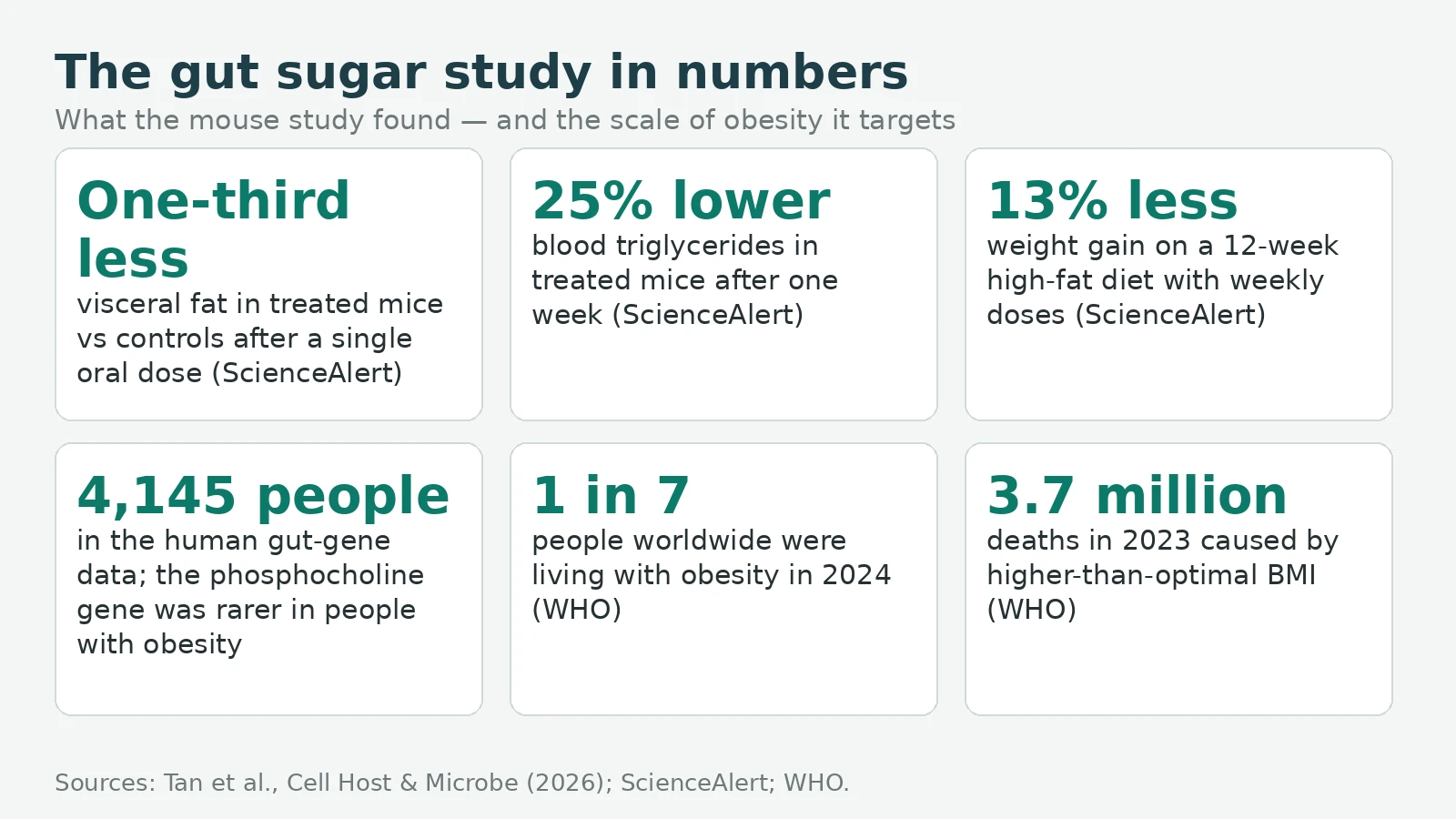
The scale of the problem is large. The World Health Organization reports that in 2024, one in seven people worldwide — 1.1 billion people — were living with obesity, and 45% of adults were overweight. Higher-than-optimal body weight caused an estimated 3.7 million deaths in 2023, largely through heart disease, diabetes and some cancers.
The study: a sugar made by a gut bacterium
The researchers, led by physician-scientist Neeraj Surana at Duke, worked with a bacterium called Clostridium immunis, a recently identified member of the healthy human gut microbiome. The team had previously found that the bacterium could protect mice against inflammation in the gut. This time they asked whether it could do anything about weight and fat.
They found that C. immunis releases a complex sugar molecule called an exopolysaccharide, or EPS for short. The sugar carries a small chemical group called phosphocholine, and that addition turns out to be essential: when the researchers used genetically modified versions of the bacterium that could not add phosphocholine, the protective effect disappeared.
The findings were published in September 2026 in Cell Host & Microbe, in a paper titled “A commensal-derived sugar protects against obesity by regulating immunometabolism”. The team has filed a patent on the bacterium and the sugar it produces, and is planning clinical trials in the United States.
What happened in the mice
The results were striking. In one experiment, mice given a single oral dose of C. immunis weighed 3% less after a week than untreated mice, and their blood triglycerides — a type of fat in the blood — were 25% lower. Most importantly, they had about a third less visceral fat than the control animals.
In a second experiment, mice were fed a high-fat diet for 12 weeks. The untreated animals gained 50% of their body weight. Mice given weekly doses of the bacterium gained 13% less weight than their untreated counterparts.
Then came the decisive test. When the researchers gave mice the EPS sugar on its own, without the bacterium, they saw the same weight-loss and fat-reduction effects. That showed the sugar itself — not the bacterium — is responsible. And the mice achieved all of this without eating less, without moving more and without losing muscle, according to the Duke researchers.
How the sugar works
The team traced the effect to the immune system. The phosphocholine-modified sugar reduces a group of immune cells in the gut wall, called ILC3 cells, and so lowers their production of a signalling protein known as IL-22 in the small intestine and in visceral fat.
As IL-22 levels fall, more cells containing a protein called UCP1 appear in the visceral fat. UCP1 is linked to thermogenesis — the process of burning energy to generate heat. In effect, the sugar releases a brake the immune system places on visceral fat, making the fat more metabolically active so the body spends more energy on it.
That matters because visceral fat is normally stubborn: it resists the signals that prompt other fat to burn. The researchers were surprised that the effect did not come from eating less or moving more. As first author Chin Yee Tan put it, the sugar changed how visceral fat used energy — a completely different way of thinking about how gut bacteria can influence metabolism.
What the human data shows — and what it does not
So far, everything above comes from mice. To check whether the biology could apply to people, the team examined existing gut microbiome data from 4,145 people around the world. They found that a bacterial gene involved in producing phosphocholine was less abundant in people with obesity than in people with a body mass index below 25. Lower levels of the gene were also linked to higher blood triglyceride levels.
That is an intriguing clue, but it is an association in existing genetic data — not evidence that giving people the sugar, or the bacterium, would change their weight. No human dose has been tested, no human safety study has been done, and no human weight-loss result exists. The researchers themselves are clear that clinical trials are still to come, and that funding for them is being sought.
It is also worth keeping the timeline in view. The paper appeared online in September 2026, and the headlines arrived two months later when the universities publicised it. Nothing about the science changed in between — only the attention.
How this differs from weight-loss drugs
Today’s most widely used weight-loss medicines, the GLP-1 drugs, work mainly by reducing appetite, so people eat less. The bacterial sugar works the other way: it raises the amount of energy the body spends. Senior author Neeraj Surana has suggested it could one day be used alongside GLP-1 medicines or as an alternative for people they do not suit — GLP-1 drugs do not work for everyone and often cause significant side effects.
That is a possibility, not a promise. The World Health Organization only published its guideline on using GLP-1 therapies for obesity in adults in December 2025, and those medicines remain one part of broader obesity care, alongside diet, activity and support. If you are considering any weight-loss medicine, it is a decision to make with a doctor or pharmacist — not something to start on the basis of a mouse study. Our guide to one of the newer options, retatrutide, explains how that class of drugs is being studied.
What actually helps visceral fat now
While this research works its way towards human trials, the proven ways to reduce visceral fat are unglamorous but effective. The WHO’s advice for preventing and managing overweight and obesity includes a diet rich in fruit, vegetables, legumes, whole grains and nuts, with foods high in fats, sugars and salt kept limited, and sugar-sweetened drinks cut back. Regular physical activity through life, enough sleep and avoiding tobacco all help, and the Cleveland Clinic notes that inactivity and stress both push visceral fat upwards.
Small, steady habits add up: short walking breaks during the day, for example, have been shown to help blood sugar. Waist measurement is a simple way to track visceral fat — the WHO lists waist circumference alongside body mass index as a way to identify overweight and obesity — and your GP can measure it and talk through what it means for you.
When to see a doctor
Talk to your GP if you are concerned about your weight or waist size, if you have put on weight quickly, or if you have symptoms that can accompany metabolic problems, such as constant thirst, needing to urinate often, or feeling tired all the time. A GP can check your blood pressure, blood sugar and cholesterol, and discuss options that fit your health and circumstances.
Get urgent help if you notice chest pain, breathlessness, or sudden weakness or numbness. In an emergency call 911 (US), 999 (UK) or 112 (EU).
Frequently asked questions
What is visceral fat?
Visceral fat is the fat stored deep inside your abdomen, around organs such as the liver, pancreas and intestines. Unlike the fat under your skin, you cannot see or pinch it. Having too much raises the risk of type 2 diabetes and heart disease. Genes play a part, but so do diet, inactivity and stress. Waist size is a simple way to track it.
Can a gut bacterium really help burn visceral fat?
In mice, yes — so far. A sugar made by the gut bacterium Clostridium immunis helped mice burn visceral fat and gain less weight without eating less or moving more. The effect came from the sugar switching on heat-burning cells in the fat. But this has only been tested in animals, and no human treatment exists yet.
How does the bacterial sugar work?
The sugar, called an exopolysaccharide, carries a chemical group called phosphocholine. It lowers levels of an immune signal called IL-22 in the gut and visceral fat, which allows more heat-burning UCP1 cells to appear in the fat. Those cells burn energy as heat, making visceral fat more metabolically active. The mice spent more energy without eating less.
Does this mean a probiotic can burn belly fat?
No. The study tested one specific bacterium and its sugar in mice, and there is no product based on this research. Ordinary probiotics are different bacteria and have not been shown to burn visceral fat. Anyone selling a supplement on the back of this study is getting ahead of the evidence. Talk to your GP about proven ways to reduce visceral fat.
What actually reduces visceral fat now?
The proven approaches are a healthy eating pattern, regular physical activity, enough sleep and avoiding tobacco. The WHO recommends plenty of fruit, vegetables, legumes and whole grains, with foods high in fats, sugars and salt kept limited, and sugary drinks cut back. Even short walking breaks during the day help. Your GP can measure your waist and advise on a plan.
Sources
- Tan et al. A commensal-derived sugar protects against obesity by regulating immunometabolism. Cell Host & Microbe, 2026 doi.org
- ScienceAlert: Scientists Discover a Natural Sugar That May Help to Burn Visceral Fat www.sciencealert.com
- Medical Xpress: Sugar made by gut bacterium may help the body burn visceral fat medicalxpress.com
- Duke University School of Medicine: A sweet discovery to fight obesity medschool.duke.edu
- WHO: Obesity and overweight www.who.int
- Cleveland Clinic: What Is Visceral Fat & How To Get Rid of It my.clevelandclinic.org

Try the tool
Not sure if it can wait?
Common causes and warning signs for 16 everyday symptoms.
Open the symptom guide