What Is Autophobia? Fear of Being Alone Explained
Being alone can feel frightening even when you know you are safe. Here is what autophobia is, how it differs from loneliness, and the treatments that help.
- Written by
- Health Daily Advice
- Published
- Reading time
- 6 minutes
- Sources
- 8 cited
In this guide
Autophobia is an intense, irrational fear of being alone, also called monophobia. It is a type of specific phobia: being alone, or thinking about being alone, can trigger anxiety, dread and physical symptoms such as a racing heart and sweating. It is different from loneliness, and it is treatable — talking therapies, especially exposure therapy and CBT, help most people.
Most of us enjoy company, and many of us dislike being alone sometimes. Autophobia is different. The fear is out of proportion to any real danger, it lasts for months, and it starts to shape daily life — who you spend time with, where you go, and what you avoid. Cleveland Clinic describes it as an irrational, extreme fear of being alone, and notes that some people feel it even in a crowd, worrying that people will leave them or that they will have to go home and be alone.
What is autophobia?
Autophobia, also known as monophobia, eremophobia or isolophobia, is a specific phobia centred on being alone. A phobia is a type of anxiety disorder: the fear does not match the real risk, and the body reacts as though there is genuine danger. Cleveland Clinic notes that people with a specific phobia are usually aware that the fear is not rational, but they cannot control their physical reactions when the situation arises.
It is not a separate diagnosis in the American Psychiatric Association’s Diagnostic and Statistical Manual of Mental Disorders (DSM). A clinician would usually diagnose it as a specific phobia, when the fear is clearly about being alone, lasts six months or more, is out of proportion to the danger, and causes significant distress or problems in daily life.
Phobias are common. Cleveland Clinic reports that about 1 in 10 American adults and 1 in 5 teenagers will deal with a specific phobia disorder at some point in their lives. NHS inform estimates that around 10 million people in the UK have a phobia.
Autophobia vs loneliness
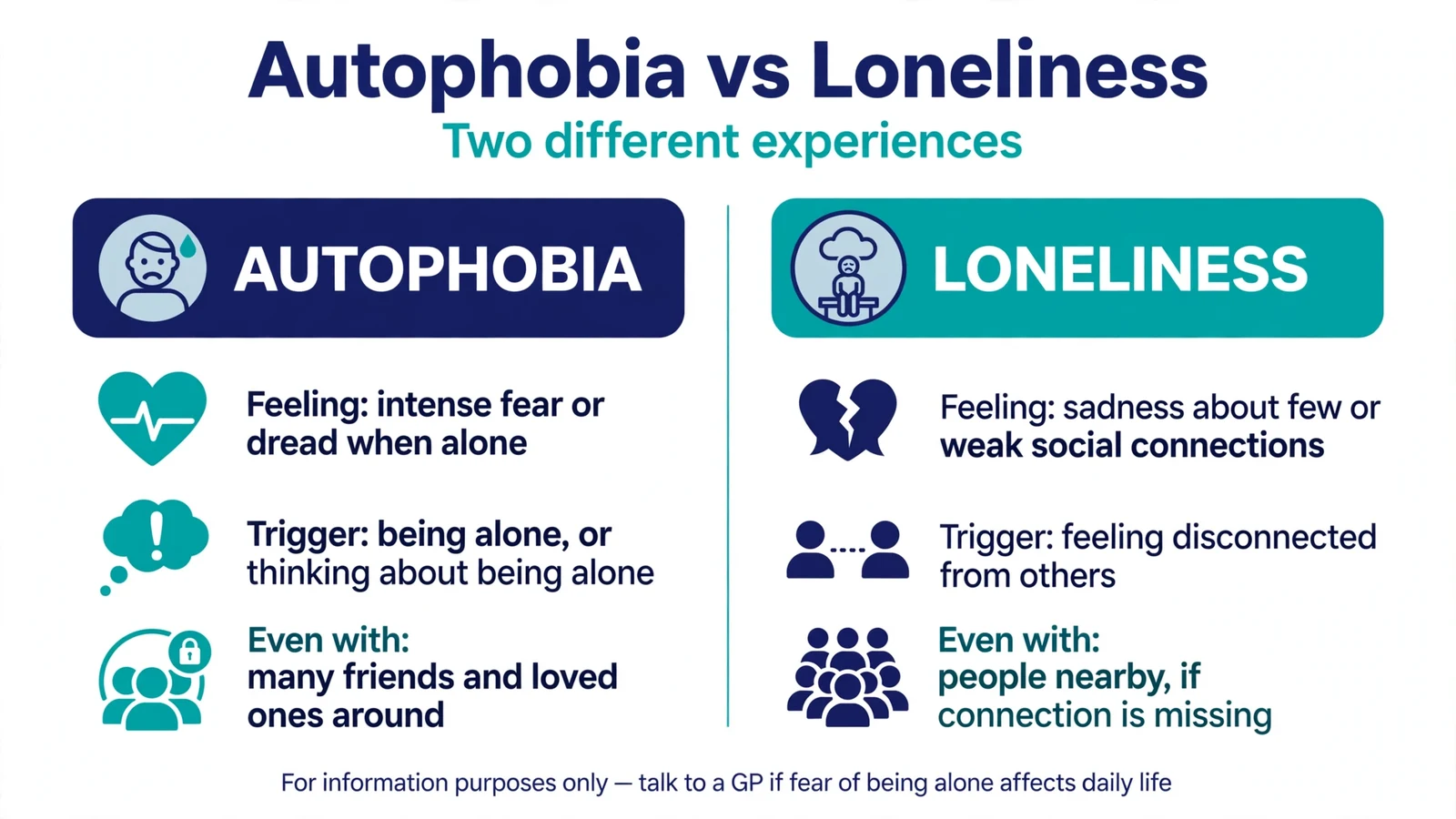
Autophobia and loneliness are often confused, but they are not the same thing. Loneliness is sadness about the quantity or quality of your social connections. Autophobia is fear and dread when you are alone, or when you think about being alone — and you can feel it even with many loved ones and friends in your life.
Signs and symptoms
Autophobia affects everyone differently. You may feel unsafe unless you are with other people, and being alone may bring on intense feelings of sadness, dread or anxiety. According to Cleveland Clinic, symptoms can include chills, dizziness and lightheadedness, excessive sweating, heart palpitations, nausea, shortness of breath, trembling or shaking, and an upset stomach.
The NHS lists similar physical symptoms for phobias generally: unsteadiness, nausea, sweating, a faster heartbeat, shortness of breath, trembling and an upset stomach. Some people have panic attacks, which can be very frightening and happen suddenly, without warning.
Behaviour often changes too. You might avoid being alone at all costs, only go out if someone comes with you, keep the television or radio on for company, or constantly message and call people. Mind calls these “safety behaviours”: they feel protective, but they can make a phobia worse, because they stop you learning that being alone is safe. Autophobia can also overlap with other problems, such as separation anxiety, social anxiety, depression or claustrophobia, and it is sometimes part of agoraphobia.
What causes autophobia?
There is rarely one single cause. Cleveland Clinic lists several experiences that can lie behind a fear of being alone:
- Being ignored, uncared for or feeling abandoned in childhood, or the divorce or loss of a parent.
- Getting separated from a loved one in a crowd or another public setting.
- A frightening experience while alone, such as a panic attack, an injury, a home break-in or a mugging with nobody to help.
- Witnessing a traumatic incident without someone to support you.
The NHS adds that phobias can be a learned response: growing up around anxious parents or siblings can shape how you react to being alone, and there is evidence that some people are born with a tendency to be more anxious than others. Mind notes that you can develop a phobia even without a bad experience, and that the same phobia can have different causes in different people. Autophobia is also more common alongside conditions such as borderline personality disorder, where fear of rejection and abandonment is intense.
How is autophobia diagnosed?
Most people with a phobia are fully aware of the problem, and many live with it without a formal diagnosis. Mind says a fear becomes a phobia when it is out of proportion to the danger, lasts for more than six months, and has a significant impact on day-to-day life. A GP can assess the fear and refer you to a specialist, such as a psychologist, if it is interfering with your life. They will also check for overlapping conditions, such as anxiety, depression or panic disorder, which can look similar.
Treatment and coping
Most phobias can be treated successfully, and autophobia is no exception. The NHS says simple phobias are usually treated through gradual exposure to the feared situation — known as desensitisation or self-exposure therapy — and that talking treatments, especially cognitive behavioural therapy (CBT), are often very effective. Cleveland Clinic agrees: exposure therapy helps most people overcome specific phobias, and CBT is also used.
1. Gradual exposure
Exposure therapy works by slowly increasing the time you spend alone, in small steps you can manage. A therapist might start with a few minutes alone in a safe place, then build up to longer periods, an evening alone, or a night alone. Each step teaches your brain that solitude is safe.
2. Cognitive behavioural therapy (CBT)
CBT helps you spot and challenge the thoughts that drive the fear — for example, “something terrible will happen and nobody will help” — and replace them with more balanced ones. It also teaches relaxation techniques, such as slow breathing and meditation, to manage symptoms when they appear.
3. Coping day to day
While you work on the fear, small steps can help: build a routine for time alone, keep a calming activity ready (a walk, a podcast, a familiar task), practise slow breathing when anxiety rises, and notice and question catastrophic thoughts rather than acting on them. Avoid using alcohol or recreational drugs to cope, as Mind warns this can make anxiety worse over time.
4. Medication
Medication is not usually the first treatment for a phobia. The NHS notes that anti-anxiety medicines or beta blockers may sometimes be prescribed short-term to help with the effects of anxiety, while Cleveland Clinic says they may help temporarily as you work to overcome the fear. Any medication should be discussed with a GP.
When to see a doctor
See a GP if your fear of being alone is making daily life hard — if you cannot stay alone, cannot work or travel alone, feel panicky at the thought of being alone, or rely on other people for every part of your day. In England, adults can also refer themselves directly to NHS talking therapies without seeing a GP first. If you are struggling to cope, talk to someone you trust, and consider reading our guides to thanatophobia and fear of public speaking for related fears.
If you feel unable to cope or keep yourself safe, get urgent help now — call NHS 111, or Samaritans on 116 123. For more support, visit our get help now page.
In an emergency call 911 (US), 999 (UK) or 112 (EU).
Frequently asked questions
What is autophobia?
Autophobia is an intense, irrational fear of being alone, also called monophobia. It is a type of specific phobia: being alone, or even thinking about being alone, can trigger anxiety, dread and physical symptoms such as a racing heart, sweating and shortness of breath. It is not a separate diagnosis in the DSM, but a clinician can diagnose it as a specific phobia.
Is autophobia the same as loneliness?
No. Loneliness is sadness about the quantity or quality of your social connections, while autophobia is fear and dread when you are alone. You can feel lonely in a crowd, and you can have autophobia even with many friends and loved ones around. The two can overlap, but they are different experiences and need different support.
What causes a fear of being alone?
There is rarely one cause. It can follow childhood experiences such as being ignored or abandoned, the divorce or loss of a parent, getting separated from a loved one, or a frightening experience while alone, such as a panic attack or a break-in. It can also be learned from anxious family members, and some people are born with a tendency to be more anxious.
How is autophobia treated?
The main treatments are exposure therapy and cognitive behavioural therapy (CBT). Exposure therapy gradually increases the time you spend alone in small, manageable steps, so your brain relearns that solitude is safe. CBT helps you challenge the thoughts that drive the fear and teaches relaxation techniques. Medication is not usually the first option, but may help short-term.
When should I see a doctor about a fear of being alone?
See a GP if the fear makes daily life hard — if you cannot stay alone, work or travel alone, feel panicky at the thought of being alone, or rely on other people for everything. In England, adults can refer themselves directly to NHS talking therapies without a GP. If you feel unable to cope or keep yourself safe, call NHS 111 or Samaritans on 116 123.
Sources
- Cleveland Clinic: Autophobia (Fear of Being Alone) my.clevelandclinic.org
- NHS 111 Wales: Phobias 111.wales.nhs.uk
- Mind: Understanding phobias www.mind.org.uk
- NHS inform: Phobias www.nhsinform.scot

Try the tool
Is it a fear, or a phobia?
Look up the name of 45 fears and take a 5-question check.
Open the phobia finder