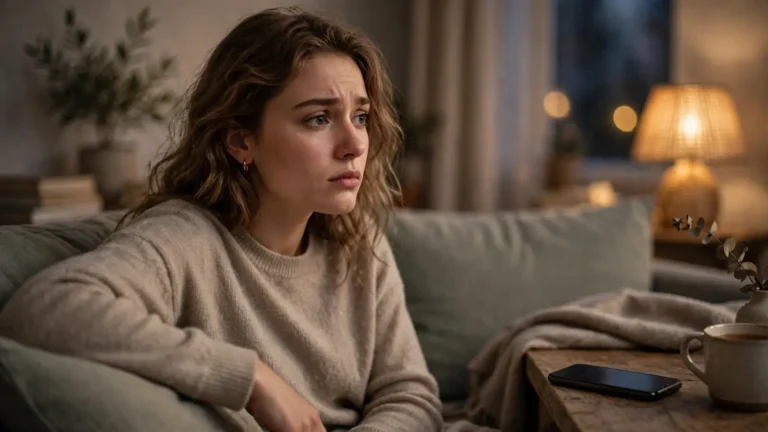
What Is Nyctophobia? Fear of the Dark Explained
Nyctophobia is far more than disliking the dark — it is an intense fear that can steal sleep and shrink daily life. Here is what causes it, how to spot it in adults and children, and the treatments that work.
- Written by
- Health Daily Advice
- Published
- Reading time
- 11 minutes
- Sources
- 9 cited
In this guide
Nyctophobia is an extreme, persistent fear of the dark that goes beyond normal unease. It is a type of specific phobia, and it can trigger intense anxiety, panic and broken sleep when the lights go out. The fear usually centres on what cannot be seen in the dark. Talking therapies, especially CBT and gradual exposure, can help.
Most of us have felt a flicker of unease walking down a dark hallway or lying awake listening to unfamiliar sounds at night. That is normal. Nyctophobia is different. The fear is stronger, it lasts, and it starts to shape everyday choices — whether to go out after dark, whether to sleep with the lights off, even whether to stay in a job that involves night shifts. If that sounds familiar, you are far from alone, and the fear is treatable.
What is nyctophobia?
Nyctophobia is an extreme fear of night or darkness. The name comes from the Greek words nyktos, meaning night, and phobos, meaning fear. It is sometimes also called scotophobia or lygophobia, as Cleveland Clinic explains.
Nyctophobia is classed as a specific phobia, a type of anxiety disorder. A specific phobia is an intense, irrational fear of one particular thing or situation that poses little or no real danger. People with a phobia often know the fear is out of proportion, yet even thinking about the feared situation can bring on severe anxiety, according to the National Institute of Mental Health (NIMH).
Importantly, nyctophobia is usually not a fear of darkness itself. It is a fear of what cannot be seen in the dark. Without visual information, the mind fills the gaps — an intruder, something hiding in the corner, a noise with no visible cause. Medical News Today notes that researchers have found darkness triggers a startle response in the brain, releasing chemicals that heighten the perception of anxiety. Some people can quieten that response. Others magnify it, and the fear grows.
How common is nyctophobia?
There is no separate published prevalence figure for nyctophobia alone, but fear of the dark is one of the most common fears of childhood. Cleveland Clinic reports that nearly 45% of children have an unusually strong fear of some kind, and fear of the dark is one of the most common fears among children aged 6 to 12. Most children outgrow it by adolescence, but not always — for some, the fear carries on into adult life.
For specific phobias as a group, the NIMH reports that an estimated 9.1% of adults in the United States had a specific phobia in the past year, and 12.5% experience one at some point in their lives. The past-year figure was higher for women (12.2%) than for men (5.8%). Among US adolescents aged 13 to 18, lifetime prevalence was 19.3%. These figures cover all specific phobias — heights, spiders, flying and the dark together — rather than nyctophobia on its own.
Fear of the dark often starts early. Healthline notes that it frequently begins between the ages of 3 and 6, when imagination is vivid and the difference between real and pretend is still blurry. At that age, fear of ghosts, monsters, sleeping alone and strange noises is a normal part of development.
What causes nyctophobia?
There is rarely a single cause. Several factors can combine, and sometimes the person has no idea where the fear began.
A frightening experience. A traumatic or troubling event in the dark — getting lost, a burglary, a bad storm and power cut — can link darkness with danger in the mind. The memory can return whenever the lights go out, or even when the person only thinks about being in the dark. Cleveland Clinic notes that nyctophobia can develop as part of post-traumatic stress disorder (PTSD) after such an experience.
Scary films and stories. Watching a horror film or hearing a distressing story can plant images that return at night. WebMD points out that the images from films and stories can haunt a person, leaving them fearing that something from them is lurking in the shadows.
Evolution. Some researchers believe the fear has deep roots. Long ago, when our ancestors slept out in the open, the dark really was dangerous — predators moved at night and threats could not be seen coming. A wariness of darkness may be part of our inheritance, as Cleveland Clinic explains.
Learning it from others. Children can pick up fear by watching an anxious parent or carer, or by growing up around people who are fearful of the dark. The NHS says a phobia is more likely if family or friends have one, and if other people have reacted negatively to your panic or fear, which can increase anxiety.
Other mental health conditions. The risk of any specific phobia is higher in people who have depression, generalised anxiety disorder, panic disorder or obsessive-compulsive disorder, and in people with a family history of phobias, according to Cleveland Clinic. In children, fear of the dark often occurs alongside separation anxiety — fear of being away from a parent or carer — as Medical News Today notes.
What are the symptoms of nyctophobia?
Symptoms can be physical, emotional or behavioural, and they can appear when a person is in the dark or simply thinking about darkness. The NHS lists severe anxiety and worry, dizziness, palpitations, chest tightness, feeling sick, trembling and a strong fear of fainting, losing control or dying among the symptoms of a phobia.
Physical symptoms of nyctophobia can include:
- a racing heart, heart palpitations or chest tightness
- shortness of breath or trouble breathing
- sweating, shaking or trembling, and hot or cold flushes
- dizziness, headaches or light-headedness
- nausea, an upset stomach or vomiting
- a dry mouth or trouble swallowing
Emotional and behavioural symptoms can include:
- overwhelming anxiety, dread or panic in the dark
- an intense need to escape and find light
- feeling detached from yourself, or that things are unreal
- crying or screaming in the dark, particularly in children
- avoiding dark rooms, cinemas, tunnels, evening outings or travel after dark
- refusing to go to bed, or insisting the lights stay on
Children may avoid going to bed or refuse to turn the lights out, and may ask a parent to check under the bed or in the wardrobe. Adults may stay indoors after sunset, avoid social events that run into the evening, or sleep with a light on every night.
How nyctophobia affects sleep and daily life
Sleep is often where nyctophobia does the most damage. Cleveland Clinic explains that people with nyctophobia may have trouble sleeping in a darkened room, and the resulting insomnia can lead to daytime fatigue and even trouble keeping a job. Healthline reports that in a small study of college students with insomnia, nearly half had a fear of the dark, and the poor sleepers became more anxious and easily startled by noises in the dark over time, while good sleepers got used to them.
Medical News Today describes a small study of more than 100 people which found that those who reported poor sleep were often uncomfortable in the dark and more likely to be startled while sleeping in the dark. Anxiety around bedtime can also build during the day, as the person starts dreading the night ahead. Over weeks and months, broken sleep affects mood, concentration, work and relationships — which can make the fear itself harder to manage.
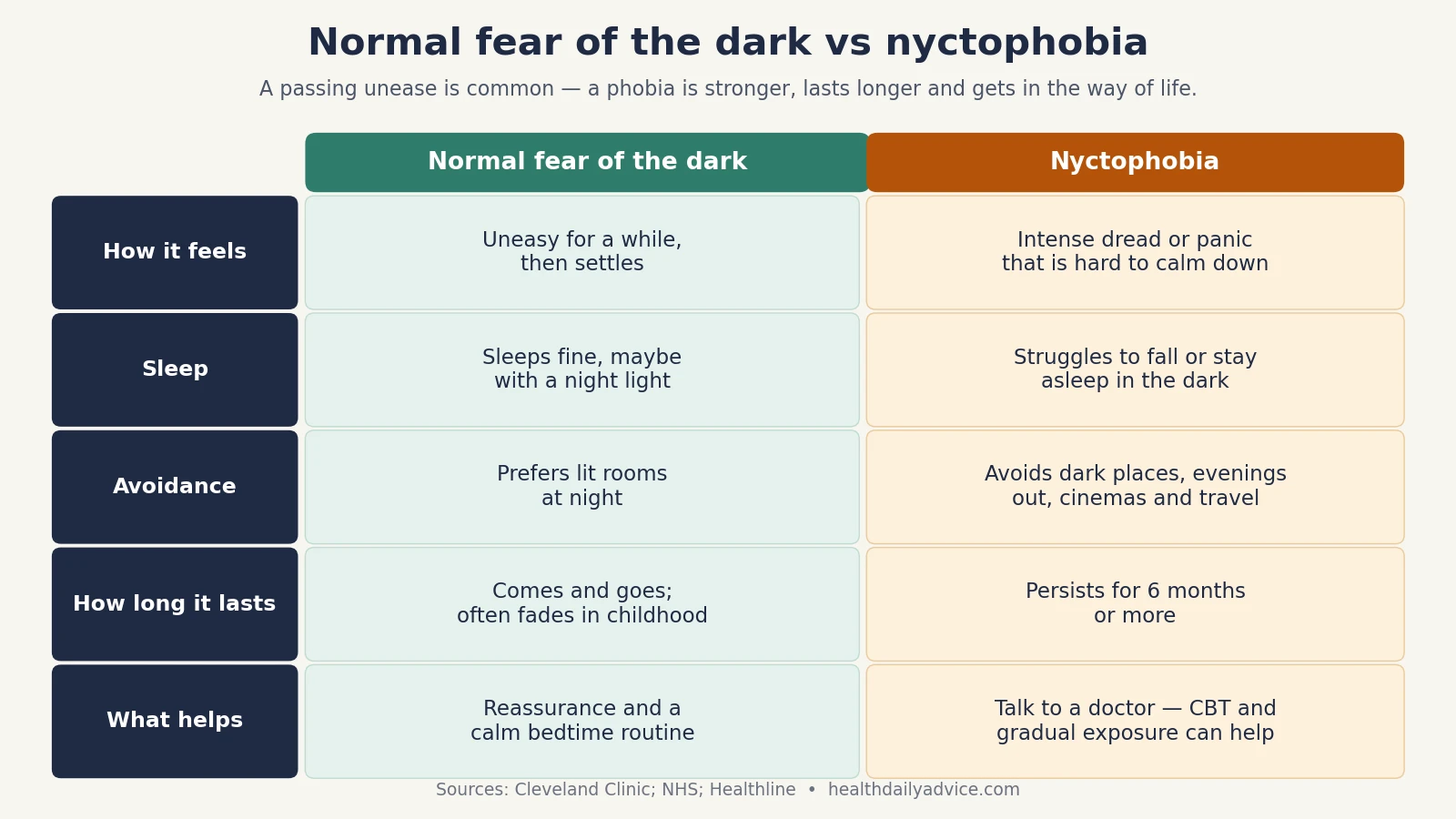
Nyctophobia vs a normal fear of the dark
Feeling uneasy with the lights off does not mean you have a phobia. The line is crossed when the fear is out of proportion to any real danger, lasts for months, and interferes with daily life. Healthline gives a clear example: feeling uneasy with the lights off at night is a normal reaction, while missing sleep or feeling extremely distressed at bedtime in darkness may point to a phobia.
A useful way to tell the difference is to ask three questions. Does the fear stop you doing things that matter — sleeping, going out, working, travelling? Do you arrange your life around avoiding darkness? Has it been going on for six months or longer? If the answer to several of these is yes, it is worth talking to a doctor, even if the fear feels embarrassing. Phobias are common, and doctors hear about them often.
How is nyctophobia diagnosed?
There is no blood test or scan for nyctophobia. Diagnosis usually involves talking with a doctor about your symptoms, when they started and how they affect your life. The doctor may also ask about your mental health history and that of your family.
Doctors use the criteria for specific phobia in the Diagnostic and Statistical Manual of Mental Disorders (DSM-5), the manual psychiatrists use to diagnose mental health conditions. In general, the fear must be intense and out of proportion to the actual danger, it must cause distress or get in the way of daily life, and it must have lasted for six months or longer. Healthline notes that doctors often suggest considering treatment when the fear causes extreme anxiety or panic, feels excessive, leads to avoidance, or has been present for six months or more.
How is nyctophobia treated?
Nyctophobia is treatable, and several types of therapy can help children and adults. The NHS says talking treatments are often very effective for phobias, and that in England you can refer yourself directly to an NHS talking therapies service without a referral from a GP.
Cognitive behavioural therapy (CBT). CBT — called cognitive behavioral therapy in the US — helps you notice the thoughts that feed the fear and replace them with more realistic ones, while changing the behaviours that keep the fear going. A therapist might help you test the belief that something bad will happen in the dark against what actually happens, and build practical ways of dealing with the fear. The NHS describes CBT as very effective for treating phobias.
Exposure therapy. This is often part of CBT. It involves facing the dark gradually, in small planned steps, so the anxiety has a chance to settle. It might start with imagining a dim room, then sitting in a dimly lit room, then spending short periods in progressively darker rooms, always with coping techniques in hand. Cleveland Clinic stresses that exposure therapy should be done under the supervision of a provider. Healthline notes that some exposure-based treatment plans have helped people in as little as one long session.
Other talking therapies. Psychotherapy, or talk therapy, can help you understand your fears and manage them. Cleveland Clinic also lists hypnotherapy, which uses guided relaxation while the mind is calm to help rethink the fear, and mindfulness exercises such as yoga, breathing exercises and meditation to help control anxiety in the dark. The NHS lists hypnotherapy among the treatments for phobias too.
Medicine. Medicine is not usually the first step for a specific phobia, and it does not treat the phobia itself. The NHS says medication is not usually recommended for phobias because talking therapies are usually effective and do not have side effects, though it may sometimes be prescribed for the effects of a phobia, such as anxiety. Medical News Today makes the same point: doctors may prescribe medicine for temporary anxiety or to help with sleep, but therapy is needed to address the cause. Talk to a doctor about what fits your situation — do not start or stop any medicine on your own.
Coping strategies that can help at home
Self-help does not replace professional treatment when the fear is severe, but these steps can support progress and make nights easier:
- Use a gradual dimming plan. Instead of switching from bright light to total darkness, dim the lights a little more each night, or use a night light and make it dimmer over time. Sleeping with a night light can help some children and adults feel more comfortable, according to Cleveland Clinic.
- Practise slow breathing. Breathe in slowly through your nose, let your belly fill, hold briefly, then breathe out slowly through your mouth as if blowing out a candle. The NHS recommends breathing exercises to help you relax.
- Use a coping phrase. Repeating a short, calm sentence such as “It is dark, but I am safe” can steady anxious thoughts. Medical News Today suggests this as a home strategy.
- Picture something pleasant. Focusing on a positive image — a beloved pet, a favourite place — can help replace frightening thoughts in the dark.
- Keep a steady bedtime routine. The same wind-down steps each night, at the same time, signal safety to the brain. Avoid caffeine after mid-afternoon, as the NHS advises, since it can affect sleep and make anxiety worse.
- Try progressive muscle relaxation. Tense and release each muscle group in turn, from your feet upwards, to teach the body to let go of tension before bed.
- Talk about it. Telling someone you trust, or joining a self-help group, can help. The NHS suggests talking to someone you trust and joining a self-help group online or in person.
One thing to avoid is forcing yourself — or a child — into total darkness all at once to “get over it”. Sudden, uncontrolled exposure can make the fear worse. Gradual steps, agreed in advance and ideally guided by a therapist, are the safer route.
Helping a child who is afraid of the dark
For most young children, fear of the dark is a normal phase that fades with time. What helps most is patience and reassurance, not dismissal. Do not tell a child their fear is silly — that can add shame to the fear.
Instead, validate the feeling, then show them the room is safe: look together into the dark corners, leave a night light on, or keep the door open with the hallway light on. A calm, predictable bedtime routine helps a child feel secure. WebMD suggests practising deep breathing together and repeating brave affirmations such as “I am brave” or “I am safe”.
If the fear makes it impossible for your child to sleep, causes severe anxiety, or continues into adolescence, talk to your GP. A therapist experienced with children can work with the whole family on gentle, gradual steps. Never leave a frightened child alone in a dark room as a “treatment” — any exposure work for children should be planned with a professional.
When to see a doctor
See a GP if you think you or your child has nyctophobia and the symptoms are affecting daily life — that is the NHS advice. In particular, talk to a doctor if the fear has lasted six months or more, if you have trouble sleeping, if you feel particularly anxious or distressed in the dark, or if you are avoiding work, school, travel or social life because of it.
Get help sooner if the fear comes with panic attacks, low mood, or thoughts of harming yourself. If you are in distress right now, you can find support at https://www.healthdailyadvice.com/get-help-now/.
In an emergency call 911 (US), 999 (UK) or 112 (EU).
Nyctophobia can make nights feel endless, but it is one of the more treatable fears. Many children grow out of it, and adults who seek help often find that gradual, supported steps — and a therapist who understands phobias — shrink the fear down to size. The dark does not have to run your evenings. With the right help, it can become ordinary again.
Frequently asked questions
What is nyctophobia?
Nyctophobia is an extreme, persistent fear of the dark, classed as a specific phobia — a type of anxiety disorder. The name comes from the Greek words for night and fear. It is usually less about darkness itself and more about what cannot be seen in the dark. It can cause intense anxiety, panic and broken sleep, and it is treated with talking therapies such as CBT and gradual exposure.
Is fear of the dark normal in children?
Yes, in young children it is a normal part of development. Fear of the dark often starts between the ages of 3 and 6, when imagination is vivid. Cleveland Clinic reports that nearly 45% of children have an unusually strong fear of some kind, and fear of the dark is one of the most common in children aged 6 to 12. Most outgrow it by adolescence, but for some it continues into adult life.
What causes nyctophobia?
There is rarely one cause. A frightening experience in the dark, such as getting lost or a burglary, can link darkness with danger. Scary films and stories can plant images that return at night. Some researchers point to evolution, since darkness once meant unseen predators. Children can also learn the fear from an anxious parent, and the risk is higher with depression, generalised anxiety or a family history of phobias.
How is nyctophobia treated?
The main treatments are cognitive behavioural therapy (CBT) and exposure therapy, where a person faces the dark gradually in small, planned steps under a therapist's guidance. The NHS says talking therapies are often very effective for phobias, and in England you can self-refer to NHS Talking Therapies without a GP referral. Hypnotherapy, psychotherapy and mindfulness can also help. Medicine is not usually the first step.
Can nyctophobia be cured?
Many children grow out of a fear of the dark naturally, and adults can improve greatly with the right help. CBT and gradual exposure therapy are the best-supported treatments, and Healthline notes some exposure-based plans have helped people in as little as one long session. There is no guaranteed cure or fixed timetable, but most people who seek treatment find the fear shrinks and nights become easier.
When should I see a doctor about fear of the dark?
See a GP if the fear has lasted six months or more, disturbs your sleep, causes panic attacks, or stops you going out, working, travelling or living normally. The NHS advises seeing a GP if you think you have a phobia and the symptoms are affecting your life. Get help sooner if the fear comes with low mood or thoughts of harming yourself.
Sources
- Cleveland Clinic: Nyctophobia (Fear of the Dark) my.clevelandclinic.org
- NHS: Phobias www.nhs.uk
- Healthline: Nyctophobia: Understanding Fear of the Dark www.healthline.com
- Medical News Today: Nyctophobia: Treatment and what to know www.medicalnewstoday.com
- NIMH: Specific Phobia www.nimh.nih.gov
- WebMD: Nyctophobia: What It Means, How It's Caused, and How It's Treated www.webmd.com

Try the tool
Is it a fear, or a phobia?
Look up the name of 45 fears and take a 5-question check.
Open the phobia finder