Does Red Light Therapy Help Hair Loss? The Evidence
Red light therapy can add measurable hair density for pattern hair loss, but the gains are modest, slow and need ongoing use. Here is what two large meta-analyses actually found.
- Written by
- Health Daily Advice
- Published
- Reading time
- 8 minutes
- Sources
- 8 cited
In this guide
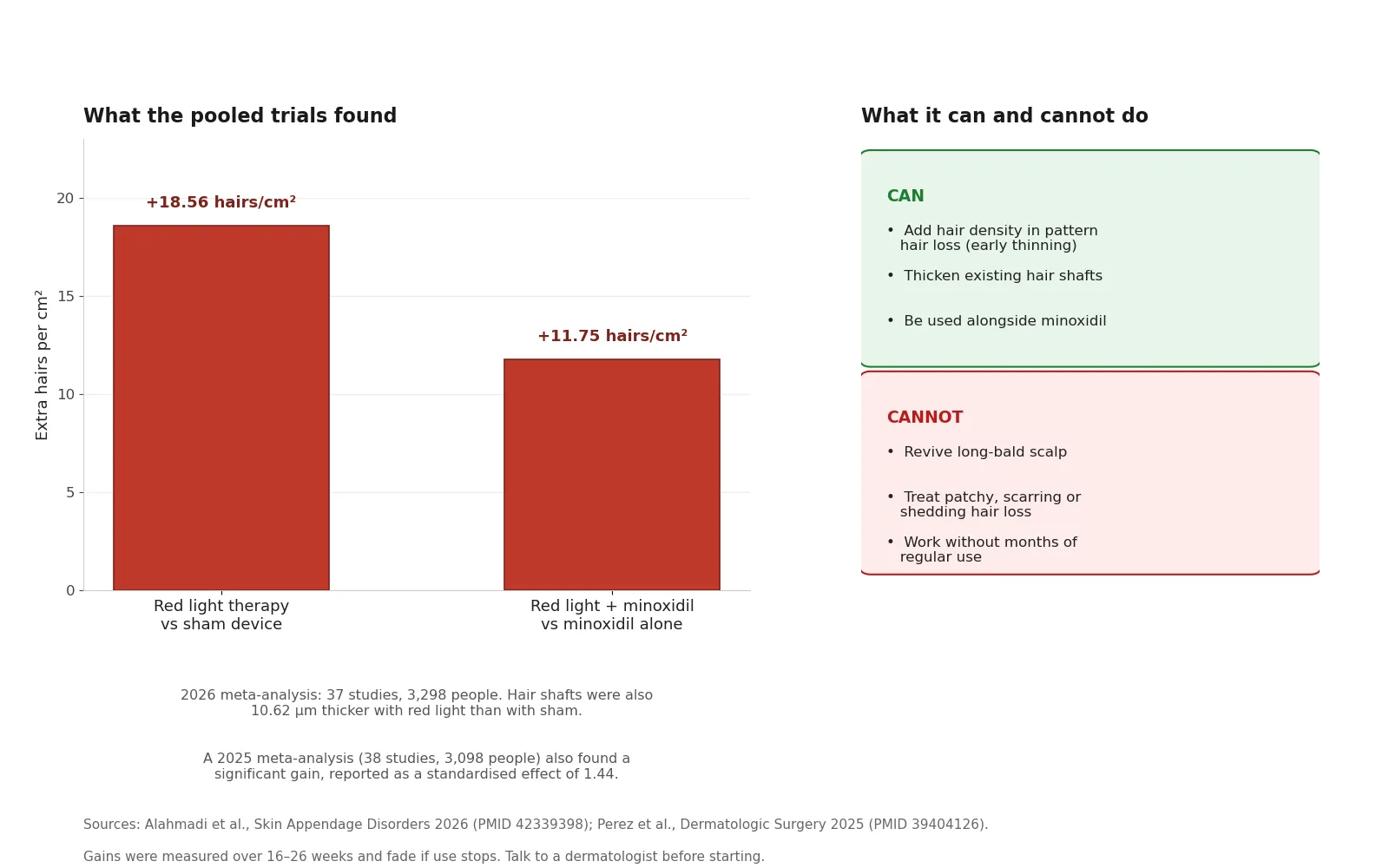
Yes — for pattern hair loss, and only modestly. Pooled trials show red light therapy can add measurable hair density over 16 to 26 weeks of regular use, with a 2026 meta-analysis finding about 19 extra hairs per square centimetre versus a sham device. It cannot revive long-bald scalp, and any gains fade if you stop.
Searches for red light therapy for hair loss have jumped sharply this year, and glowing caps and helmets are everywhere on social media. The marketing usually promises far more than the science supports. This article looks at what the trials actually measured, who the evidence covers, and where the honest limits lie.
What is red light therapy for hair loss?
Red light therapy for hair is better known in the research literature as low-level laser therapy (LLLT) or photobiomodulation. It uses low levels of red light, usually in the 630–680 nanometre range, shone onto the scalp through a comb, cap or helmet. The Cleveland Clinic lists low-level laser light therapy, cold laser therapy and photobiomodulation among its other names, and notes that the treatment is thought to act on the mitochondria, the energy-producing parts of cells.
The working theory, as DermNet NZ explains it, is that light absorbed by an enzyme in the mitochondria boosts energy production in follicle cells, improves blood flow to the scalp and nudges resting follicles back into their growth phase. That mechanism is biologically plausible and fits the trial results, but much of the detail comes from laboratory work rather than human scalps, so it is best treated as a leading explanation, not a proven chain of events.
One point of language matters. These devices are FDA-cleared, not FDA-approved. Clearance means the device was judged substantially equivalent to an earlier device for a specific use; it is not the same as approval after proof of effectiveness. The first laser comb was cleared for pattern hair loss in men in 2007, and for women in 2011, according to DermNet NZ.
What does the evidence actually show?
The strongest evidence comes from two large pooled analyses published in 2025 and 2026. A 2025 meta-analysis in Dermatologic Surgery gathered 38 studies covering 3,098 patients. Of those, 2,930 had androgenetic alopecia — pattern hair loss — and the pooled result showed a significant increase in hair density compared with placebo after 4 to 26 weeks of treatment. The effect was larger in courses longer than 20 weeks than in shorter ones.
A 2026 meta-analysis in Skin Appendage Disorders pooled 37 studies with 3,298 patients and put the gain in plain numbers: low-level laser therapy added an average of 18.56 extra hairs per square centimetre compared with a sham device, and hair shafts were 10.62 micrometres thicker. When light therapy was combined with minoxidil, it added 11.75 extra hairs per square centimetre over minoxidil alone. Adverse events in the pooled studies were described as mild and transient.
Individual sham-controlled trials tell a similar story. In a 2014 multicentre trial of 269 men and women, a 655 nanometre laser comb used three times a week for 26 weeks raised terminal hair density by 18.4 to 25.7 hairs per square centimetre, against 1.6 to 9.4 with a sham device. A helmet trial in 60 adults found a gain of 41.90 hairs per square centimetre versus 0.72 with sham over 16 weeks. And in a 2009 trial of 110 men, treated scalps gained an average of 19 normal-sized hairs per square centimetre over 26 weeks while the sham group lost 7, as reported by DermNet NZ.
There is an important catch, though. Hair counts are measured on a small marked patch of scalp under magnification. What you see in the mirror is the whole head, and people often rate their own improvement more conservatively than the counts suggest. A 2016 Cochrane review of treatments for female pattern hair loss found that in two laser-comb trials, women using the real device did not rate it more effective than women using the sham, even though hair counts favoured the real device. The counts go up reliably; whether the change is visible to you is far less certain.
The pooled results also carry a statistical warning. Variation between the included studies was very high in both meta-analyses, which means the average gain hides a wide spread of results across different devices, schedules and patient groups. Treat the headline numbers as a reasonable middle of the evidence, not a promise.
Who is most likely to benefit?
The evidence is almost entirely about one condition: androgenetic alopecia, the hereditary, hormone-driven pattern loss that produces a receding hairline and thinning crown in men and a widening part in women. Pattern hair loss is common — DermNet NZ notes it can affect up to 70% of men and 40% of women at some point in their lives.
Even within pattern hair loss, the trials enrolled a specific slice of people: mild to moderate thinning, typically Norwood stages II to V in men and Ludwig stages I and II in women. That is the stage where follicles have shrunk but are still cycling. A crown that has thinned over the past two or three years is a far better candidate than a scalp that has been smooth and shiny for fifteen years, because light therapy can only work on follicles that are still alive.
For other kinds of hair loss, the evidence is too thin to say anything useful. The 2025 meta-analysis found only 50 patients with alopecia areata, 49 with scarring alopecia, 32 with chemotherapy-related hair loss and 17 with telogen effluvium across all its studies — too few to pool. Its authors concluded that light therapy is a promising option for pattern hair loss, but that more studies are needed for every other type.
How is it used in the trials?
Every trial that produced positive results used a device built for the scalp: a comb moved through the hair, or a cap or helmet sitting against the head. Schedules in the trials ranged from daily sessions to every other day to three times a week, with sessions lasting roughly 6 to 30 minutes depending on the device. DermNet NZ notes that two to three sessions a week, each lasting 8 to 15 minutes, is typical for comb and cap devices, and that improvement is usually reported after 12 to 26 weeks of use.
More sessions did not mean more hair. A 2019 meta-analysis found a larger effect in lower-frequency treatment groups than in higher-frequency ones, which fits the idea that cells respond best to a moderate dose of light and that doubling sessions adds nothing. The practical lesson from the trials is consistency over months, not intensity.
Wall panels and full-body panels are a different story. No sham-controlled trial of a panel for hair growth has been published, and panels are not cleared under the hair-growth device category. Hair also blocks light, which is why combs part the hair and caps sit directly on the scalp. If hair growth is the goal, the devices that match the evidence are combs, caps and helmets cleared specifically for hair growth.
Whether the light comes from a laser or an LED is less settled. Most of the strongest sham-controlled trials used laser diodes, but no rigorous head-to-head trial has shown lasers beating LEDs for hair at matched wavelengths and doses. Wavelength, delivered energy, coverage and consistency almost certainly matter more than the laser-versus-LED distinction.
Is red light therapy better than minoxidil?
Only one small head-to-head trial has compared the two directly. In 2025, 91 men with pattern hair loss were randomised to 5% minoxidil twice a day or LED light at 633 nanometres, 10 minutes three times a week, for six months; 75 finished the trial. Hair density rose in both groups — from 97.6 to 134.6 hairs per square centimetre with minoxidil and from 104.8 to 130 with light — and there was no significant difference between them. Minoxidil produced more “excellent” responses, and it has the far stronger evidence base overall, but light therapy performed as a reasonable alternative in this one small, single-blind trial.
Combining the two looks more promising than either alone. The 2026 meta-analysis found that light therapy plus minoxidil beat minoxidil alone by 11.75 hairs per square centimetre. If you already use minoxidil, adding light is the combination with the best support — but talk to a dermatologist before changing any treatment plan.
Is it safe?
Short-term safety looks reassuring. The Cleveland Clinic says red light therapy appears safe and is not associated with side effects when used short-term and as directed, while noting that long-term safety is not yet known. The helmet and laser-comb trials reported no serious adverse events, and the 2026 meta-analysis described adverse events as mild and transient.
Two cautions are worth taking seriously. First, eyes: laser-based devices should never be pointed at the eyes, and any eye protection the device instructions call for should be worn every time. Second, light sensitivity: DermNet NZ warns against using laser therapy alongside medicines or products that make the skin sensitive to light, and the Cleveland Clinic advises people with photosensitive conditions, or on medicines that increase sun sensitivity, to check with a dermatologist first.
How long before you know if it works?
Plan on about six months. The trials measured results at 16 to 26 weeks, and the 2025 meta-analysis found a bigger effect after 20 weeks than before. Judging a device at six weeks is judging it before the evidence says it can show anything.
There is also no evidence about what happens after you stop. None of the trials followed people once they put the device away, and pattern hair loss is progressive, so there is no reason to expect gains to last without continued use. Think of it as maintenance, like exercise for muscle: the stimulus has to keep coming for the benefit to persist.
When to see a doctor
See a GP or dermatologist before buying a device if your hair loss is sudden, patchy or all over the scalp rather than a receding hairline or thinning crown; if it comes with scalp pain, redness, scaling or scarring; if it started after childbirth, a serious illness, a new medicine or rapid weight loss; or if you are having chemotherapy. Women with irregular periods, acne or excess facial hair alongside thinning should also get checked, as these can point to a hormonal cause that needs its own diagnosis.
A dermatologist can confirm whether your hair loss is the pattern type the trials studied, rule out causes that need different treatment, and talk through whether light therapy, minoxidil or another option fits your situation. Get urgent help if hair loss comes with a rapidly spreading scalp infection, severe pain, or any sign of a serious skin condition.
In an emergency call 911 (US), 999 (UK) or 112 (EU).
The bottom line
Red light therapy is not a miracle cure, but it is not empty hype either. For early pattern hair loss, sham-controlled trials and two large meta-analyses show a real, modest gain in hair density — roughly 19 extra hairs per square centimetre — after four to six months of regular use. The gain is measurable under a microscope and often subtle in the mirror, it only applies to living follicles, and it almost certainly needs ongoing use to last. If that sounds like a fair trade for several sessions a week over months, talk to a dermatologist first and choose a device cleared for hair growth.
Frequently asked questions
Does red light therapy help hair loss?
Yes, modestly, for pattern hair loss. A 2026 meta-analysis of 37 studies found low-level laser therapy added 18.56 hairs per square centimetre versus a sham device, and hair shafts were 10.62 micrometres thicker. A 2025 meta-analysis of 38 studies also found a significant gain. It cannot revive long-bald scalp, and the evidence covers pattern hair loss only.
How long does red light therapy take to grow hair?
The trials measured results at 16 to 26 weeks, and a 2025 meta-analysis found a larger effect after 20 weeks than before. Plan on about six months of regular use before judging a device. Improvement is usually reported after 12 to 26 weeks, according to DermNet NZ, and judging it at six weeks is too early.
Can red light therapy regrow hair on a bald head?
No. Red light therapy only works on follicles that are still alive. It is most likely to help mild to moderate thinning where follicles have shrunk but are still cycling. A scalp that has been smooth and bald for years has follicles that, in most cases, have closed down, and no consumer light device reopens them.
Is red light therapy better than minoxidil for hair loss?
One small 2025 trial in 91 men found no significant difference between 5% minoxidil and red light over six months, though minoxidil produced more excellent responses and has the stronger evidence base. Combining the two worked better than minoxidil alone: a 2026 meta-analysis found light plus minoxidil added 11.75 hairs per cm² over the drug alone.
Is red light therapy safe for hair loss?
Short-term use as directed looks low risk. Cleveland Clinic says it appears safe with no side effects when used short-term and as directed, and trial reports list no serious adverse events, with the 2026 meta-analysis calling adverse events mild and transient. Long-term safety is not yet known, and eye protection and light-sensitising medicines need care.
Does red light therapy work for alopecia areata?
There is too little evidence to say. A 2025 meta-analysis found only 50 patients with alopecia areata across its studies and could not pool the results, and the same was true for scarring alopecia, telogen effluvium and chemotherapy-related hair loss. Patchy hair loss should be diagnosed and treated by a dermatologist.
Sources
- Cleveland Clinic: Red Light Therapy my.clevelandclinic.org
- DermNet NZ: Low dose laser therapy for hair loss dermnetnz.org
- HealthyMag: Red Light Therapy for Hair Growth: Tested in 5 Kinds of Hair Loss, Shown in 1 healthymag.org
- Acibadem International: Red Light Therapy for Hair Loss: Evidence & Expectations acibademinternational.com
- Perez SM et al. Low-Level Laser and LED Therapy in Alopecia: A Systematic Review and Meta-Analysis. Dermatol Surg, 2025 (PMID 39404126) pubmed.ncbi.nlm.nih.gov
- Alahmadi M et al. Lasers and Energy-Based Devices in the Treatment of Androgenetic Alopecia: A Systematic Review and Meta-Analysis. Skin Appendage Disord, 2026 (PMID 42339398) pubmed.ncbi.nlm.nih.gov

Try the tool
Not sure if it can wait?
Common causes and warning signs for 16 everyday symptoms.
Open the symptom guide

