Good Sleep and Brain Health in Heart Disease and Diabetes
- Written by
- Health Daily Advice
- Published
- Reading time
- 7 minutes
- Sources
- 9 cited

In this guide
People with type 2 diabetes, heart disease or stroke who slept well had slightly sharper thinking and larger brains than those with the same conditions who slept poorly, a study of 408,977 UK Biobank participants found. The link is real but modest, and the study cannot prove that better sleep caused the difference.
What did the new study find?
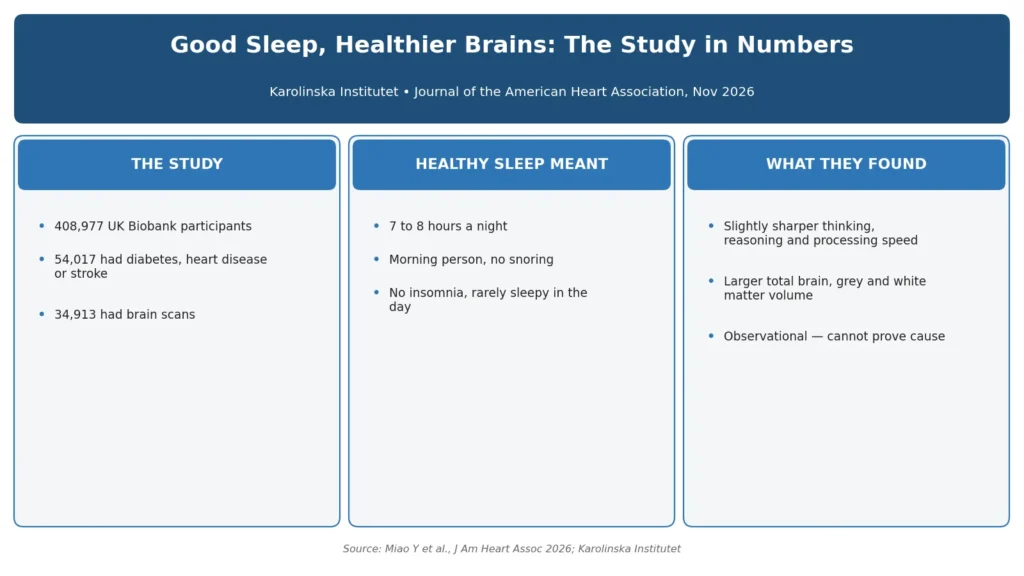
Researchers at Karolinska Institutet in Sweden analysed data from 408,977 middle-aged and older adults in the UK Biobank, a large health database. Of those, 54,017 people — 13.2% of the group — had at least one cardiometabolic disease: type 2 diabetes, heart disease or stroke. Brain MRI scans were available for 34,913 of the participants. The findings were published on 4 November 2026 in the Journal of the American Heart Association.
Among people with cardiometabolic disease, those with a healthy sleep pattern scored slightly higher on tests of general thinking, verbal and numerical reasoning, and processing speed than those with a poor sleep pattern. Their brain scans also showed significantly larger total brain volume, along with more grey matter and more white matter — the tissue that carries signals between different parts of the brain.
Notably, the link between sleep and brain structure was stronger in people with type 2 diabetes, heart disease or stroke than in people without those conditions. That is what makes the study interesting: sleep seemed to matter most exactly where the brain is already under strain. Co-author Abigail Dove, a researcher at Karolinska Institutet’s Aging Research Center, described the message as encouraging, because sleep is something most people can realistically work on — unlike many other risk factors for dementia, which are harder to change.
What counted as “healthy sleep”?
The researchers did not look at sleep duration alone. They scored each person on five self-reported aspects of sleep and combined them into one overall pattern, rated as healthy, intermediate or poor. A “healthy sleeper” in this study was someone who:
- slept seven to eight hours a night
- described themselves as a morning person
- did not snore
- did not have insomnia
- did not often feel sleepy during the day
Because the team studied the combined pattern rather than testing each factor on its own, the study cannot say which of the five mattered most. A separate 2025 study by the same group found that sleep duration and chronotype — whether you are naturally a morning or evening person — were the characteristics most strongly related to brain health.
Why might sleep protect the brain?
Nobody yet knows the full chain of events, but researchers have a few plausible explanations, and they fit together rather neatly.
The brain’s overnight cleaning system
During sleep — especially deep, slow-wave sleep — the brain runs a waste-clearance system called the glymphatic system. Cerebrospinal fluid flows through brain tissue and carries away metabolic waste, including amyloid-beta and tau, the proteins that build up in Alzheimer’s disease. A 2026 review in the journal Brain and Behavior describes how this clearance is most active during deep non-REM sleep, when the gaps between brain cells widen and fluid exchange increases. In a foundational mouse study, the space between brain cells expanded by about 60% during sleep, with a marked increase in fluid flow. Human evidence is catching up too: a 2026 randomised crossover study found higher levels of amyloid and tau in morning blood samples after a normal night’s sleep than after sleep deprivation, consistent with more overnight clearance while asleep.
Inflammation and blood-vessel health
Type 2 diabetes, heart disease and stroke all damage blood vessels and drive chronic, low-grade inflammation, and both are thought to wear the brain down over years. Poor sleep adds to the same burden: the American Heart Association notes that poor sleep may raise the risk of high blood pressure, high blood sugar and high cholesterol, as well as memory loss and dementia. If sleep helps keep blood pressure, blood sugar and inflammation steadier, the brain may simply take less damage over time.
Memory and repair
Sleep is also when the brain consolidates memories and repairs cells and tissues. The American Heart Association lists better alertness, decision-making, focus, learning, memory, reasoning and problem-solving among the benefits of a good night’s sleep. In other words, sleep does not just rest the brain — it is part of how the brain maintains itself.
What the study cannot prove
This was an observational study, so it can only show an association, not cause and effect. It is possible that people whose brains are already healthier simply sleep better, rather than the other way round — or that some other factor, such as overall lifestyle or other health conditions, explains part of the link. Sleep was also self-reported rather than measured with a device, so it may not capture the full picture. And the UK Biobank’s volunteers are, on average, healthier and less diverse than the general population, so the results need to be repeated in other, more varied groups before they can be generalised. The researchers themselves stress that this is one study, and that replication is needed.
None of that makes the findings unimportant. It means they should be read as encouraging evidence that sleep is worth taking seriously — not as proof that fixing your sleep will prevent dementia.
How much sleep should adults aim for?
The American Heart Association, in its Life’s Essential 8 framework, says adults should aim for an average of seven to nine hours of sleep a night. Mayo Clinic advises at least seven hours for a healthy adult, noting that most people do not need more than eight hours in bed to feel well rested. The seven-to-eight-hour window that counted as “healthy” in the Karolinska study sits neatly inside that range.
The wider evidence points the same way. Alzheimer’s Society notes that people who consistently sleep poorly have a higher risk of dementia, and that obstructive sleep apnoea — where breathing stops briefly during the night — is probably the sleep disorder with the strongest evidence of increased dementia risk. That is one more reason to take loud snoring and daytime sleepiness seriously rather than shrugging them off.
Sleep habits that may help
There is no single trick that guarantees good sleep, but small, steady habits add up. The NHS, Mayo Clinic and the American Heart Association all point to the same basics:
- Keep regular hours. Go to bed and get up at roughly the same time every day, including weekends. A steady routine helps your body clock know when it is time to sleep.
- Wind down before bed. Spend 20 to 30 minutes relaxing — reading, a warm bath, breathing exercises or calming music — and avoid phones, tablets and computers for an hour before bed. The blue light from screens can delay sleep.
- Make the bedroom sleep-friendly. Aim for a room that is cool, dark and quiet. Curtains drawn fully, an eye mask, earplugs or a fan can all help.
- Be active during the day. Regular physical activity helps you sleep better, though vigorous exercise close to bedtime can keep some people awake, so earlier in the day is usually better.
- Watch food, drink and nicotine. Avoid large meals close to bedtime, and be careful with caffeine, alcohol and nicotine in the evening. Alcohol may make you feel drowsy at first, but it disrupts sleep later in the night, and the NHS suggests avoiding it for one to two hours before bed.
- Do not force it. If you are still awake after around 20 minutes, get up and do something relaxing, then go back to bed when you feel sleepy. Lying there worrying about not sleeping usually makes it worse.
- Clear your mind. Writing down worries or tomorrow’s to-do list before bed can help stop them circling once the lights go out.
If you snore loudly, gasp during the night or feel very sleepy during the day despite a full night in bed, talk to your GP. These can be signs of sleep apnoea, which is treatable — and treating it may help both your sleep and your long-term brain health.
When to see a doctor
Almost everyone has an occasional sleepless night, and that on its own is nothing to worry about. But do talk to your GP if you often have trouble falling asleep or staying asleep, if you wake up unrefreshed most mornings, if your partner notices you stop breathing during the night, or if daytime sleepiness is affecting your work, driving or mood. A GP can check for underlying causes — including sleep apnoea, thyroid problems, low mood or medicines that disturb sleep — and can discuss treatments, including talking therapies for insomnia. Do not start or stop any medicine, including over-the-counter sleep aids, without speaking to a doctor or pharmacist first.
Get urgent help if you notice sudden confusion, slurred speech, weakness on one side of the body or a sudden severe headache — these can be signs of a stroke. In an emergency call 911 (US), 999 (UK) or 112 (EU)
The bottom line
Good sleep will not guarantee a healthy brain, and this study does not prove it prevents dementia. But in more than 400,000 people, those with type 2 diabetes, heart disease or stroke who slept well had slightly sharper minds and measurably larger brains than those who slept poorly. Sleep is free, it has no side effects, and it is one of the few things about brain health that is genuinely within your control. For anyone living with a cardiometabolic condition, that makes it worth protecting.
Frequently asked questions
Does good sleep protect the brain if I have diabetes or heart disease?
The evidence points that way, but it is not proof. In a study of 408,977 UK Biobank participants, people with type 2 diabetes, heart disease or stroke who slept well scored slightly higher on thinking tests and had larger brain volume than those who slept poorly. Because the study was observational, it cannot show that sleep caused the difference, only that the two were linked.
What counts as healthy sleep in the study?
The researchers scored five self-reported aspects of sleep: sleeping seven to eight hours a night, being a morning person, not snoring, not having insomnia, and not often feeling sleepy during the day. These were combined into one overall pattern, rated healthy, intermediate or poor. The team did not test each factor separately, so the study cannot say which of the five mattered most.
How much sleep do adults need?
The American Heart Association says adults should aim for an average of seven to nine hours a night as part of its Life's Essential 8. Mayo Clinic advises at least seven hours for a healthy adult, noting most people do not need more than eight hours in bed. The seven-to-eight-hour window that counted as healthy in the Karolinska study sits inside that range.
Can better sleep prevent dementia?
There is no proof that it can. This study found an association between good sleep and healthier brains, not a proven cause. Alzheimer's Society notes that people who consistently sleep poorly have a higher risk of dementia, and that obstructive sleep apnoea has the strongest evidence of increased risk. Good sleep is one part of a brain-healthy lifestyle, alongside exercise, blood pressure control and not smoking.
Why does sleep help the brain?
During deep sleep, the brain's glymphatic system flushes away waste, including amyloid-beta and tau, the proteins that build up in Alzheimer's disease. A 2026 review found this clearance is most active in deep non-REM sleep, when the gaps between brain cells widen. Poor sleep may also add to inflammation and raise blood pressure, blood sugar and cholesterol, which can damage the brain over time.
What should I do if I snore or cannot sleep?
Talk to your GP, especially if you snore loudly, gasp during the night, wake up unrefreshed or feel very sleepy during the day. These can be signs of sleep apnoea, which is treatable. A GP can also check for other causes of poor sleep and discuss treatments, including talking therapies for insomnia. Do not start or stop any medicine, including over-the-counter sleep aids, without speaking to a doctor or pharmacist first.
Sources
- Miao Y, et al. Healthy Sleep Mitigates the Association Between Cardiometabolic Disease and Poorer Cognitive and Brain Health. J Am Heart Assoc, 2026 pubmed.ncbi.nlm.nih.gov
- Karolinska Institutet: Good sleep linked to better brain health in cardiometabolic disease (Medical Xpress) medicalxpress.com
- Inc.: Healthy Sleep May Mitigate the Reduced Cognition Linked to Cardiometabolic Diseases www.inc.com
- NHS Every Mind Matters: Fall asleep faster and sleep better www.nhs.uk
- Alzheimer's Society: Dementia risk and prevention www.alzheimers.org.uk
- Mayo Clinic: Sleep tips: 6 steps to better sleep www.mayoclinic.org
- American Heart Association: Life's Essential 8 - How to Get Healthy Sleep www.heart.org
- Zare F, et al. Sleep-Dependent Clearance of Brain Metabolites via the Glymphatic System. Brain Behav, 2026 pmc.ncbi.nlm.nih.gov

Try the tool
Not sure if it can wait?
Common causes and warning signs for 16 everyday symptoms.
Open the symptom guide