Vitamin D and Sleep: What the New Study Really Found
Older adults with the highest vitamin D levels slept almost 20 minutes longer a night in a new Johns Hopkins study — but the link is not proof that supplements help you sleep.
- Written by
- Health Daily Advice
- Published
- Reading time
- 6 minutes
- Sources
- 7 cited

In this guide
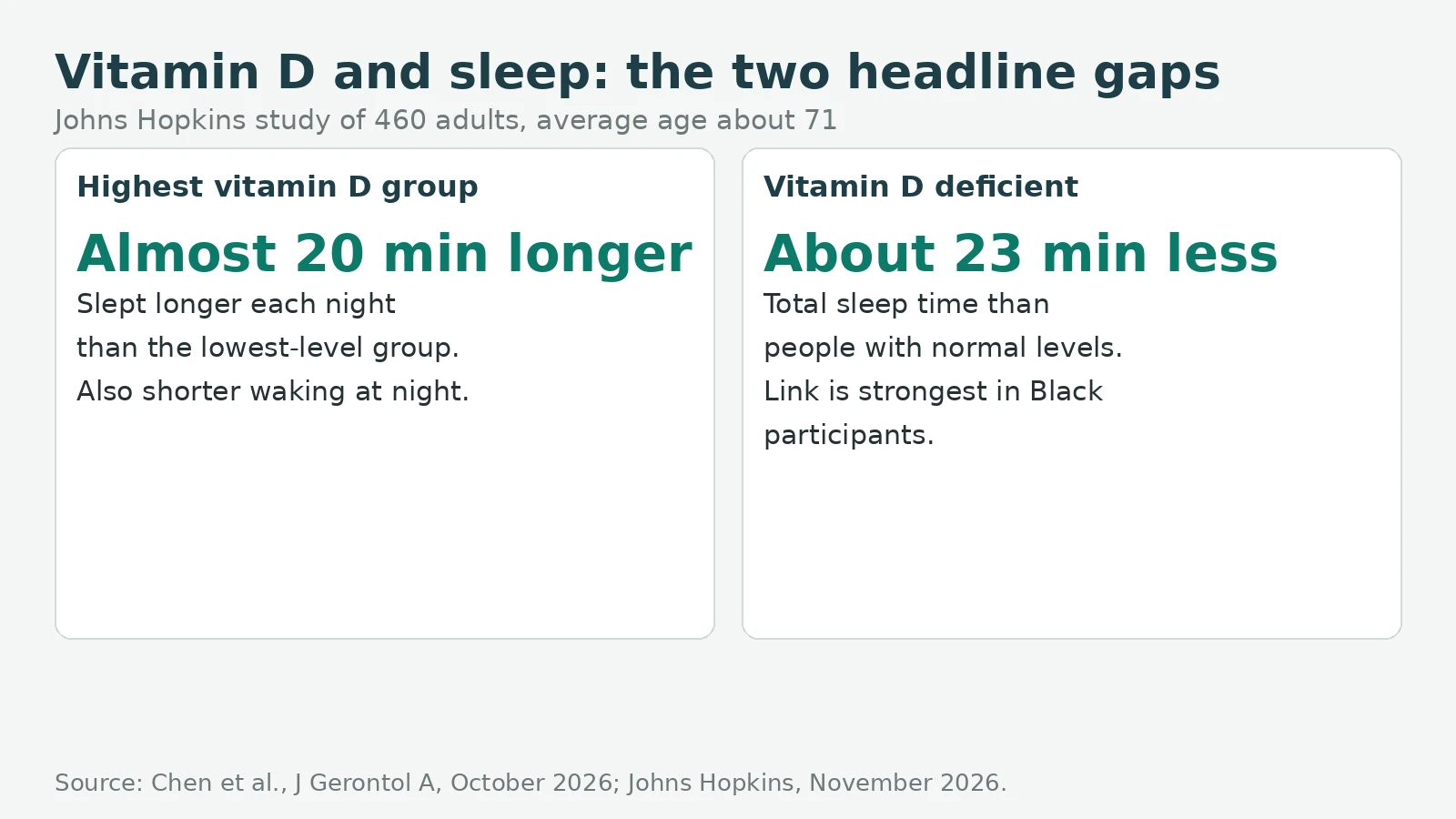
A Johns Hopkins study found older adults with the highest vitamin D levels slept almost 20 minutes longer each night than those with the lowest levels, while people classed as deficient slept about 23 minutes less. But the study only shows a link, not a cause — and a trial of vitamin D supplements found no sleep benefit at all.
What the new study found
Researchers at the Johns Hopkins Bloomberg School of Public Health, working with scientists at the National Institute on Aging, looked at blood vitamin D levels and sleep in 460 men and women with an average age of about 71. The volunteers were part of the long-running Baltimore Longitudinal Study of Aging, and their sleep was measured with wrist-worn movement monitors rather than questionnaires. The findings were published in The Journal of Gerontology: Medical Sciences in October 2026 and shared by the university in November.
The headline numbers are striking. People in the group with the highest vitamin D levels slept almost 20 minutes longer per night on average than those in the lowest group, and spent less time awake during the night. People whose levels met the standard definition of vitamin D deficiency slept about 23 minutes less, on average, than those with normal levels. The link looked strongest among Black participants, a group in which both vitamin D deficiency and sleep disturbance are more common in the United States.
The same study also looked at vitamin B12, which some earlier work had tied to sleep. Those results were inconclusive: women with higher B12 levels spent a little less time awake after falling asleep, while in men the pattern went the other way, and neither finding was statistically convincing.
Why vitamin D and sleep might be linked
There are plausible biological reasons for a connection, though none of them is proven. Vitamin D receptors and the enzymes that process vitamin D are found in brain areas involved in sleep regulation, including the hypothalamus. Vitamin D may also play a part in making melatonin, the hormone that helps set the sleep-wake cycle, and in the workings of the body’s internal clock. Sunlight matters for both: it drives vitamin D production in the skin and it is also the main signal that keeps our circadian rhythms on track.
There is another reason the finding matters. Poor sleep in older adults is linked to higher risks of dementia, diabetes and cardiovascular disease, and low vitamin D is very common in later life — about 1 billion people worldwide are deficient, according to the Cleveland Clinic, and around 35% of adults in the United States. That makes any link between the two worth investigating properly, even if this study alone cannot prove one.
How much vitamin D do you need?
Official advice differs a little between countries, because recommendations are set nationally. In the UK, the NHS says children from age 1 and adults need 10 micrograms (400 IU) of vitamin D a day, and the government advises everyone to consider a daily 10-microgram supplement during autumn and winter, when sunlight is too weak to make enough. In the US, the recommended amount is 600 IU a day for adults and 800 IU a day for people over 70.
| Group | Daily amount | Upper limit |
|---|---|---|
| UK adults (NHS) | 10 micrograms (400 IU) | 100 micrograms (4,000 IU) |
| US adults (Mayo Clinic) | 600 IU | 4,000 IU |
| US adults over 70 | 800 IU | 4,000 IU |
Do not go above the upper limit: taking too much vitamin D over a long period can raise calcium in the blood, which can weaken bones and damage the kidneys and heart. You cannot overdose on vitamin D from sunlight — the risk comes from supplements.
Where do you get vitamin D?
Your body makes vitamin D when direct sunlight hits your skin, and from late March to the end of September most people in the UK can make all they need this way. Between October and early March, sunlight is too weak, which is why the autumn and winter supplement advice exists. Food helps too: oily fish such as salmon, sardines and mackerel, red meat and egg yolks all contain vitamin D, as do some fortified foods such as breakfast cereals and fat spreads. Note that cows’ milk in the UK is generally not fortified, unlike in some other countries.
Some people are more likely to run low: older adults, people with darker skin, people who spend little time outdoors or who cover most of their skin when they do, and people with conditions that limit fat absorption, such as Crohn’s disease or coeliac disease. If you think you might be low, a blood test through your GP can check your level — and if you want more detail on the signs, see our guide to vitamin D deficiency symptoms.
Does taking vitamin D help you sleep?
This is where the headlines need a health warning. The Johns Hopkins study was observational: it took snapshots of people’s vitamin D levels and sleep over time, so it cannot show whether low vitamin D causes poor sleep, whether poor sleep somehow lowers vitamin D, or whether something else entirely — such as spending less time outdoors — explains both. The researchers themselves say the next step is to test whether raising vitamin D levels actually improves sleep.
So far, the trials that have tried have not been encouraging. In a 2021 randomised trial, 189 adults who were low in vitamin D took either a vitamin D supplement or a placebo for four months. At the end, there was no significant difference in sleep duration, daytime sleepiness or insomnia between the two groups. Other small trials have given mixed results: some found a small benefit, others found none, and a few even reported worse sleep. The Sleep Foundation lists vitamin D among natural sleep aids whose evidence is limited, and Sleep Doctor puts it plainly: vitamin D supplements are not a proven treatment for sleep disorders.
None of this means vitamin D does not matter for sleep — it means nobody has yet shown that taking a supplement fixes it. The best-proven treatment for long-term insomnia remains cognitive behavioural therapy for insomnia (CBT-I), and the sleep basics still matter most: a regular bedtime, a dark, cool, quiet bedroom, daylight in the morning, and no caffeine, alcohol or screens close to bedtime.
Signs you might be low in vitamin D
Many people with low vitamin D have no symptoms at all, which is one reason deficiency is so often missed. When symptoms do appear, the Cleveland Clinic lists fatigue, bone pain, muscle weakness, muscle aches or cramps, and mood changes such as depression. Severe deficiency over time can soften bones in adults, a condition called osteomalacia, and raise the risk of fractures. These symptoms are vague and have many causes, so they are a reason to talk to a doctor, not to start a supplement on your own.
When to see a doctor
See a GP if you have had trouble sleeping for months, if poor sleep is affecting your daily life, or if changing your sleep habits has not helped. Your GP can check for other causes, arrange a vitamin D blood test if appropriate, and offer CBT-I, which is the first-line treatment for insomnia. Sleeping pills are now rarely prescribed, and only for a few days or weeks at most.
Get urgent help if you have severe symptoms alongside poor sleep, such as chest pain, breathlessness or confusion. In an emergency call 911 (US), 999 (UK) or 112 (EU). If you are considering a vitamin D supplement, talk to your GP or pharmacist first, especially if you take other medicines or have kidney or liver disease.
Frequently asked questions
Does low vitamin D cause poor sleep?
Not proven. A Johns Hopkins study of 460 older adults found people with higher vitamin D levels slept longer, but it was observational, so it shows a link rather than a cause. Poor sleep and low vitamin D may share a cause, such as spending little time outdoors. A trial of vitamin D supplements found no sleep benefit, so low vitamin D should not be assumed to be the reason for poor sleep.
How much vitamin D should I take for sleep?
No dose of vitamin D has been proven to improve sleep, so there is no sleep-specific amount. The NHS advises 10 micrograms (400 IU) a day for adults, and suggests considering a daily supplement from October to March. In the US the recommended amount is 600 IU a day, or 800 IU over 70. Never take more than 100 micrograms (4,000 IU) a day, and ask a GP or pharmacist first.
Can vitamin D supplements help insomnia?
The evidence is mixed and does not support it as a treatment. A 2021 randomised trial in 189 vitamin D-insufficient adults found no improvement in sleep duration, daytime sleepiness or insomnia after four months of vitamin D. Some small trials found a small benefit and others found none. The first-line treatment for long-term insomnia is cognitive behavioural therapy for insomnia (CBT-I).
What are the symptoms of vitamin D deficiency?
Many people have no symptoms at all. When symptoms appear, the Cleveland Clinic lists fatigue, bone pain, muscle weakness, muscle aches or cramps, and mood changes such as depression. Severe deficiency over time can soften bones in adults and raise fracture risk. These symptoms have many causes, so they are a reason to talk to a doctor rather than to start a supplement alone.
How can I raise my vitamin D levels?
Sunlight is the main source from late March to September in the UK, when most people can make all they need from being outdoors. Oily fish, egg yolks and fortified foods also contain vitamin D. The NHS advises considering a daily 10-microgram supplement from October to March, and all year if you are at higher risk. A GP can check your level with a blood test.
Sources
- Johns Hopkins Bloomberg School of Public Health: Vitamin D Levels Linked to Sleep Quality publichealth.jhu.edu
- NHS: Vitamin D www.nhs.uk
- NHS: Insomnia www.nhs.uk
- Cleveland Clinic: Vitamin D Deficiency my.clevelandclinic.org
- Sleep Foundation: Natural Cures for Insomnia www.sleepfoundation.org
- Sleep Doctor: Does Vitamin D Help With Sleep? sleepdoctor.com
- Larsen et al. No improvement of sleep from vitamin D supplementation. Sleep Medicine: X, 2021 pmc.ncbi.nlm.nih.gov

Try the tool
Not sure if it can wait?
Common causes and warning signs for 16 everyday symptoms.
Open the symptom guide