Air Pollution and Dementia: Can Dirty Air Raise Your Risk?
Tiny particles in the air you breathe may be quietly harming your brain. A major new study of nearly half a million people — backed by experiments in mice — shows how pollution reaches the brain and raises dementia risk.
- Written by
- Health Daily Advice
- Published
- Reading time
- 4 minutes
- Sources
- 6 cited

In this guide
Yes, according to a major new study. People in the most polluted areas were 25% more likely to develop Alzheimer’s disease or a related dementia than those in the cleanest areas. In mice, breathing concentrated fine particles (PM2.5) for five months reprogrammed the brain’s immune cells, damaged the blood-brain barrier and killed newborn memory neurons, even in healthy brains.
What is PM2.5 — and how does it reach the brain?
PM2.5 is the name for fine particles in the air that measure 2.5 micrometres or less across — far thinner than a human hair. They come from traffic exhaust, industry, burning wood and fossil fuels, and wildfires. Because they are so small, they can be breathed deep into the lungs, pass into the bloodstream, and a small proportion can reach the brain, as the Alzheimer’s Society explains.
The World Health Organization sets its guideline for average yearly PM2.5 at 5 micrograms per cubic metre of air (5 µg/m³), a level it halved in 2021 as the evidence of harm grew. Yet in 2023, 99% of the world’s population lived in places where even the strictest WHO guideline levels were not met. Air pollution is linked to more than 8 million premature deaths every year.
What the study of 475,000 people found
Researchers at Case Western Reserve University, University Hospitals and the Louis Stokes Cleveland VA Medical Center analysed health and environmental records from 475,325 adults in the UK Biobank, tracked for up to 14 years. Their findings were published in the Journal of Neuroinflammation in November 2026.
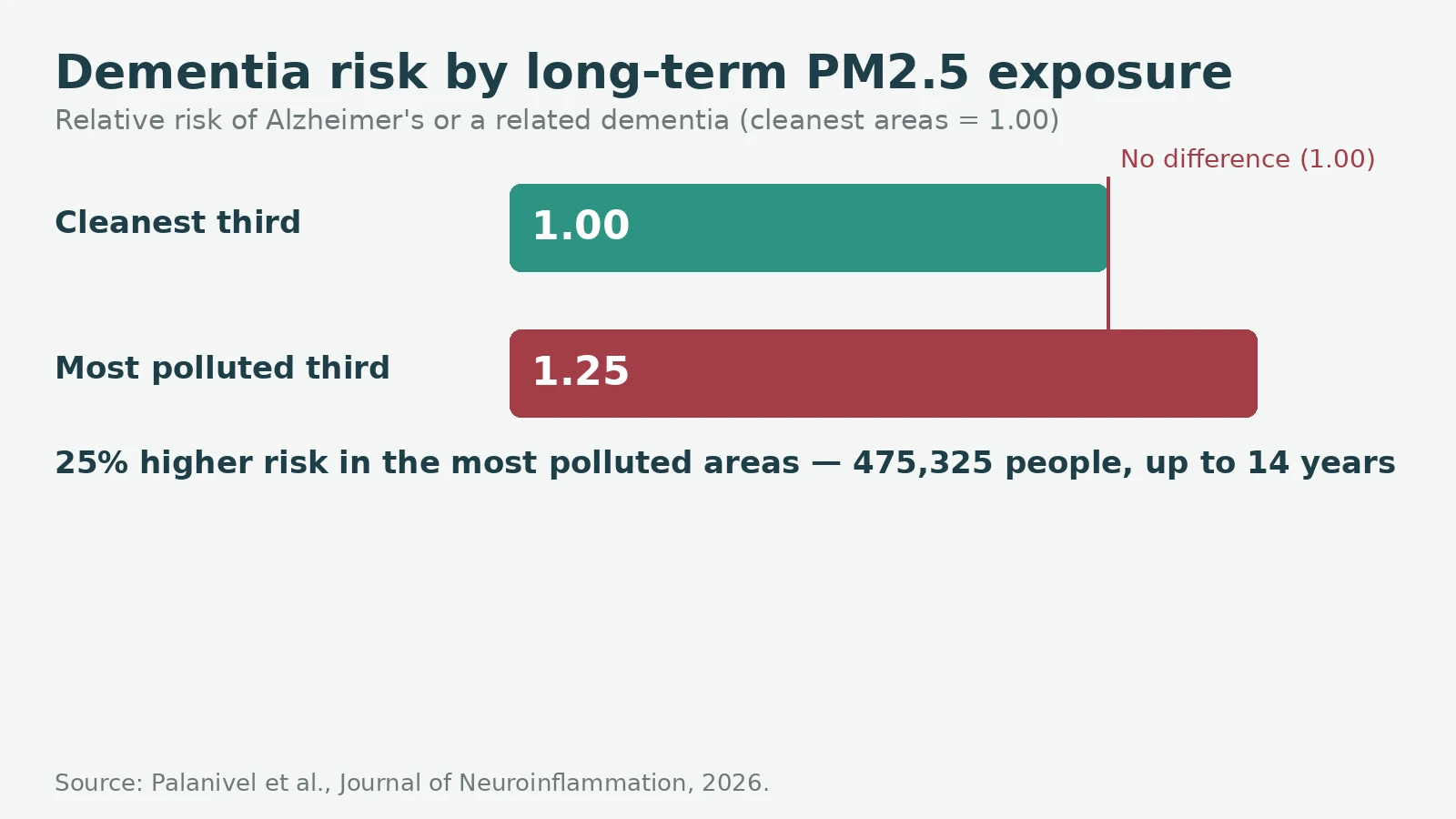
People living in the third of areas with the highest PM2.5 levels were 25% more likely to develop Alzheimer’s disease or a related dementia than people in the cleanest third. The link held after accounting for age, smoking, diabetes and socioeconomic factors — and it held whether or not someone carried a high inherited genetic risk for Alzheimer’s. In total, 12,758 participants — 2.68% of the group — developed Alzheimer’s or a related dementia during the study.
Because this part of the study looked back at people’s records, it can show an association, not prove cause and effect on its own. That is why the researchers ran a controlled experiment alongside it.
What the mouse experiments showed
To test whether pollution itself causes the damage, the team exposed mice to real outdoor air from Cleveland for five months, with the fine particles concentrated to levels found in the world’s most polluted cities. The effects were striking, and they appeared even in healthy mice with no Alzheimer’s plaques at all:
- Immune cells reprogrammed: pollution changed which genes were switched on and off inside microglia, the brain’s resident immune cells, pushing them into a disrupted, inflammatory state.
- Leaky blood-brain barrier: the protective barrier between the blood and the brain broke down, alongside lasting inflammation.
- Energy collapse: the brain’s NAD+/NADH ratio — a measure of cellular energy reserves — fell sharply.
- Memory neurons lost: more newborn neurons died in the hippocampus, the brain’s hub for learning and memory, and the mice developed memory problems.
When mice genetically prone to Alzheimer’s breathed the same polluted air, they suffered the same damage and their amyloid plaques built up faster. As co-senior author Sanjay Rajagopalan put it:
“By recreating in mice what happens when people breathe polluted air, we found that pollution causes major changes in which genes are active in the brain’s immune cells.”
The researchers stress that mouse results are not direct proof in people, but the human and animal evidence pointing the same way makes the case for pollution as a contributor to dementia much stronger.
How much does air pollution contribute to dementia overall?
It is one piece of a much bigger picture. Age remains by far the biggest risk factor for dementia: more than 9 in 10 people with dementia are over 70, and the typical age at diagnosis is 80 to 85. The Lancet Commission on dementia prevention estimated that modifying 12 risk factors across life could delay or prevent 40% of dementia cases — with air pollution in later life accounting for about 2% of cases.
That 2% still matters at population level, because almost everyone breathes polluted air. And unlike age or genes, air quality is something societies can improve. Leisure-time exercise is also linked to a lower dementia risk, so the everyday choices that protect the brain work alongside cleaner air, not instead of it.
What you can do to cut your exposure
You cannot avoid air pollution entirely, and nobody should feel blamed for where they live. But the Alzheimer’s Society points to a few steps that can lower your personal exposure:
- Walk or cycle away from heavy traffic where possible, rather than along the busiest roads.
- Make sure your home is well ventilated when cooking with gas or using a woodburner.
- Check your local air-quality forecast and plan outdoor exercise for times when pollution is lower.
The Society is clear, though, that the greatest reduction in exposure will come from policies and changes that improve air quality across towns and cities — cleaner transport, less burning of fossil fuels and wood, and tighter controls on industry.
When to see a doctor
See a GP if you, or someone close to you, notice persistent problems with memory or thinking that affect everyday life — such as forgetting recent conversations, getting lost in familiar places or struggling with familiar tasks. An early assessment can identify the cause and open the door to support, whatever the cause turns out to be.
In an emergency call 911 (US), 999 (UK) or 112 (EU)
Frequently asked questions
Can air pollution cause dementia?
The evidence now points that way, but it is not proof for any one person. A study of 475,000 people found a 25% higher dementia risk in the most polluted areas, and mouse experiments showed pollution damaging the brain's immune cells, blood-brain barrier and memory neurons. Dementia has many causes, and age remains the biggest risk factor, so pollution is one contributor among several.
What does PM2.5 mean?
PM2.5 means fine particles in the air that are 2.5 micrometres or less across — far thinner than a human hair. They come from traffic exhaust, industry, burning wood and fossil fuels, and wildfires. Because they are so tiny, they can be breathed deep into the lungs, enter the bloodstream, and a small proportion can reach the brain.
How much does air pollution raise dementia risk?
In the 2026 study, people in the most polluted third of areas were 25% more likely to develop Alzheimer's disease or a related dementia than those in the cleanest third. That is a relative increase: your absolute risk still depends mainly on age and other factors. The Lancet Commission estimated air pollution in later life accounts for about 2% of dementia cases overall.
Does living in a city mean I will get dementia?
No. Most people who live in polluted areas never develop dementia, and most dementia is driven by age and other factors. Air pollution raises risk at population level, but it does not decide any one person's future. Keeping active, looking after heart health and staying socially connected are among the better-established ways to protect the brain.
How can I reduce my exposure to air pollution?
Walk or cycle away from heavy traffic where possible, and keep your home well ventilated when cooking with gas or using a woodburner — the steps the Alzheimer's Society suggests. Checking local air-quality forecasts can help you time outdoor exercise. The biggest gains, though, come from cleaner air across whole towns and cities, through policy and cleaner transport.
Sources
- Palanivel R, et al. Air pollution exposure interacts with Alzheimer's genetic susceptibility to reshape microglial epigenomic and transcriptional programs. Journal of Neuroinflammation, 2026 doi.org
- Neuroscience News: Air Pollution Reprograms Brain Immune Cells, Raises Dementia Risk by 25% neurosciencenews.com
- Alzheimer's Society: Who is most at risk of dementia? www.alzheimers.org.uk
- Alzheimer's Society: Report: Is there a link between air pollution and dementia? www.alzheimers.org.uk
- Alzheimer's Society: The Lancet: 40% of dementia cases could be prevented or delayed by targeting 12 risk factors www.alzheimers.org.uk
- UNEP: Air Pollution Note – Data you need to know www.unep.org

Try the tool
Not sure if it can wait?
Common causes and warning signs for 16 everyday symptoms.
Open the symptom guide