Physical Activity and Dementia: Why Work and Leisure Differ
A study of 4.2 million people found leisure exercise cuts dementia risk by 24%, while heavy physical work raises it by 20%. Why the context of movement matters.
- Written by
- Health Daily Advice
- Published
- Reading time
- 5 minutes
- Sources
- 6 cited

In this guide
A study of 4.2 million people found free-time exercise linked to a 24% lower risk of dementia, while heavy physical work was linked to a 20% higher risk. The difference is not the movement itself but the conditions around it — control, rest, stress and pollution — and the research cannot prove work activity causes dementia.
What the new study found
Regular physical activity has long been linked to a lower risk of dementia. But a major analysis published in The Lancet Public Health suggests the circumstances matter as much as the movement. Researchers at the University of Southern California, led by Professor David Raichlen with first author Dr Natan Feter, pooled 74 cohort and case-control studies covering 4,227,297 people aged 45 to 93 from 30 countries, followed for a median of 10 years. It is the first systematic investigation of whether the “physical activity paradox” — already well established in heart disease research — also applies to dementia.
Overall, people with high levels of physical activity had a lower risk of all-cause dementia, with a relative risk of 0.80, as well as lower risks of Alzheimer’s disease (0.79) and vascular dementia (0.71). But when the team split activity by where it happens, the picture changed sharply. Leisure-time activity, such as walking, cycling, running, swimming and playing sports, was linked to a 24% lower risk of dementia. Household activity, such as chores, was linked to a 15% lower risk, though that finding rests on a single study. Occupational activity was linked to a 20% higher risk, and physically active commuting to a 10% higher risk, based on just two studies.
Leisure exercise protects, work activity does not
The contrast is the heart of the finding. In the analysis, the most active leisure-time group had a relative risk of 0.76 compared with the least active, meaning their dementia risk was about a quarter lower. The most physically active workers had a relative risk of 1.20, meaning their risk was about a fifth higher. Commuters who walked or cycled to work sat in between, at 1.10, while housework came in at 0.85.
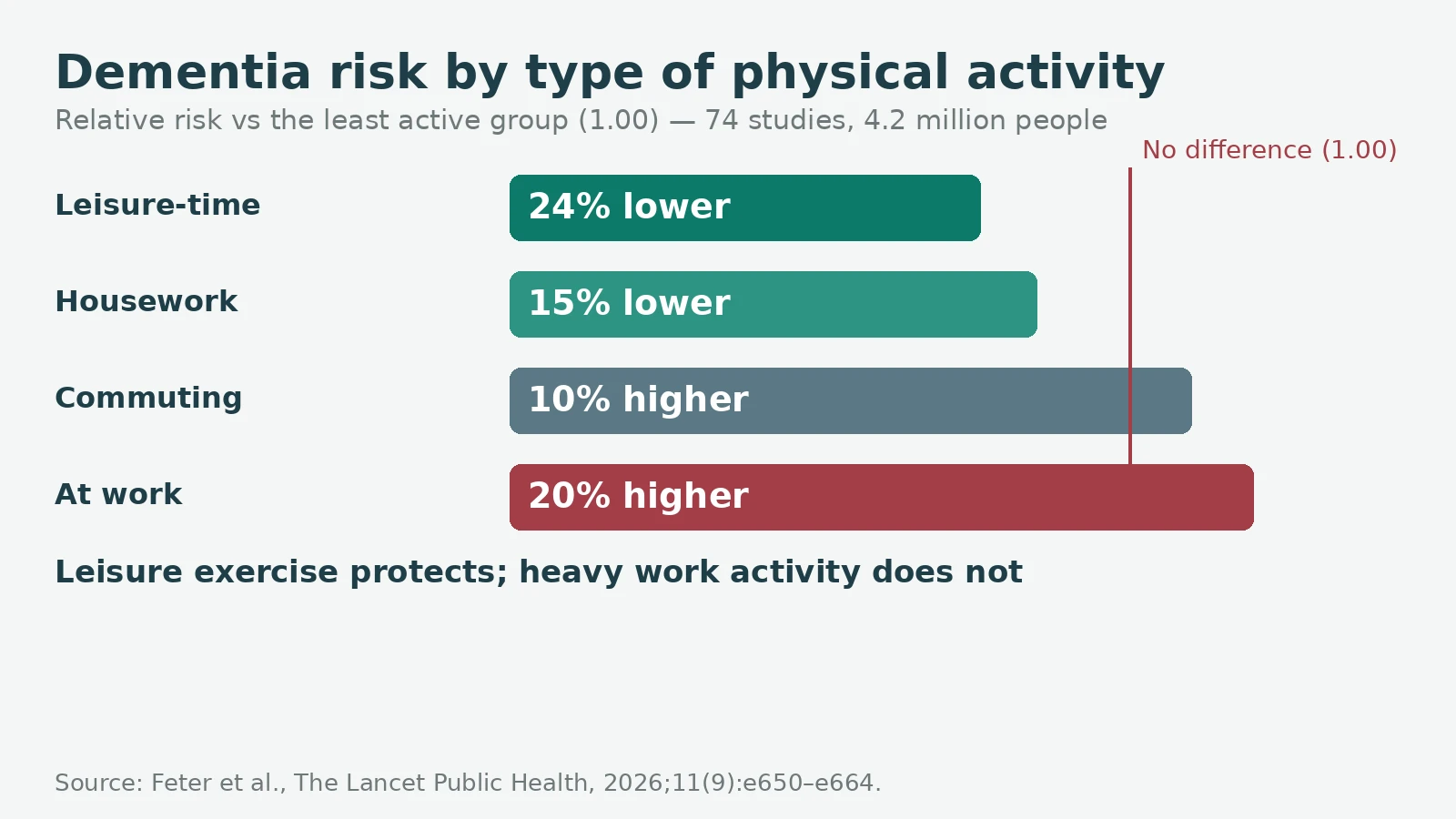
The dose-response pattern was also opposite. As leisure-time activity rose, dementia risk fell gradually until the benefit levelled off. As occupational activity rose, risk increased before eventually reaching a plateau. The authors stress that the certainty of the evidence ranged from very low to low across the different domains, so these numbers should be read as the best current estimate rather than a settled fact.
Why would work and leisure affect the brain differently?
The researchers do not believe the movement itself is the problem. People who exercise in their free time generally choose the intensity, can stop and rest, and often socialise and relieve stress while they do it. Physically demanding jobs are different: repeated movements, long periods of standing, heavy lifting and too little time to recover, often combined with psychological stress, little control over the work, unsafe conditions and exposure to air and noise pollution. Each of those factors has independently been linked to dementia risk.
Social circumstances matter too. People in physically demanding occupations may have had fewer educational opportunities than office workers, and may be too exhausted, short of time, or lacking safe spaces to exercise in their leisure hours. As Professor Raichlen put it, “when it comes to protecting the brain, the context of physical activity may matter just as much as movement itself.” The authors argue that encouraging people to simply “move more” is not enough without also improving access to safe parks and walking trails, ensuring adequate leisure time, and reducing harmful workplace exposures.
What the study cannot prove
This is observational research, and the authors are clear about its limits. It cannot establish that occupational physical activity causes dementia. Almost all the included studies relied on people reporting their own activity, which can be inaccurate. Most of the evidence comes from high-income countries, even though low- and middle-income countries are expected to see the greatest increases in dementia cases in the coming decades.
Reverse causation is another real possibility. People in the early, preclinical phase of dementia may already be moving less, so low leisure activity could be an early sign of the disease rather than its cause. A commentary in the same issue of The Lancet Public Health notes that physical activity predicted a lower dementia risk mainly during the first 10 years of follow-up, when this kind of reverse causation is most likely. The researchers also stress that nobody should be discouraged from a physically active job on the basis of these findings, and the association for work activity remained even after accounting for age, education and chronic health conditions.
What this means for reducing your dementia risk
The practical message is reassuringly simple: keep moving in your free time, whatever your job. The NHS recommends at least 150 minutes of moderate-intensity aerobic activity a week, such as brisk walking, cycling or dancing, plus strengthening exercises at least twice a week, such as gardening or yoga — and sitting less. The WHO lists being physically active among the main actions that can reduce the risk of cognitive decline and dementia, alongside not smoking, avoiding harmful alcohol use, eating a healthy balanced diet, staying socially and cognitively active, maintaining a healthy weight, and managing blood pressure, cholesterol and blood sugar.
The scale of the problem makes the point urgent. The WHO reports that 57 million people were living with dementia in 2021, with nearly 10 million new cases every year, and that Alzheimer’s disease contributes to 60–70% of cases. Dementia is the fifth leading cause of death worldwide and cost economies US$1.3 trillion in 2019. The NHS estimates that around 4 in 10 cases could be prevented by changing the risk factors we can control. If your job is physically demanding, that makes leisure-time movement more important, not less — a walk in daylight, a swim, a dance class, or anything you enjoy and can keep doing.
When to see a doctor
See a GP if you or someone close to you notices memory problems that affect daily life, such as forgetting recent events, losing track of time, getting lost in familiar places, or struggling to follow conversations or find words. The WHO lists these among the early signs of dementia, along with losing or misplacing things, difficulties solving problems and changes in mood or behaviour. Early assessment matters because some causes of memory problems can be treated, and a diagnosis opens the door to support, planning and care.
Seek urgent help if confusion comes on suddenly, or if someone becomes very drowsy, cannot be woken, or loses speech or movement — these can be signs of a stroke or another emergency. In an emergency call 911 (US), 999 (UK) or 112 (EU).
Frequently asked questions
Does physical work increase dementia risk?
The study found an association, not proof. Across five studies, people with the highest levels of occupational physical activity had a 20% higher risk of dementia than the least active workers. But the research is observational, so it cannot show that work activity causes dementia. The authors believe social and environmental factors linked to manual labour — stress, low control, pollution and little recovery time — are the more likely explanation.
Is walking enough exercise to protect against dementia?
Walking counts as leisure-time activity, which is the type linked to the clearest benefit. In the analysis, leisure activities such as walking, cycling, running, swimming and playing sports were associated with a 24% lower risk of dementia. The NHS recommends at least 150 minutes of moderate-intensity activity a week, such as brisk walking, plus strengthening exercises twice a week. Regular, enjoyable movement you can sustain matters most.
Why is leisure exercise better for the brain than work activity?
Leisure exercise usually comes with choice, rest and social contact, which support brain health. Physically demanding jobs often involve repeated movements, long standing, heavy lifting and too little recovery, plus stress, low control over the work, unsafe conditions and exposure to air and noise pollution. Each of those factors has been linked to dementia risk on its own. Workers may also be too tired to exercise in their free time.
How much exercise do I need to lower dementia risk?
The NHS advises at least 150 minutes of moderate-intensity aerobic activity each week — brisk walking, cycling, dancing or swimming — plus strengthening exercises on two or more days a week, such as gardening or yoga. The new study found the benefit of leisure activity levelled off as activity rose, so you do not need extreme amounts. Sitting less through the day also helps, and staying socially and mentally active adds further benefit.
Can dementia be prevented by exercise alone?
No single habit can guarantee prevention, and there is no certain way to prevent all types of dementia. But the NHS estimates that around 4 in 10 cases could be prevented by changing the risk factors we can control. Exercise is one of them, alongside a balanced diet, a healthy weight, not smoking, limiting alcohol, staying socially active and managing blood pressure, cholesterol and blood sugar. Healthy habits work together.
Sources
- Feter N et al. Domain-specific physical activity levels and risk of dementia: a systematic review and meta-analysis. Lancet Public Health 2026;11(9):e650–e664 doi.org
- PubMed: Domain-specific physical activity levels and risk of dementia (42612650) pubmed.ncbi.nlm.nih.gov
- ScienceDaily: One type of physical activity is linked to a 20% higher dementia risk, 25 Nov 2026 sciencedaily.com
- SciTechDaily: Not All Physical Activity Protects Your Brain, Scientists Warn scitechdaily.com
- WHO: Dementia fact sheet www.who.int
- NHS: Can dementia be prevented www.nhs.uk

Try the tool
Not sure if it can wait?
Common causes and warning signs for 16 everyday symptoms.
Open the symptom guide