Hodgkin Lymphoma Symptoms: Signs to Know and When to Act
Three public figures announced Hodgkin lymphoma diagnoses in November 2026. Here is the symptom to check first, what B symptoms mean, and why about 9 in 10 people survive.
- Written by
- Health Daily Advice
- Published
- Reading time
- 5 minutes
- Sources
- 7 cited
In this guide
Hodgkin lymphoma is a cancer of the lymphatic system, and its most common sign is a painless lump or swelling, usually in the neck, armpit or groin. Other warning signs include drenching night sweats, unexplained fever and weight loss. It is one of the most treatable cancers: 9 in 10 people in the US are alive five years after diagnosis.
Why Hodgkin lymphoma is in the news
Three public figures announced Hodgkin lymphoma diagnoses within three weeks in November 2026. German comedian Dieter Nuhr, 66, said on Instagram on 23 November that he had been diagnosed and would need treatment, cancelling his shows until spring. College basketball player Jack McCaffery announced his diagnosis on 8 November, and professional footballer Belal Halbouni, 26, announced his on 6 November. None of the three has disclosed the stage of their disease or their treatment plan, and this article does not speculate about either.
The cluster of announcements has driven fresh searches for what the disease feels like and how it is spotted. The spread across ages is itself the story: Hodgkin lymphoma is unusual among cancers because it peaks in young adults in their twenties and thirties, as well as in older people.
What is Hodgkin lymphoma?
Hodgkin lymphoma is a cancer of the lymphatic system, the part of the immune system that includes the lymph nodes, spleen, thymus, tonsils, adenoids and bone marrow. It starts in B lymphocytes, the white blood cells that fight infection. What sets it apart from other lymphomas is the presence of large abnormal cells called Reed–Sternberg cells, which doctors look for under the microscope to confirm the diagnosis.
Lymphoma is divided into two broad categories: Hodgkin and non-Hodgkin. Hodgkin lymphoma is far rarer — in the United States, an estimated 8,920 new cases are expected in 2026, compared with 79,320 new cases of non-Hodgkin lymphoma, according to the National Cancer Institute.
What are the symptoms of Hodgkin lymphoma?
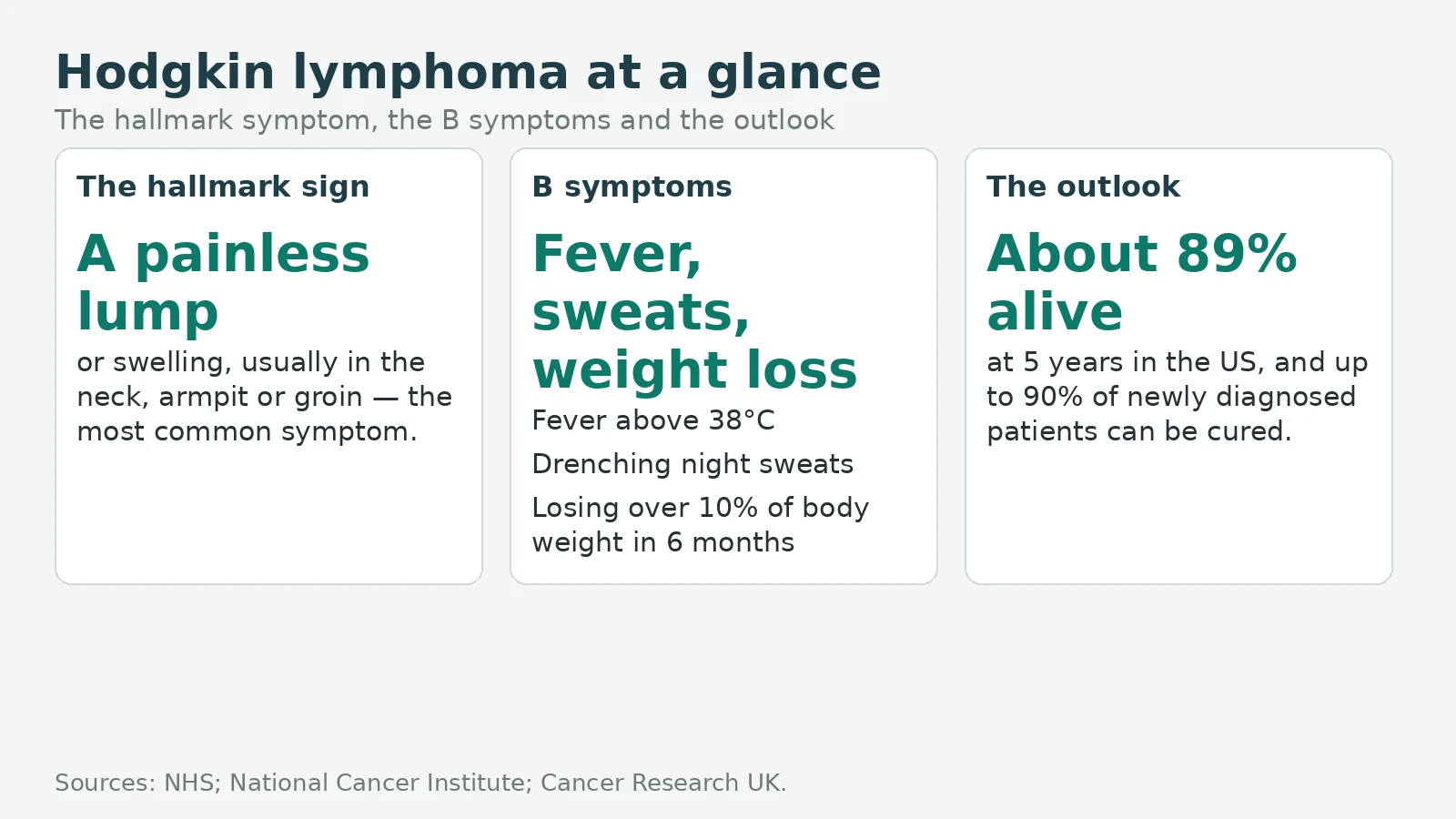
The most common symptom is a painless lump or swelling, usually in the neck, armpit or groin. The swollen glands often grow slowly and may be present for months before they are noticed, though sometimes they grow quickly. They usually do not hurt, although some people feel an ache, or pain in the glands after drinking alcohol.
Other symptoms listed by the NHS and Mayo Clinic include:
- A high temperature (fever) that comes and goes without an obvious cause, often overnight
- Drenching night sweats
- Unexplained weight loss
- Itchy skin, which may be worse after drinking alcohol
- Tiredness (fatigue)
- Shortness of breath or a persistent cough
- Pain in the glands or tummy after drinking alcohol
It is important to keep these symptoms in proportion. Most swollen glands are caused by infection, not cancer, and most people with these symptoms will not have Hodgkin lymphoma. The NHS advises seeing a GP if you have any of them, because finding it early means treatment is more likely to be successful.
What are B symptoms?
Doctors call fever, night sweats and weight loss “B symptoms”. They matter because the stage of the disease is subclassified A (no B symptoms) or B (B symptoms present), and B symptoms are linked to a less favourable outlook. The National Cancer Institute defines them precisely:
| B symptom | What it means |
|---|---|
| Weight loss | Losing more than 10% of body weight in the 6 months before diagnosis, without trying |
| Fever | Unexplained fever above 38°C |
| Night sweats | Drenching and recurrent sweating at night |
Fever and weight loss carry the most weight in the definition; night sweats on their own do not confer a worse prognosis, according to the National Cancer Institute.
Less common symptoms
Depending on where the swollen nodes are, they can press on nearby structures. Cancer Research UK notes that this can cause pain if a nerve is pressed, swelling of an arm or leg, yellowing of the skin and eyes (jaundice), or small lumps or ulcers on the skin near the nodes.
About 5 in 100 people have lymphoma cells in the bone marrow. That can cause breathlessness and tiredness from anaemia, more infections than usual, and bleeding such as nosebleeds, very heavy periods or tiny blood spots under the skin.
How common is Hodgkin lymphoma, and who gets it?
Hodgkin lymphoma is uncommon. In the UK, about 2,184 people are diagnosed every year — roughly 6 a day — and about 320 people die from it each year, according to Cancer Research UK. In the US, the National Cancer Institute estimates 8,920 new cases in 2026 and 1,100 deaths, about 0.4% of all new cancer cases.
It most often affects people in their twenties and thirties, and people over 65. In the US, the largest share of new cases — 31.7% — is diagnosed in people aged 20 to 34, and the median age at diagnosis is 38. It is slightly more common in men than in women. Risk factors include being in early adulthood (20 to 39) or late adulthood (65 and over), being male, a previous Epstein–Barr virus infection in the teenage years or early childhood, and having a first-degree relative with the disease.
How is Hodgkin lymphoma diagnosed?
Diagnosis usually starts with a physical examination to check swollen lymph nodes and an enlarged spleen or liver, plus blood tests and imaging. The key step is a biopsy — a tissue sample, preferably taken by removing a whole lymph node — which a pathologist examines for Reed–Sternberg cells.
Once confirmed, doctors stage the disease from I to IV according to how far it has spread, using CT scans or a PET-CT scan. In the US, 13% of cases are stage I at diagnosis, 38% stage II, 19% stage III and 25% stage IV. Each stage is then subclassified A or B, depending on whether B symptoms are present.
Treatment and outlook
Hodgkin lymphoma is highly treatable and often curable. Treatment may include chemotherapy, radiotherapy, targeted therapy or immunotherapy, and sometimes a bone marrow transplant or a clinical trial. The National Cancer Institute states that up to 90% of all newly diagnosed patients can be cured with combination chemotherapy and/or radiation therapy.
Survival figures back that up. In the US, 5-year relative survival is 89.3% overall, and by stage it is 92.7% at stage I, 95.4% at stage II, 87.7% at stage III and 82.8% at stage IV, according to the National Cancer Institute. In the UK, 81.6% of people survive for 10 or more years. Treatment has improved over time, so people diagnosed now may do better than these figures suggest. Relapse is possible and is more common with advanced disease, but the 5-year risk of relapse is 5.6% for patients who are event-free two years after their first treatment.
When to see a doctor
See a GP if you have a swollen lymph node, especially if you have not had a recent infection, or any of the other symptoms listed above. Although the symptoms are unlikely to be cancer, getting them checked matters — and the sooner Hodgkin lymphoma is found, the more likely treatment is to succeed. A lump that is painless, keeps growing, or is still there after a few weeks deserves attention, as do drenching night sweats, unexplained fever or weight loss.
If you notice a lump, do not try to diagnose it yourself. A GP can examine it, arrange blood tests or an ultrasound, and refer you to a specialist if needed. In an emergency call 911 (US), 999 (UK) or 112 (EU).
Frequently asked questions
Is a painless lump in the neck always cancer?
No. Most swollen glands are caused by infection, such as a cold, sore throat or tooth infection, and they usually settle within a few weeks. A lump that is painless, keeps growing, is still there after a few weeks, or appears without any recent infection deserves a GP check. Only a doctor can tell what it is, usually with blood tests, an ultrasound or a biopsy.
What are B symptoms in Hodgkin lymphoma?
B symptoms are fever, drenching night sweats and unexplained weight loss. Doctors use precise cut-offs: fever above 38°C, weight loss of more than 10% of body weight in the 6 months before diagnosis, and night sweats that soak through clothes or bedding. Stages are labelled A when B symptoms are absent and B when they are present, and B symptoms are linked to a less favourable outlook.
Is Hodgkin lymphoma curable?
In most cases, yes. It is one of the most treatable cancers: the National Cancer Institute states that up to 90% of newly diagnosed patients can be cured with combination chemotherapy and/or radiation therapy. In the US, about 89% of people are alive five years after diagnosis, and survival is higher still when the disease is found at an early stage. Treatment has improved over time, so people diagnosed now may do better than past figures suggest.
What is the difference between Hodgkin and non-Hodgkin lymphoma?
Both are cancers of the lymphatic system, but Hodgkin lymphoma is defined by the presence of Reed–Sternberg cells in the lymph nodes, which non-Hodgkin lymphoma does not have. Hodgkin lymphoma is far rarer — about 8,920 new US cases in 2026 versus 79,320 for non-Hodgkin lymphoma — and it is usually more curable, with up to 90% of newly diagnosed patients cured.
What age does Hodgkin lymphoma affect most?
It peaks twice: in young adults in their twenties and thirties, and again in people over 65. In the US, the largest share of new cases — 31.7% — is diagnosed in people aged 20 to 34, and the median age at diagnosis is 38. That young-adult peak is unusual among cancers, and it is why the recent diagnoses of players in their twenties have drawn so much attention.
Can Hodgkin lymphoma come back after treatment?
Yes, relapse is possible and is more common with advanced disease. However, the risk falls sharply with time: the 5-year risk of relapse is 5.6% for patients who are event-free two years after their first treatment. If it does come back, further treatment is often available, and your specialist team will discuss the options with you.
Sources
- NHS: Hodgkin lymphoma symptoms www.nhs.uk
- Mayo Clinic: Hodgkin lymphoma symptoms and causes www.mayoclinic.org
- Cancer Research UK: Hodgkin lymphoma symptoms www.cancerresearchuk.org
- National Cancer Institute (SEER): Hodgkin lymphoma statistics seer.cancer.gov
- National Cancer Institute: Adult Hodgkin lymphoma treatment (PDQ) www-prod-acsf.cancer.gov
- American Cancer Society: Hodgkin lymphoma survival rates www.cancer.org
- Mulemo: Dieter Nuhr reveals Hodgkin lymphoma diagnosis www.mulemo.com

Try the tool
Not sure if it can wait?
Common causes and warning signs for 16 everyday symptoms.
Open the symptom guide