Colorectal Cancer in Young Adults: Why Cases Are Rising
Bowel cancer is rising in under-50s while falling in older adults. The warning signs to act on, what the 2026 research found, and when screening should start.
- Written by
- Health Daily Advice
- Published
- Reading time
- 5 minutes
- Sources
- 7 cited

In this guide
Colorectal cancer — bowel cancer — is rising in adults under 50 while falling in older age groups. In the US, cases in people aged 20 to 49 rose about 3% a year between 2013 and 2022. The warning signs are rectal bleeding, a change in bowel habits, tummy pain and unexplained weight loss. Found early, it is highly treatable.
How fast is it rising in young adults?
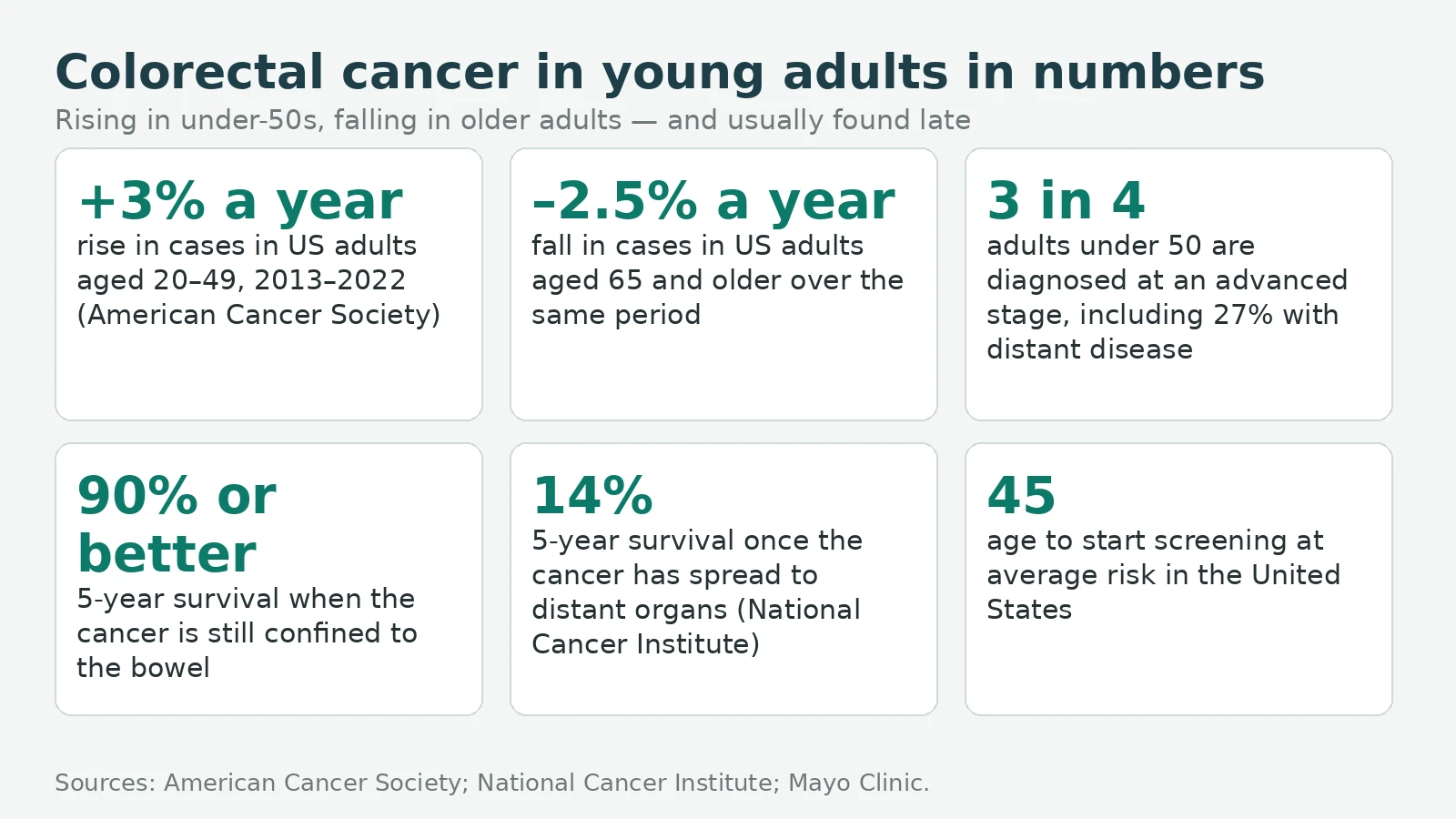
The American Cancer Society’s 2026 statistics report paints a clear split. In the US, colorectal cancer incidence rose by 3% per year in adults aged 20 to 49 and by 0.4% per year in adults aged 50 to 64 between 2013 and 2022, while falling by 2.5% per year in adults aged 65 and older. Death rates have risen by 1% per year in adults under 50 since 2004, while falling by 2 to 3% per year in people over 65 since the 1990s.
Colorectal cancer is now the most common cause of cancer death in people under 50 in the US, and the second most common cause of cancer death overall. In 2026, an estimated 158,850 new cases will be diagnosed in the US and 55,230 people will die from the disease. The rise is happening in all racial and ethnic groups, fastest in Hispanic people at 4% per year.
The pattern is not limited to the US. In the UK, around 43,000 people are diagnosed with bowel cancer every year, and in October 2026 UK scientists began recruiting 250,000 people aged 18 to 50 to help find out what might be causing the rising rates in younger people.
Why younger people are often diagnosed late
About 3 in 4 adults younger than 50 with colorectal cancer are diagnosed at an advanced stage — when the cancer has already spread to nearby tissue or beyond — including 27% with distant-stage disease, according to the American Cancer Society. That is the key problem: the disease is found late because neither patients nor doctors think of cancer first at this age, and symptoms are put down to piles, irritable bowel or stress.
A study presented at the American Academy of Pediatrics 2026 conference shows how long the delay can be. Researchers looked at 84 patients aged 21 or younger diagnosed between 2012 and 2023 at 34 institutions. The median age at diagnosis was 16.5 years, symptoms had been present for a median of 12 weeks before diagnosis, and the median time to colonoscopy was 13 weeks. Most patients presented with stage III (51%) or stage IV (29%) disease, and only 20.2% had a close relative with colorectal cancer. By the end of the study period, 45.2% of the patients had died, and 5-year overall survival was 47%.
That study was small and looked back at a rare presentation, so its figures should not be read as the outlook for all young adults. But it underlines the same message as the national data: persistent bowel symptoms in a young person deserve to be taken seriously.
The warning signs to act on
Symptoms of colorectal cancer can include a change in bowel habits, rectal bleeding or blood in the stool, narrow stools, ongoing abdominal discomfort such as cramps, gas or pain, a feeling that the bowel does not empty fully, weakness or fatigue, and losing weight without trying.
Research highlighted by the National Cancer Institute found four warning signs that show up in the 3 months to 2 years before an early-onset diagnosis: abdominal pain, rectal bleeding, diarrhoea and iron-deficiency anaemia. Having just one of those signs was associated with nearly twice the likelihood of an early-onset diagnosis, and having three or more was associated with about six times the likelihood. In younger people, the change in bowel habits is more often diarrhoea.
These signs do not mean cancer — they are common and usually have other causes. But if they are persistent, unexplained or different from your usual pattern, they should be discussed with a doctor rather than waited out.
What the 2026 tumour atlas found
A study published in Nature Medicine on 29 October 2026 looked inside the tumours themselves. Researchers analysed 189 primary colorectal tumours — 54 from patients diagnosed before age 50 and 135 from patients aged 50 or older — measuring gene activity in more than 850,000 cell nuclei, one by one.
In the most common subtype of the disease, tumours from younger patients had a significantly higher proportion of connective and supporting (stromal) cells relative to cancer cells, a pattern confirmed in data from 564 other tumours and in computer analysis of stained tissue from another 712. Younger patients’ tumours also showed higher activity of long non-coding RNAs and stronger cell-to-cell signalling linked to cancer cells moving into nearby tissue.
The authors are clear about what this does not show: the findings do not explain why cases are rising, and they do not prove that the differences make the disease more aggressive. They offer a roadmap for research, not a new treatment.
Screening: who should be checked, and when?
Experts now recommend starting colorectal cancer screening at age 45 for people at average risk in the US, and people with risk factors such as a family history may need to start younger. Screening can find and remove polyps — growths in the bowel — before they become cancer. Half of colorectal cancer diagnoses under age 50 are in people aged 45 to 49, the age group eligible for screening at average risk.
Talk to a doctor or pharmacist about which screening test is available where you live. In the UK, the NHS bowel cancer screening programme invites people from age 50, and people with a strong family history may be offered earlier checks. Screening is for people without symptoms; if you have symptoms, you need a doctor’s appointment, not a screening test.
What researchers think might be behind the rise
The exact reason for the rise in younger people is not yet known. Researchers are investigating environmental and lifestyle factors, including major changes in diet — more ultra-processed food and red meat — changes in gut bacteria, less exercise and rising obesity. The American Cancer Society lists possible risk factors including drinking 3 or more alcoholic drinks a day, a body mass index of 30 or greater, eating a lot of red or processed meat, a diet low in fruit, vegetables and fibre, low physical activity and smoking.
None of these is a proven cause of the rise, and the leading explanation researchers point to is a birth cohort effect: something about how recent generations were raised or exposed to their environment early in life, not just how they live now. People born after 1983 carry an elevated risk compared with earlier generations. The honest answer is that the cause is still being worked out — which is why symptom awareness and screening matter more than any single lifestyle change.
When to see a doctor
See a doctor promptly if you notice blood in your stool or rectal bleeding, a persistent change in your bowel habits, ongoing abdominal pain, unexplained weight loss, or fatigue that does not improve. These symptoms are usually caused by something other than cancer, but they should be checked — especially if they last more than a few weeks, keep coming back, or you are under 50 and have never had them investigated.
If you have a family history of bowel cancer or polyps, or a condition such as inflammatory bowel disease, ask your doctor whether you should be screened earlier than 45. And if you are 45 or older and have never been screened, talk to your doctor about it. In an emergency call 911 (US), 999 (UK) or 112 (EU).
Frequently asked questions
What are the first symptoms of colorectal cancer in young adults?
The warning signs most often seen before an early-onset diagnosis are abdominal pain, rectal bleeding, diarrhoea and iron-deficiency anaemia. Other symptoms include a persistent change in bowel habits, narrow stools, ongoing cramps or bloating, a feeling that the bowel does not empty, fatigue and unexplained weight loss. These symptoms are common and usually have other causes, but if they persist for more than a few weeks, see a doctor.
Should I get screened for bowel cancer before 45?
Screening from 45 is recommended for people at average risk in the US, but talk to your doctor sooner if you have a family history of bowel cancer or polyps, inflammatory bowel disease, or symptoms such as bleeding or a lasting change in bowel habits. Screening is for people without symptoms; if you have symptoms, you need a doctor's appointment rather than a screening test.
What causes colorectal cancer in young people?
The honest answer is that nobody knows yet. Researchers are investigating diet changes, including more ultra-processed food and red meat, changes in gut bacteria, less exercise and rising obesity, and the leading idea is a birth cohort effect — something about how recent generations were raised or exposed early in life. None of these is a proven cause, so symptom awareness and screening matter most.
Is colorectal cancer curable if it is found early?
Yes — stage matters more than almost anything else. When the cancer is still confined to the colon or rectum, five-year survival is 90% or better; once it has spread to distant organs, it is typically 14% or less, according to the National Cancer Institute. That is why about 3 in 4 under-50s being diagnosed at an advanced stage is the problem to fix, through symptom awareness and screening from 45.
How fast is colorectal cancer rising in young adults?
In the US, cases in people aged 20 to 49 rose about 3% a year between 2013 and 2022, while falling 2.5% a year in people aged 65 and older, according to the American Cancer Society. Death rates in under-50s have risen 1% a year since 2004. The rise is happening in all racial and ethnic groups, and rectal cancer now accounts for about one in three diagnoses.
Sources
- American Cancer Society: Colorectal cancer drops in older adults and rises in young ones prod.cancer.org
- ecancer: Study reveals distinct cellular and genetic differences in colorectal cancer in younger patients (Nature Medicine) ecancer.org
- Mayo Clinic: You're at risk of colorectal cancer — know the symptoms, get screened cancerblog.mayoclinic.org
- American Academy of Pediatrics: Colorectal cancer on the rise in adolescent patients www.aap.org
- National Cancer Institute: Colorectal cancer in young people — warning signs www-prod-acsf.cancer.gov
- Cancer Research UK: Bowel (colorectal) cancer news.cancerresearchuk.org
- Medscape: In youngest patients, colorectal cancer is more severe and fatal www.medscape.com

Try the tool
Not sure if it can wait?
Common causes and warning signs for 16 everyday symptoms.
Open the symptom guide