Mutated H1N1 Flu Strain 2026: What the G155E Change Means
Flu season has started weeks early, driven by a reshaped H1N1 strain carrying the G155E mutation. Here is what the change does, who it affects most, and why health officials still say: get the jab.
- Written by
- Health Daily Advice
- Published
- Reading time
- 5 minutes
- Sources
- 9 cited

In this guide
The flu strain spreading fastest this winter is a changed version of H1N1, the virus behind the 2009 pandemic. It carries a mutation called G155E that may help it dodge some antibodies, especially in teenagers and young adults. Early evidence suggests this year’s vaccine should still offer meaningful protection, and health officials are urging people to get it now.
What is the G155E mutation?
Flu viruses are restless things. Every season they pick up small changes to the proteins on their surface, and the changes that help a virus slip past existing immunity tend to spread. This season’s change is called G155E: a single swap in the virus’s haemagglutinin protein, the spike that antibodies grab hold of. At position 155, the amino acid glycine has been replaced by glutamic acid, in a spot scientists call the Sa antigenic site. The change was first spotted in Japan as early as May 2026, and it now turns up in most of the H1N1 viruses circulating in the United States.
The strain carrying it belongs to a branch of H1N1 known as subclade D.3.1.1, which the US Centers for Disease Control and Prevention (CDC) has now renamed subclade E. It is still the same H1N1pdm09 virus that caused the 2009 pandemic and has circulated every winter since — just a newer, slightly reshaped version of it.
How widespread is the mutated strain?
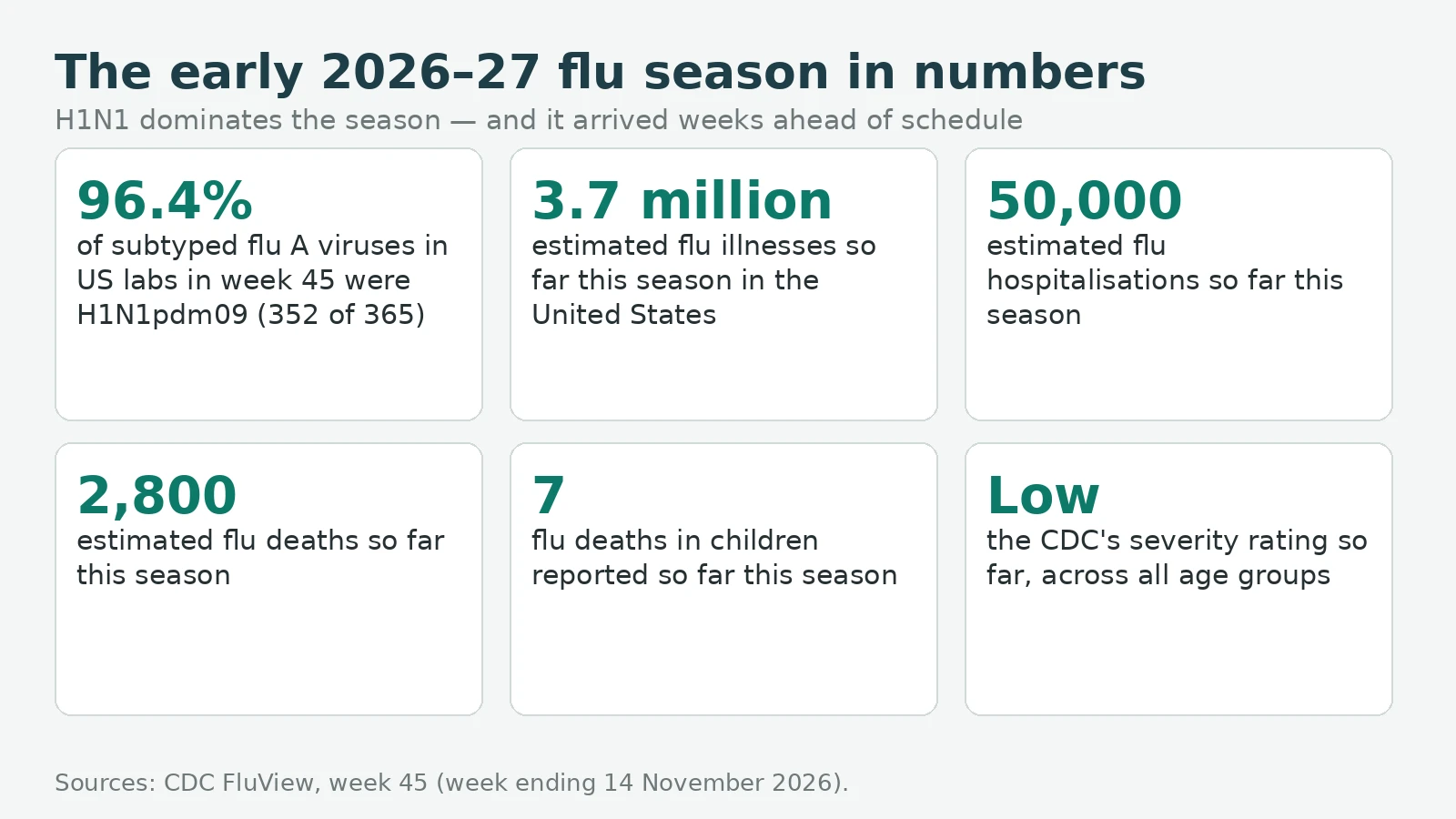
Very widespread, and unusually early. The CDC’s weekly FluView report for the week ending 14 November 2026 found that 96.4% of the influenza A viruses subtyped in US public health laboratories were H1N1pdm09, and nearly all of those belonged to subclade E. Since late May, H1N1 has accounted for 84.8% of reported influenza A viruses. Flu activity is climbing weeks ahead of the usual winter peak, and the CDC estimates the season has already caused at least 3.7 million illnesses, 50,000 hospitalisations and 2,800 deaths in the United States, including seven deaths in children. Its FluSight forecasts expect hospital admissions to keep rising into early December.
Who is most affected by G155E?
The clearest evidence comes from a study by researchers at the Fred Hutchinson Cancer Center in Seattle, posted as a preprint in November 2026 and not yet peer-reviewed. They tested how well blood samples from 355 people, collected between April and August 2026, could neutralise 148 flu strains. For 75 of those samples, G155E more than halved the antibody neutralisation, and the effect was strongest in teenagers and young adults who already had high levels of H1N1 antibodies.
The researchers think this comes down to immune imprinting: the first flu strain you meet shapes your antibody defences for life, and people first exposed to H1N1 around or after the 2009 pandemic — today’s teenagers and young adults — seem most thrown by this particular change. It is important to keep the finding in proportion. The study measured antibodies in a laboratory dish, not real infections, and it did not measure T cells, another arm of immunity that helps prevent severe illness. And so far, CDC surveillance does not show teenagers or young adults being hospitalised at higher rates: hospital admissions remain highest among people aged 65 and over, and the CDC still rates the season’s severity as low across all age groups.
Does this year’s flu vaccine still work?
Probably yes, though the honest answer is that it is too early to be sure. The CDC says it is too early to know whether G155E will affect vaccine effectiveness this season, but almost all the viruses it has characterised so far are antigenically similar to the vaccine’s reference viruses. This season’s vaccine is built around an A/Missouri/11/2025 (H1N1)pdm09-like virus, chosen before the G155E change spread.
Even a vaccine that does not match the circulating strain perfectly still does useful work. In seasons when the vaccine viruses are well matched to the ones spreading, vaccination cuts the risk of a flu-related doctor’s visit by 40–60%, according to the CDC. In the 2024–25 season, vaccination prevented an estimated 10 million illnesses, 180,000 hospitalisations and 12,000 deaths in the United States. And people who catch flu despite being vaccinated tend to have milder illness: among hospitalised adults, vaccinated patients had a 26% lower risk of intensive-care admission and a 31% lower risk of death than unvaccinated patients.
The message from health officials is consistent: get vaccinated now rather than waiting to see how the season develops, because protection takes time to build and the season is already under way.
What are the symptoms, and what should you do?
Flu comes on quickly. The NHS lists a sudden high temperature, an aching body, exhaustion, a dry cough, a sore throat, a headache, difficulty sleeping and loss of appetite. Most healthy people feel much better within about a week, though tiredness can linger. Rest, sleep, plenty of fluids and paracetamol or ibuprofen for fever and aches are the usual advice; antibiotics do not work against flu because it is a virus. Prescription antiviral drugs can treat flu, and the CDC says they should be started as early as possible, especially for people at higher risk of complications — ask a doctor or pharmacist if you think you may need them.
How to protect yourself this winter
- Get this season’s flu vaccine — the CDC recommends annual vaccination for everyone aged 6 months and older.
- Wash your hands often, and cover coughs and sneezes with a tissue or your elbow.
- Stay at home when you are ill, and keep rooms ventilated where you can.
- Keep an eye on older relatives and anyone with a long-term condition, who are most likely to become seriously ill.
When to see a doctor
Get urgent medical advice if you have flu symptoms and you are 65 or over, pregnant, have a long-term medical condition or a weakened immune system, feel very unwell or short of breath, or your symptoms have not improved after seven days. In the UK you can call NHS 111 for urgent advice. Call 999 or go to A&E if you get sudden chest pain, have severe difficulty breathing or start coughing up blood.
In an emergency call 911 (US), 999 (UK) or 112 (EU)
Frequently asked questions
What is the G155E flu mutation?
G155E is a single change in the H1N1 flu virus's haemagglutinin protein, the spike that antibodies latch onto. At position 155, the amino acid glycine is replaced by glutamic acid, in a region called the Sa antigenic site. The change was first spotted in Japan in May 2026 and is now found in most H1N1 viruses circulating in the United States.
Is the mutated H1N1 strain more dangerous?
There is no evidence so far that it makes people sicker. The mutation affects how well antibodies recognise the virus, not how severe the illness is. The CDC still rates this season's severity as low across all age groups, and hospital admissions remain highest among people aged 65 and over. What the change does is help the virus spread more easily among people whose antibodies no longer recognise it well.
Does the 2026 flu vaccine work against G155E?
It is too early to know for certain, but the signs are encouraging. The CDC says almost all the viruses it has characterised this season are antigenically similar to the vaccine's reference viruses, which suggests the vaccine should still recognise the circulating strain. Even when the match is imperfect, vaccination cuts the risk of flu illness by 40–60% in well-matched seasons and reduces the chance of severe illness and hospitalisation.
Who is most at risk from the new H1N1 strain?
Teenagers and young adults look most affected by the G155E change itself. In a preprint study, the mutation more than halved antibody neutralisation in 75 of 355 blood samples, most strongly in teenagers and young adults whose first flu exposure came around or after the 2009 pandemic. But the people most likely to become seriously ill with flu remain older adults, young children, pregnant women and people with long-term conditions.
How can I tell flu from a cold?
Flu usually arrives suddenly, with a high temperature, aching body, exhaustion and a dry cough. Colds tend to build up gradually and stay milder, with a blocked or runny nose and a sore throat as the main symptoms. Flu can also leave you feeling tired for a week or more after the worst has passed. If you are unsure, or you are in a higher-risk group, talk to a doctor or pharmacist.
When should I get the flu vaccine?
As soon as you can. The CDC recommends annual flu vaccination for everyone aged 6 months and older, and the best time is in the autumn before flu starts spreading widely. This season is running early, so waiting carries more risk than usual. If you have not had this season's vaccine yet, it is still worth getting — vaccination is recommended even once flu is circulating.
Sources
- CDC: Weekly US Influenza Surveillance Report, Week 45, ending November 14, 2026 www.cdc.gov
- Kikawa C, et al. Near real-time data on the human neutralizing antibody landscape to influenza virus in summer of 2026 (preprint, bioRxiv) pmc.ncbi.nlm.nih.gov
- CDC: Benefits of Flu Vaccination www.cdc.gov
- NHS: Flu www.nhs.uk
- WHO: Influenza (seasonal) www.who.int
- Medical Daily: Mutated H1N1 Flu Strain Driving Early U.S. Season May Partly Dodge Antibodies of Some Teens and Young Adults www.medicaldaily.com

Try the tool
Not sure if it can wait?
Common causes and warning signs for 16 everyday symptoms.
Open the symptom guide