What Is Lymphatic Drainage Massage? Benefits and Evidence
Lymphatic drainage massage is one of the most-searched health topics of the month — but what does it actually do? The evidence for swelling is real and modest, while the detox and weight-loss claims fall short.
- Written by
- Health Daily Advice
- Published
- Reading time
- 5 minutes
- Sources
- 8 cited
In this guide
Lymphatic drainage massage is a very gentle massage that moves fluid through the lymphatic system toward the lymph nodes. It is mainly used for lymphoedema, especially after breast cancer surgery. The evidence is modest: it adds a small extra reduction in arm swelling on top of compression, but detox, weight-loss and “immune-boosting” claims are not backed by trials.
What is lymphatic drainage massage?
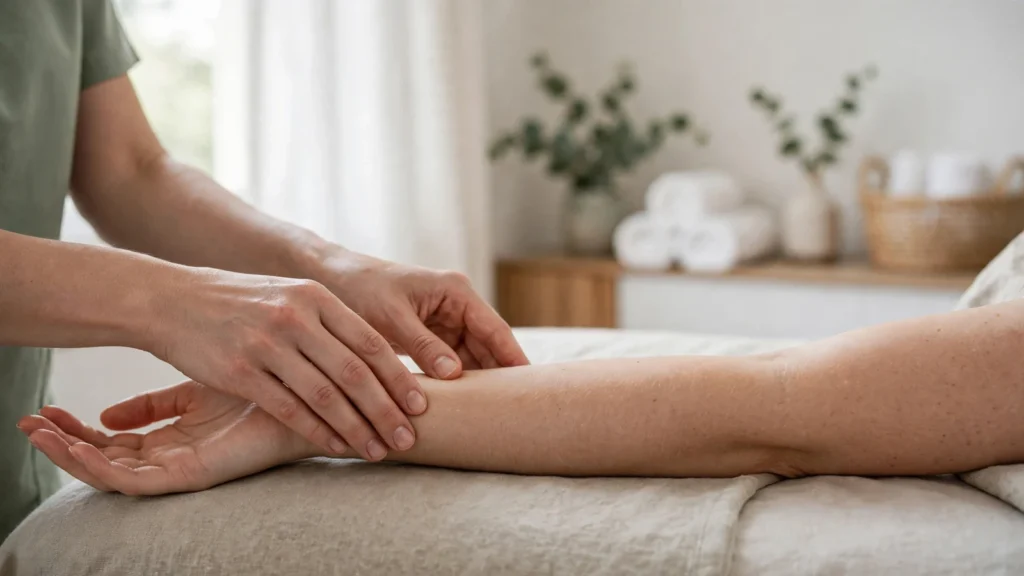
Manual lymphatic drainage (MLD) is a specialised, gentle form of massage used to relieve swelling caused by a build-up of lymph fluid. The therapist uses very light, slow, rhythmic skin movements — not the deep pressure of a regular massage — first to clear the area the fluid will drain into, then to move fluid from the swollen area toward healthy lymph nodes. There are several named methods, including Vodder, Földi and Casley-Smith.
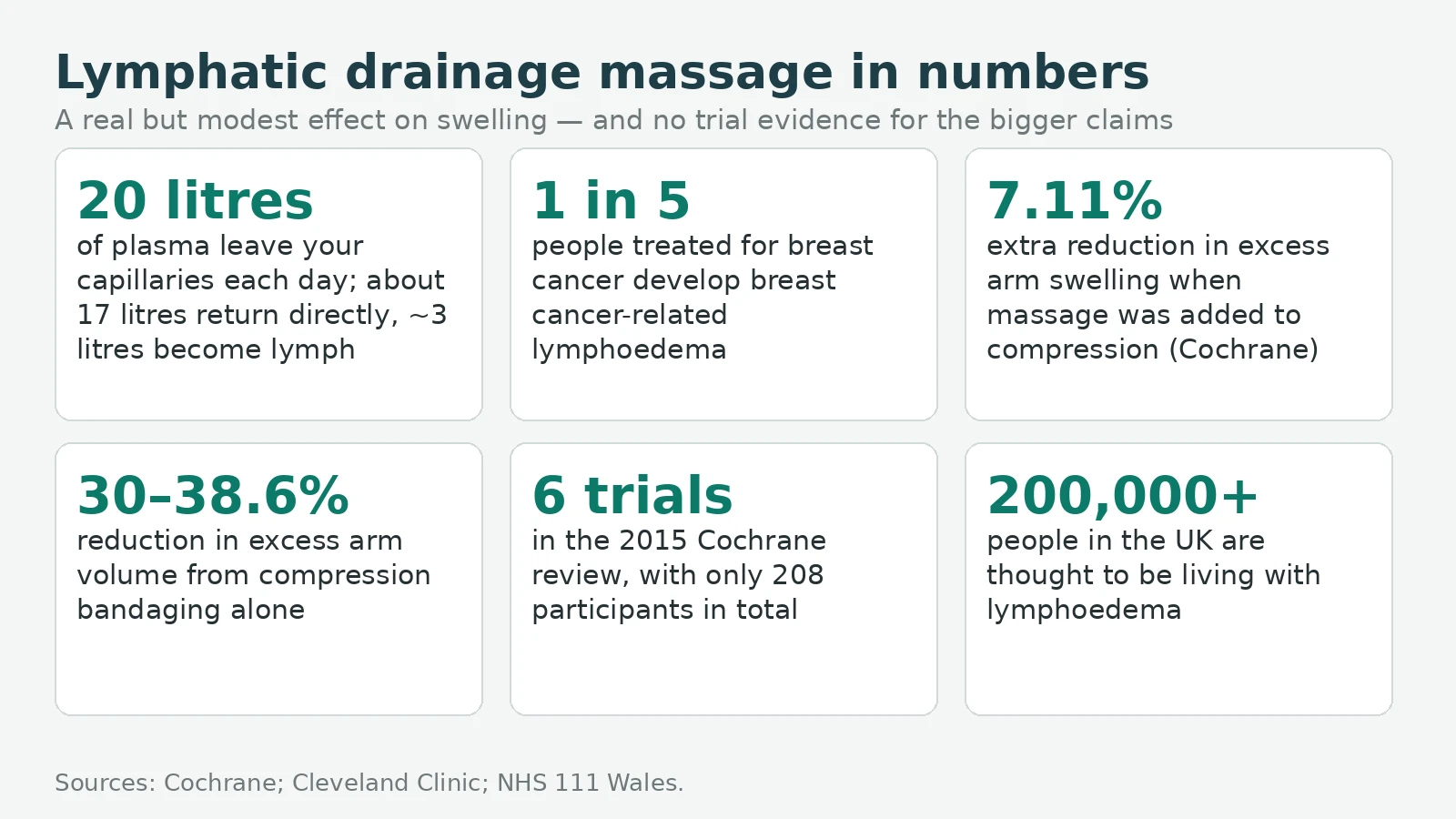
To understand it, it helps to know how the lymphatic system works. It is a network of vessels, nodes and organs that returns fluid to the bloodstream and helps protect the body from infection. Every day about 20 litres of plasma flow out of the smallest blood vessels; about 17 litres return directly to the bloodstream, and the remaining 3 litres are collected by lymphatic vessels as lymph. Unlike blood, lymph has no central pump like the heart — it is moved by the squeezing of surrounding muscles, breathing and one-way valves. The body has about 500 to 600 lymph nodes, commonly near the groin, armpits, neck, chest and abdomen.
When the system does not work properly, lymph fluid builds up and causes long-term swelling called lymphoedema, usually in the arms or legs. Healthcare providers mainly use MLD to relieve lymphoedema after breast cancer surgery, because surgeons remove several lymph nodes during the procedure. More than 1 in 5 people treated for breast cancer develop breast cancer-related lymphoedema, according to the Cochrane review. Lymphoedema is thought to affect more than 200,000 people in the UK.
What the evidence actually shows
The best evidence comes from a 2015 Cochrane review of 6 small trials with 208 participants in total. It found that intensive compression bandaging alone cut excess arm volume by 30% to 38.6%, and adding MLD cut it by a further 7.11% — a modest extra benefit, based on just 2 trials with 83 participants, and mainly in mild-to-moderate lymphoedema. MLD was safe and well tolerated in all the trials, but the review found the evidence on movement and quality of life inconclusive. Interestingly, 60% to 80% of participants reported feeling less pain and heaviness whichever treatment they received.
Outside breast cancer, the evidence is thinner. A 2009 systematic review found the best support was for reduced swelling after an acute ankle sprain and a wrist fracture, but noted there was “limited high-ranking evidence”. And after knee replacement, a 2024 meta-analysis of 7 trials with 285 patients found no significant difference in knee bending, leg circumference or pain — its authors concluded that manual lymphatic drainage is not recommended for rehabilitation after total knee replacement.
What it can and cannot do
Cleveland Clinic lists several possible benefits of lymphatic drainage massage, including immune system support, reduced fluid retention, relief from neuropathy, stress management and glowing skin when done as a cosmetic procedure. But these are listed as possibilities, not proven effects — the trials that exist measured swelling, pain and range of movement, not these outcomes.
That gap matters, because the loudest claims around lymphatic drainage are the least supported. No trial shows that it removes toxins, burns fat, reshapes a healthy face or boosts the immune system. Most bloating is gas in the gut, not trapped lymph. And if you do not have lymphoedema, Cleveland Clinic says you may not see meaningful results at all — though the massage is not dangerous in most cases.
What is supported is narrower: a modest extra reduction in arm swelling in breast cancer-related lymphoedema when MLD is added to compression, and limited, small-trial support for swelling after an ankle sprain or wrist fracture. MLD is usually given alongside compression garments or bandaging to keep swelling down, and it is particularly useful where compression is hard to use, such as the head and neck. NICE describes it as something that “may also be helpful” for some people as part of decongestive lymphatic therapy — compression, skin care and exercise. If several sessions bring no noticeable improvement, ask your healthcare provider about other options.
What happens in a session
You usually lie down — sitting up if the lymphoedema is in the head or neck — and the therapist uses gentle pressure and slow, regular movements, starting with the unaffected lymph nodes to free up space for fluid to drain into. Breathing exercises are often done before and after. Afterwards the area may be bandaged, or you wear a compression garment. The number of treatments varies from person to person.
There is also a self-massage version, called simple lymphatic drainage (SLD), which you can continue long term. Learn the techniques from a lymphoedema specialist before starting: you are usually taught to massage only the areas where you do not have lymphoedema, to free up space for fluid to drain into — you do not massage the swollen area itself. A typical routine is twice a day for about 20 minutes, using only light pressure as taught, with no oils or creams, after some deep breathing. If your skin is red when you finish, the movement is too much.
Who should avoid it
For many people lymphatic drainage massage is safe, but you should avoid it if you have blood clots, deep vein thrombosis, cellulitis, fever, heart disease, an infection, kidney failure or a stroke. Therapists will not do lymph drainage massage directly over cancerous tissue or skin damaged by radiotherapy. You also should not have it if there is an infection or inflammation in the swollen area, cancer in the area, or a blockage in the vein that carries blood back to the heart. Few people have negative reactions, but some develop fatigue, headaches or nausea — tell your healthcare provider if that happens.
When to see a doctor
See a GP or call NHS 111 if you have swelling in one ankle, foot or leg and do not know what is causing it, swelling that is severe, painful or starts very suddenly, swelling in other areas such as the face or tummy, a swollen area that is red or feels hot, or a very high temperature. Swelling can be a warning sign: one swollen, painful, red or hot leg needs same-day advice.
Call 999 if swelling comes with feeling short of breath or struggling to breathe, a chest that feels tight, heavy or painful, coughing up blood, a more noticeable heartbeat, or feeling lightheaded, faint, confused, sick or clammy — you could have a blood clot in the lungs, which needs immediate treatment in hospital. Do not drive yourself to A&E.
Sudden swelling of the face, hands or feet in pregnancy may be a sign of pre-eclampsia — tell your midwife straight away. Pre-eclampsia affects around 2 to 8 in every 100 pregnant women.
In an emergency call 911 (US), 999 (UK) or 112 (EU).
Frequently asked questions
Does lymphatic drainage massage work?
It helps a little, for one specific problem. A 2015 Cochrane review of 6 small trials found that adding lymphatic drainage to compression bandaging cut excess arm swelling in breast cancer-related lymphoedema by a further 7.11%. But the trials were small, the extra benefit was modest, and there is no good evidence for detox, weight loss or immune-boosting claims.
What is lymphatic drainage massage good for?
It is mainly used for lymphoedema — long-term swelling when the lymphatic system does not work properly — especially after breast cancer surgery, when lymph nodes have been removed. It is also used for swelling after some injuries, though the evidence there is limited. It is usually given alongside compression garments or bandaging, not on its own.
Can lymphatic drainage massage help you lose weight?
There is no evidence for that. No trial shows lymphatic drainage massage burns fat or removes toxins, and no reputable source opened for this article cites trial evidence for weight loss. Most bloating is gas in the gut, not trapped lymph. If you do not have lymphoedema, Cleveland Clinic says you may not see meaningful results at all.
Is lymphatic drainage massage safe?
For most people, yes — it was safe and well tolerated in every trial in the Cochrane review. But avoid it if you have blood clots, deep vein thrombosis, cellulitis, fever, heart disease, an infection, kidney failure or a stroke, and never have it over cancerous tissue or skin damaged by radiotherapy. Some people feel tired or get a headache or nausea afterwards.
Can I do lymphatic drainage massage on myself?
Yes — a simpler version called simple lymphatic drainage (SLD) is self-massage you can continue long term. Learn the techniques from a lymphoedema specialist first: you massage only the areas where you do not have lymphoedema, to free up space for fluid to drain into. A typical routine is twice a day for about 20 minutes, using only light pressure, with no oils or creams.
How is it different from a normal massage?
Pressure and purpose. A regular massage works deep into muscle with firm pressure, while lymphatic drainage uses very light, slow, rhythmic movements on the skin to shift fluid toward the lymph nodes. It is done only by a trained lymphatic drainage therapist, and no other type of massage should be done on an area with lymphoedema.
Sources
- Cleveland Clinic: Lymphatic drainage massage my.clevelandclinic.org
- Cochrane: Manual lymphatic drainage for lymphedema following breast cancer treatment www.cochrane.org
- Macmillan: Lymphatic drainage for lymphoedema www.macmillan.org.uk
- Cancer Research UK: Massage (manual lymphatic drainage) www.cancerresearchuk.org
- NHS 111 Wales: Lymphoedema 111.wales.nhs.uk
- OpenStax: Anatomy of the lymphatic and immune systems openstax.org
- Vairo et al. 2009 systematic review (lymphatic drainage, sports injuries) pmc.ncbi.nlm.nih.gov
- Lu et al. 2024 meta-analysis (lymphatic drainage after knee replacement) pubmed.ncbi.nlm.nih.gov

Try the tool
Not sure if it can wait?
Common causes and warning signs for 16 everyday symptoms.
Open the symptom guide