Flu Vaccine After a Heart Attack: What the New Study Found
A Swedish study of 12,711 heart attack patients found those given a flu jab in hospital were about half as likely to die within a year — yet only 6% of eligible patients received one.
- Written by
- Health Daily Advice
- Published
- Reading time
- 6 minutes
- Sources
- 7 cited

In this guide
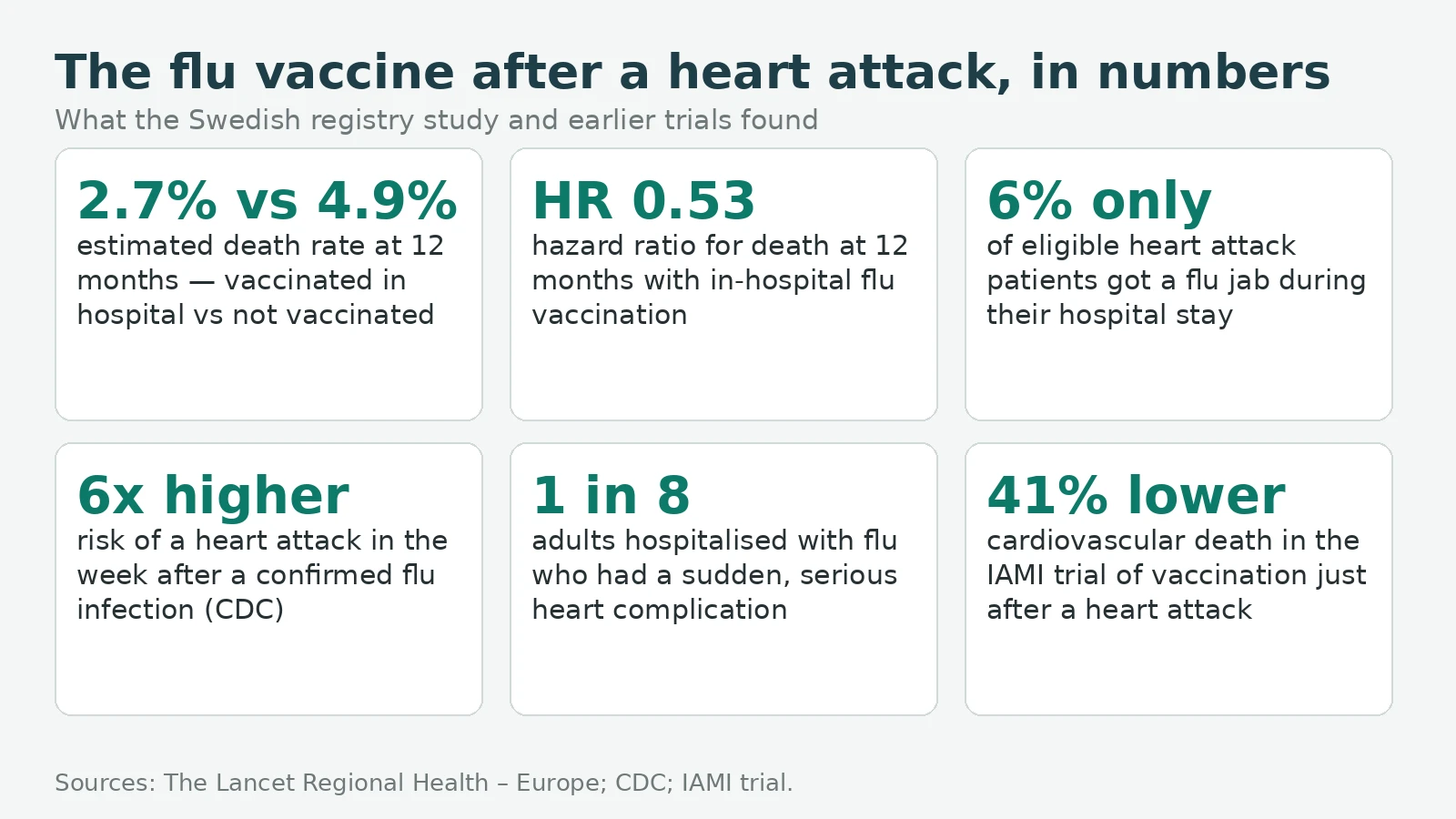
People given a flu jab while in hospital after a heart attack were less likely to die in the following year, a new Swedish study of 12,711 patients found: the death rate at 12 months was 2.7% in those vaccinated, against 4.9% in those who were not. Yet only 6% of eligible patients received the jab in hospital.
It is a striking result for such an ordinary intervention. The flu vaccine is not a heart drug, and a single jab in a hospital ward does not look like the kind of thing that changes survival. But flu infection is a powerful stress on the heart, and the evidence that vaccinating against it protects the heart has been building for years. This new study, published in The Lancet Regional Health – Europe, is the latest and largest real-world test of the idea — and it also shows how rarely hospitals are actually doing it.
What the new study found
Researchers led by a team from Örebro University in Sweden analysed nationwide data from the Swedish SWEDEHEART heart registry, covering patients hospitalised with a heart attack (myocardial infarction) during four flu seasons, from 2021–22 to 2024–25. The study was published on 20 November 2026.
Of the 12,711 eligible patients, only 760 — 6.0% — received a flu vaccine during their hospital stay. The other 11,951 did not. To make the comparison fair, the researchers matched 723 vaccinated patients with 723 unvaccinated patients of similar age, health and heart history, then followed both groups for a year.
The difference was clear. Over 12 months, 18 vaccinated patients (2.5%) died, compared with 33 unvaccinated patients (4.6%). After adjusting for the matching, the estimated 12-month death rate was 2.7% in the vaccinated group and 4.9% in the unvaccinated group — a hazard ratio of 0.53, meaning the risk of death was roughly half. There was no significant difference in readmissions for a further heart attack, repeat stenting procedures, or major adverse cardiac events as a combined measure.
The authors are careful about what the study can and cannot prove. It was observational, not a randomised trial, so patients who accepted the vaccine may have differed from those who did not — in frailty, income, or other health habits. Some vaccinations given outside the hospital system may not have been recorded. And the researchers had no data on causes of death, so they could not say whether the lower death rate was driven by fewer heart deaths. Even so, the result lines up closely with earlier randomised trials, which strengthens it.
Why flu is hard on the heart
Flu is usually thought of as a chest infection, but it is an inflammatory illness that affects the whole body, and the heart feels it. Fever, a racing pulse and low oxygen put extra strain on the heart muscle, while inflammation can make fatty deposits inside the arteries more likely to rupture — and a rupture is what causes most heart attacks.
The numbers are stark. A 2018 study found that the risk of having a heart attack was six times higher in the week after a confirmed flu infection. A 2020 study of more than 80,000 adults hospitalised with flu in the United States found that sudden, serious heart complications occurred in about one in eight of them — roughly 12%. The CDC notes that about half of adults hospitalised with flu have heart disease, and that flu vaccination has been linked with lower rates of some cardiac events in people with heart disease, especially those who have had a cardiac event in the past year.
That is the logic behind vaccinating in hospital, right after a heart attack: the patient is at their most vulnerable, the vaccine is already in the building, and the protection covers the flu season ahead. European and American guidelines already give flu vaccination after acute coronary syndromes their strongest recommendation. The Swedish study shows the recommendation is mostly not being followed.
What earlier trials showed
The new study does not stand alone. The IAMI trial, a randomised, double-blind trial, gave flu vaccination to patients within 72 hours of being hospitalised for a heart attack or high-risk coronary disease. Over 12 months, those vaccinated had a 28% lower risk of major cardiovascular events and a 41% lower risk of cardiovascular death than those given a placebo.
Pooling the evidence strengthens the picture further. An analysis of eight randomised trials covering 14,420 patients found the vaccine was linked to a 25% lower risk of major cardiovascular events. And a 2026 systematic review and meta-analysis reported that, among patients with ischaemic heart disease and heart failure, flu vaccination was associated with a lower risk of heart attack and of death from cardiovascular disease. The Swedish registry study adds the missing piece: the same pattern shows up in ordinary hospital care, not just in the controlled conditions of a trial.
None of this means the flu vaccine prevents heart attacks on its own. What the evidence supports is that catching flu makes heart problems more likely, and that avoiding flu — or softening its blow — removes one trigger at a time when the heart is already damaged.
Why so few patients got the jab
Only 6% of eligible patients were vaccinated in hospital, even though the vaccine was available and the guidelines recommend it. The researchers suggest a few reasons: patients may underestimate the value of something as routine as a flu jab when they are focused on their heart, and hospital teams may not have a system that offers it as part of discharge care. As the authors put it, adherence remained “strikingly low”.
It is a familiar gap. The CDC estimates that only about half of Americans get a flu vaccine each year, despite evidence that vaccination prevented around 10 million flu illnesses, 180,000 hospitalisations and 12,000 deaths in the 2024–25 season alone. The Swedish study’s authors argue that hospitals should treat the flu jab as part of standard care after a heart attack, given at the bedside before discharge, rather than something patients are expected to arrange themselves later.
Who should get a flu vaccine, and when
Flu vaccination is recommended every year for people at higher risk of serious illness, and heart disease is one of the conditions that qualifies. In the UK, the NHS offers a free flu vaccine to people aged 65 and over, adults aged 18 to 64 with certain long-term health conditions — including heart disease — pregnant women, care-home residents, carers, and people living with someone whose immune system is weakened. In the United States, the CDC recommends a flu vaccine for everyone aged 6 months and older, every flu season.
It is best to have the vaccine in the autumn or early winter, before flu starts circulating widely, but it is still worth having later in the season while flu is around. Protection takes around two weeks to develop. People with heart disease should generally not have the nasal spray vaccine, and should ask their doctor or pharmacist which vaccine suits them. If you have heart disease and develop flu symptoms, call your doctor straight away — the CDC recommends prompt antiviral treatment for people with heart disease who have confirmed or suspected flu.
If you or someone close to you is in hospital after a heart attack during flu season, it is worth asking the ward team whether a flu jab can be given before discharge. It takes minutes, it is already recommended in the guidelines, and the new evidence suggests it is one of the simplest things that can be done to improve the year that follows.
When to see a doctor
If you have heart disease, or you have recently had a heart attack, and you develop flu symptoms — fever, cough, sore throat, muscle aches, or feeling very tired — contact your doctor the same day rather than waiting to see how it goes. Antiviral treatment works best when it starts early, and your doctor may also want to check your heart. Do not stop taking your regular heart medicines without talking to a doctor first.
Get emergency help immediately if you notice chest pain or pressure, breathlessness, sudden weakness or numbness, or difficulty speaking. In an emergency call 911 (US), 999 (UK) or 112 (EU).
Frequently asked questions
Should you get a flu vaccine after a heart attack?
Yes, if your doctor advises it. Flu infection raises the risk of a further heart attack, and a large Swedish study found that patients vaccinated in hospital after a heart attack were about half as likely to die within a year. European and American guidelines already give flu vaccination after a heart attack their strongest recommendation. Ask the ward team about a jab before you are discharged.
How much does a flu jab lower the risk of death after a heart attack?
In the Swedish registry study, the estimated death rate at 12 months was 2.7% among patients vaccinated in hospital, compared with 4.9% among those who were not — a hazard ratio of 0.53. The earlier IAMI randomised trial found a 41% lower risk of cardiovascular death. The studies show an association, not proof of cause, but the results point in the same direction.
Why is flu dangerous for people with heart disease?
Flu is an inflammatory illness that strains the whole body: fever, a racing pulse and low oxygen put extra work on the heart, while inflammation can make fatty deposits in the arteries more likely to rupture. A 2018 study found the risk of a heart attack was six times higher in the week after a confirmed flu infection. About half of adults hospitalised with flu have heart disease.
When is the best time to get a flu vaccine?
Ideally in the autumn or early winter, before flu starts circulating widely, but it is still worth having later in the season while flu is around. Protection takes around two weeks to develop, and the vaccine is needed every year because flu viruses change. In the UK the free NHS flu vaccine is available until 31 March 2027 for eligible groups.
Can the flu vaccine itself cause a heart attack?
There is no evidence that it can. Flu vaccines have a long, established safety record in people with heart disease, and studies support their safety in these groups, according to the CDC. The vaccine cannot give you flu. People with heart disease should generally avoid the nasal spray vaccine and ask their doctor or pharmacist which vaccine suits them.
Sources
- The Lancet Regional Health – Europe: Influenza vaccination during hospitalization for myocardial infarction and 12-month all-cause mortality www.thelancet.com
- CIDRAP: In-hospital flu shots linked to lower 1-year death rate after heart attack www.cidrap.umn.edu
- CDC: Flu and People with Heart Disease or History of Stroke www.cdc.gov
- CDC: Benefits of Flu Vaccination www.cdc.gov
- NHS: Winter vaccinations and winter health www.nhs.uk

Try the tool
Not sure if it can wait?
Common causes and warning signs for 16 everyday symptoms.
Open the symptom guide