What Is the PJ.2.1 COVID Variant? What We Know So Far
The WHO placed the new PJ.2.1 COVID variant under monitoring in November 2026. Here is what it is, where it is spreading, its symptoms and whether vaccines still work.
- Written by
- Health Daily Advice
- Published
- Reading time
- 6 minutes
- Sources
- 6 cited
In this guide
PJ.2.1 is a new descendant of the JN.1 Omicron family that the World Health Organization placed under monitoring on 19 November 2026. It carries 24 changes in its spike protein and is spreading in the Americas, but the WHO rates its extra global risk as low, and current vaccines still neutralise it in laboratory tests.
What is the PJ.2.1 COVID variant?
PJ.2.1 is a lineage of SARS-CoV-2, the virus that causes COVID-19. It descends from JN.1, the Omicron family that has dominated circulation for the past two years, and evolved from an earlier lineage called MC.10.1.7. The earliest available sample dates to 25 May 2026, and the variant was first identified in Ontario, Canada, that same month. The first reported detection in the United States came from a patient in New York City on 30 June 2026.
What drew scientists’ attention is how suddenly it changed. The WHO describes PJ.2.1 as a highly mutated variant, with 24 amino acid differences in its spike protein alone compared with its parent lineage, and says it emerged through what researchers call a saltation event — a sudden burst of mutations rather than a slow accumulation. The spike protein is the part of the virus that latches onto human cells, and laboratory work shows PJ.2.1 binds strongly to the ACE2 receptor, the doorway the virus uses to enter cells. The WHO is careful to add that stronger binding “may contribute to the observed growth, but do not directly establish increased transmissibility in humans.”
How far has PJ.2.1 spread?
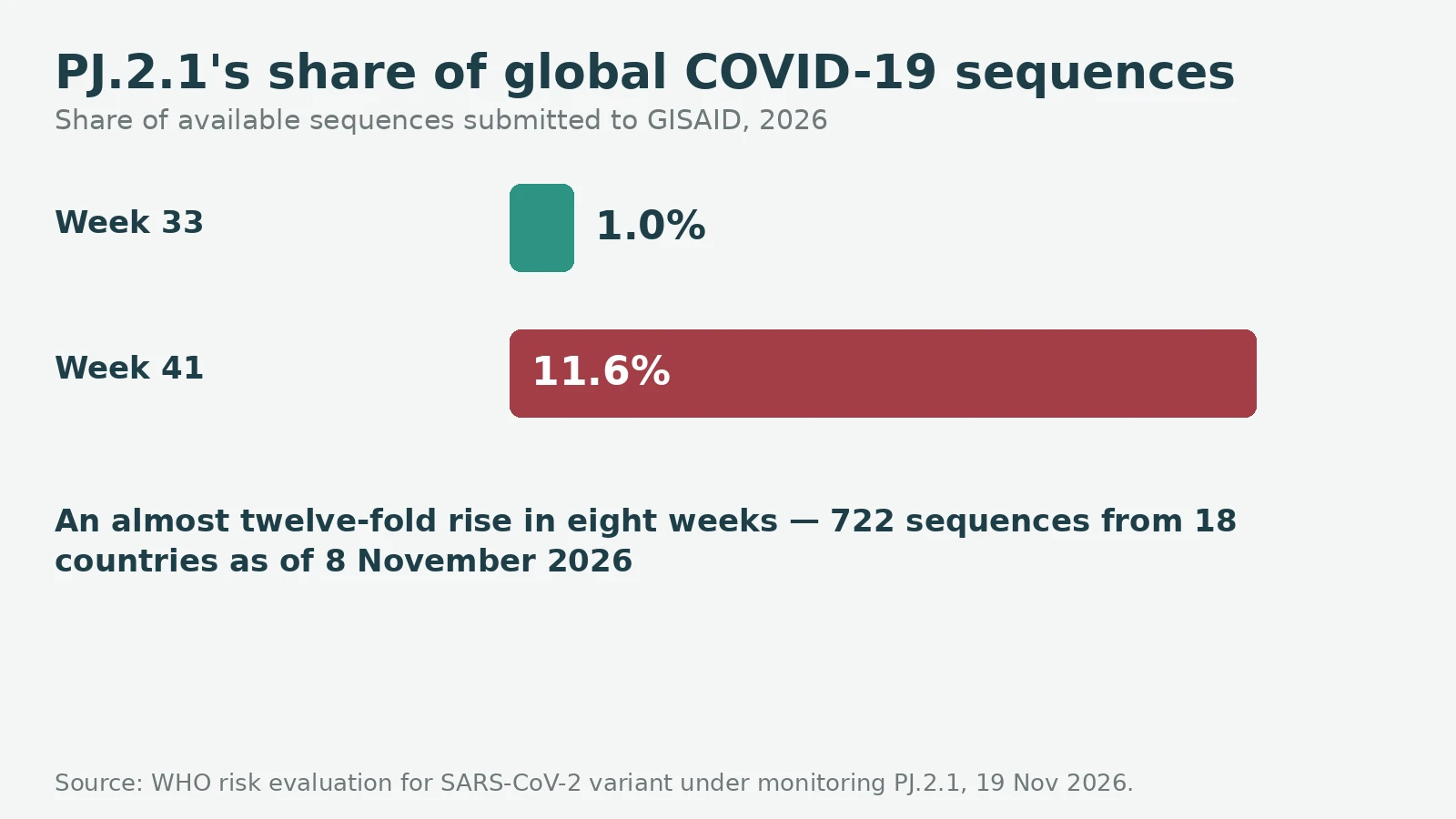
The variant’s share of sequenced COVID-19 viruses has climbed steadily. According to the WHO’s risk evaluation, PJ.2.1 accounted for 1% of available global sequences in epidemiological week 33 and 11.6% by week 41. As of 8 November 2026, 722 sequences had been submitted to GISAID, the open-access database scientists use to track variants, from 18 countries. Growth has been fastest in the Americas, particularly Canada, where it made up 25.7% of sequences, and the United States, at 13.8%.
The spread has continued since that count. Argentina’s national surveillance bulletin reported on 20 November that three samples taken between 6 and 11 November in Buenos Aires province were PJ.2.1. The Pan American Health Organization noted on 24 November that the lineage is increasing in Brazil, Canada and the United States, and urged countries to keep collecting representative samples for sequencing.
What are the symptoms of PJ.2.1?
There is no symptom list specific to PJ.2.1 yet, because no study has compared its symptoms with those of other variants. Doctors expect it to look like COVID-19 generally. The WHO says the most common symptoms reported for currently circulating variants are fever, chills and a sore throat. The NHS lists a high temperature, a new continuous cough, a loss or change to your sense of smell or taste, shortness of breath, feeling tired or exhausted, an aching body, a headache, a sore throat, a blocked or runny nose, loss of appetite, diarrhoea and feeling sick.
Symptoms usually begin 3 to 6 days after exposure and last up to 10 days, according to the WHO, although some people feel unwell for longer. Around 6% of people develop post COVID-19 condition, often called long COVID, with lasting symptoms such as fatigue, muscle and joint aches, breathlessness, headaches and difficulty thinking or concentrating. If you have respiratory symptoms, the NHS advises staying at home and avoiding contact with other people while you have a high temperature or do not feel well enough for your normal activities.
Do current COVID vaccines work against PJ.2.1?
The laboratory evidence so far is reassuring. The WHO found limited additional antibody escape for PJ.2.1 compared with the contemporary variants tested, and blood samples from people who received LP.8.1- and XFG-adapted vaccines were able to neutralise the variant in laboratory tests. In one study of 36 recipients of an LP.8.1-adapted vaccine, there was no greater antibody evasion against PJ.2.1 than against most variants tested. In another study of 22 participants, neutralisation levels against PJ.2.1 rose 2.8-fold, from 228 before vaccination to 642, a median of 14 days after an XFG-adapted mRNA vaccine.
That is not the same as proof of real-world protection. As the WHO notes, laboratory neutralisation does not establish how well a vaccine prevents infection or severe disease in everyday life, and the agency has called for further studies of vaccine effectiveness, hospitalisations and antiviral susceptibility. Even so, vaccination remains the main protection against severe illness: the WHO says COVID-19 vaccines continue to provide strong protection against severe disease and death, and recommends a single dose for people who have not yet been vaccinated, with revaccination 6 to 12 months later for high-priority groups such as older adults, people with weakened immune systems and health workers.
Is PJ.2.1 more severe or more contagious?
On the evidence available, there is no sign that it is. The WHO states that there is currently no evidence of greater disease severity associated with PJ.2.1, although comparative clinical data remain limited. The Pan American Health Organization reached the same conclusion on 24 November: despite the large number of mutations linked to stronger ACE2 binding, “there is currently no evidence demonstrating increased transmissibility in humans or increased disease severity.”
That is why the WHO’s overall judgement is calm. It evaluates the additional global public health risk posed by PJ.2.1 as low, but with low confidence, and rates its growth advantage as moderate. The variant is a “variant under monitoring”, not a variant of interest or a variant of concern — the higher categories the WHO reserves for lineages with proven changes in transmissibility, severity or immune escape. COVID-19 recommendations remain unchanged.
What does “variant under monitoring” mean?
When the WHO designates a lineage a variant under monitoring, it means the lineage has genetic features or epidemiological signals that merit closer observation. It is the first step on the WHO’s variant ladder. If further evidence shows the variant spreads more easily, causes more severe illness or evades immunity, it can be upgraded to a variant of interest and then a variant of concern. Most monitored lineages never climb that ladder; they fade as newer variants take over.
The designation also triggers practical work. The WHO and PAHO have asked countries to keep sequencing a representative sample of COVID-19 cases, to compare hospitalisation and severe disease outcomes, and to test how well vaccines and antiviral treatments hold up against the variant. That surveillance is what turns an early warning into a clear answer over the following weeks.
What to do if you have COVID symptoms
The advice has not changed for PJ.2.1. If you have symptoms and a high temperature, or you do not feel well enough to work or do normal activities, try to stay at home and avoid contact with other people until you feel better or no longer have a high temperature. The NHS says adults who test positive should try to stay at home for 5 days after the day of the test, and avoid meeting people who are more likely to become seriously ill, such as people with a weakened immune system, for 10 days.
Rest, drink plenty of water and take paracetamol or ibuprofen if you feel uncomfortable, the NHS advises. Older adults, people with weakened immune systems and those with long-term conditions such as diabetes, heart or lung disease, obesity or cancer should seek medical advice early if they develop symptoms, as should anyone who is pregnant. Keep rooms ventilated, cover coughs and sneezes, and wash your hands often. For scale, nearly 780 million COVID-19 cases and more than 7.1 million deaths have been reported worldwide since December 2019, according to the WHO, and nearly 1.2 million people had died of COVID-19 in the United States by June 2024, according to the CDC.
When to see a doctor
Ask for an urgent GP appointment or contact NHS 111 if your symptoms are getting worse or are not getting better, you have a high temperature that lasts 5 days or more or does not come down with paracetamol, or you are worried and not sure what to do. It is particularly important to get help if you are pregnant, aged 60 or over, or have a weakened immune system.
Call 999 or go to A&E if you or your child are so breathless you cannot say short sentences while resting, have sudden chest pain, cough up blood, collapse, faint, or have a seizure for the first time. In an emergency call 911 (US), 999 (UK) or 112 (EU).
Frequently asked questions
Is PJ.2.1 more dangerous than other COVID variants?
There is no evidence of that so far. The WHO says there is currently no evidence of greater disease severity linked to PJ.2.1, although comparative clinical data remain limited. The Pan American Health Organization agrees there is no evidence of increased transmissibility or severity. The WHO rates the extra global risk as low, with low confidence, and is keeping the variant under close observation.
How do I know if I have PJ.2.1?
You cannot tell from symptoms alone, because PJ.2.1 is expected to cause the same illness as other COVID-19 variants: fever, chills, sore throat, cough, tiredness and aching muscles. Only genomic sequencing of a test sample can identify the variant, and that is done in laboratories for surveillance, not for individual patients. If you have symptoms, follow the usual COVID advice and rest at home.
Do COVID vaccines protect against PJ.2.1?
Laboratory tests suggest they should still help. Blood from people given LP.8.1- and XFG-adapted vaccines neutralised PJ.2.1 in the lab, and one study found no greater antibody evasion than against most other variants. But lab results are not proof of real-world protection, and the WHO has called for studies of actual vaccine effectiveness. Staying up to date with vaccination remains the best protection against severe illness.
Where has PJ.2.1 been detected?
As of 8 November 2026, 722 sequences had been reported from 18 countries, with growth fastest in the Americas. It made up 25.7% of sequenced viruses in Canada and 13.8% in the United States. Argentina confirmed three cases in Buenos Aires province on 20 November. The WHO says the variant is increasing in Brazil, Canada and the United States, and more countries are likely to report it as sequencing continues.
Should I be worried about PJ.2.1?
There is no need to panic, but it is worth staying alert. The WHO rates the additional global risk as low, and current vaccines still neutralise the variant in laboratory tests. Older adults, people with weakened immune systems and those with long-term health conditions should take particular care. The usual precautions still apply: stay home when ill, ventilate rooms, wash hands often and seek advice early if symptoms worsen.
Sources
- WHO: Risk Evaluation for SARS-CoV-2 Variant Under Monitoring: PJ.2.1, 19 Nov 2026 www.who.int
- PAHO/WHO: Update on the emergence of SARS-CoV-2 sublineages, 24 Nov 2026 www.paho.org
- HealthandMe: PJ.2.1 Is Now Variant Under Monitoring After Detection In 18 Countries, 20 Nov 2026 www.healthandme.com
- NHS: COVID-19 symptoms and what to do www.nhs.uk
- WHO: Coronavirus disease (COVID-19) fact sheet www.who.int
- CDC: About COVID-19 www.cdc.gov

Try the tool
Not sure if it can wait?
Common causes and warning signs for 16 everyday symptoms.
Open the symptom guide