High Blood Sugar and Memory Loss: What a 30-Year Study Found
Blood sugar that creeps up slowly from your twenties may quietly affect your memory decades later. A 30-year study of 2,808 adults found the link held even in people who never developed diabetes.
- Written by
- Health Daily Advice
- Published
- Reading time
- 6 minutes
- Sources
- 7 cited

In this guide
A 30-year study of 2,808 young adults found that blood sugar creeping upwards from the late teens and twenties was linked to poorer memory, processing speed and thinking skills by the mid-50s — even in people who never developed type 2 diabetes. The finding suggests that keeping blood sugar steady from early adulthood may help protect the brain.
What the 30-year study found
Researchers from the University of São Paulo and the University of California, San Francisco followed 2,808 adults in the CARDIA study, who enrolled aged 18 to 30 in four US cities in 1985–1986. Their fasting blood sugar was measured repeatedly over 30 years, and their memory, processing speed, executive function and verbal fluency were tested at the 30-year mark, when the average age was about 55.
The team, led by Dr Regina Paradela, found three patterns of blood sugar change. Most people’s levels stayed fairly steady, but one group — about 1 in 18 of those who never developed diabetes — saw their fasting blood sugar climb steadily from around 85 mg/dL into the prediabetic range of 110–115 mg/dL. That group scored worse than the steady group on tests of memory, processing speed, executive function and overall thinking, even after the researchers adjusted for age, education, lifestyle and other health factors.
“The fact that increasing glucose levels were associated with poorer cognitive performance, even among people who had not developed Type 2 diabetes during the 30-year study, is very important,” said Dr Paradela. “This suggests that changes in glucose metabolism may be relevant to brain health earlier in adulthood than we typically think about.” The study was published on 25 November 2026 in the Journal of the American Heart Association.
Three blood sugar patterns, one clear gap
Among the 2,463 participants who did not develop type 2 diabetes, the researchers identified three fasting blood sugar trajectories over 30 years. The 345 people who did develop diabetes during the study were analysed separately — and they, too, scored worse on the thinking tests.
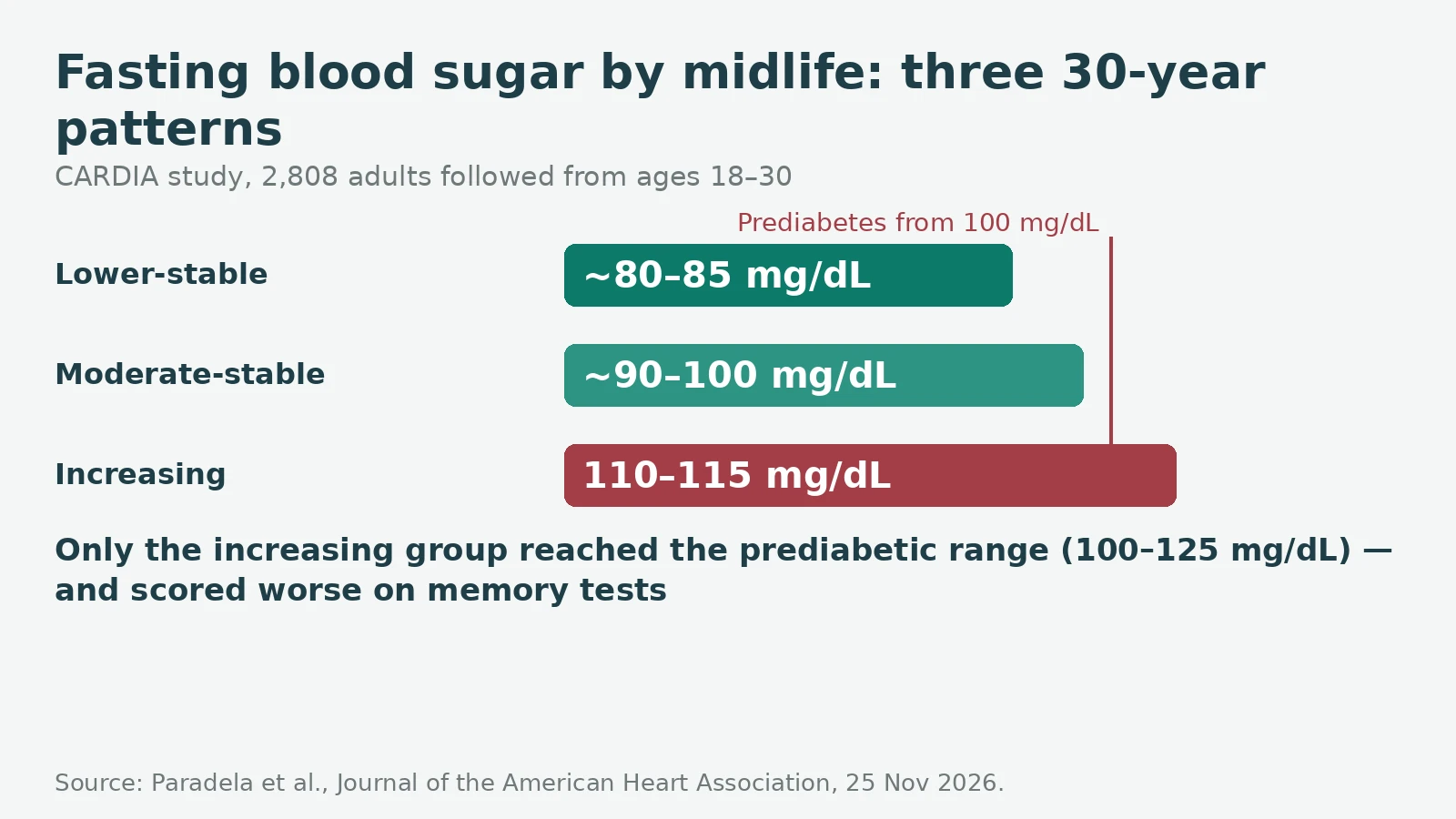
The increasing group was small — 138 people, or 5.6% of those who stayed free of diabetes — but the gap in their test scores was clear enough to show up after adjusting for other factors. A further finding came from brain scans: the 605 participants who had MRI scans showed that those who developed type 2 diabetes had less total and parietal grey matter and more abnormal white matter tissue than the steady group. The American Heart Association notes that these kinds of changes have been linked to lower thinking skills in other studies.
What counts as high blood sugar?
Fasting blood sugar is measured after not eating overnight, usually first thing in the morning. The thresholds differ slightly between the US and the UK, because the US uses mg/dL and the UK uses mmol/L for blood sugar and mmol/mol for HbA1c (a longer-term average).
| Result | US fasting blood sugar | UK HbA1c |
|---|---|---|
| Normal | Below 100 mg/dL | Below 42 mmol/mol |
| Prediabetes | 100–125 mg/dL | 42–47 mmol/mol |
| Type 2 diabetes | 126 mg/dL or above | 48 mmol/mol or above |
The rising group in the study ended up at 110–115 mg/dL — roughly 6.1 to 6.4 mmol/L — which sits squarely in the prediabetes range on both sides of the Atlantic. They had not crossed into diabetes, yet their thinking scores were already lower. That is the part of the study that surprised the researchers: until now, blood sugar was mostly thought to affect thinking in childhood type 1 diabetes or after age 65 in type 2 diabetes.
Why would blood sugar affect the brain?
Scientists are still working out the exact chain of events, but several routes are plausible. High blood sugar over time can damage small blood vessels, including those feeding the brain, and it is linked to other risks for dementia such as high blood pressure, high cholesterol and obesity. The Alzheimer’s Society notes that in both Alzheimer’s disease and diabetes, nerve cells in the brain can become resistant to insulin, which may lead to a build-up of the amyloid and tau proteins seen in Alzheimer’s.
The wider evidence backs the connection. The Alzheimer’s Society points to a review of 14 studies finding that people with type 2 diabetes are at increased risk of dementia compared with people without diabetes, and that the risk grows the longer someone has diabetes and the more severe it is. Diabetes is only a risk factor, though — it does not mean a person with diabetes will go on to develop dementia.
How common is prediabetes?
Very common, and mostly unnoticed. The US Centers for Disease Control and Prevention (CDC) reports that 115.2 million American adults — more than 2 in 5 — have prediabetes, and 8 in 10 of them do not know it. Prediabetes raises the risk of developing type 2 diabetes, heart disease and stroke, as well as being the range where this study found thinking scores already dipping.
That scale is why the researchers see early monitoring as a possible way to protect the brain. Senior author Professor Kristine Yaffe of UC San Francisco said future research should test whether “monitoring and managing increasing glucose levels earlier in adulthood can prevent or delay cognitive decline and structural brain changes.”
What you can do to protect your brain — and your blood sugar
The study did not test treatments, so it cannot say that lowering blood sugar prevents memory problems. But the steps the CDC and NHS recommend for prediabetes are the same habits linked to better brain health in general:
- Get tested. Ask your doctor for a blood sugar or HbA1c test, especially if you are overweight, have a family history of diabetes, or had high blood sugar in the past. In the UK, people with prediabetes should have their HbA1c checked at least once a year.
- Eat well. A healthy, balanced diet helps keep blood sugar steadier and lowers the risk of type 2 diabetes.
- Move more. Regular physical activity improves how the body handles blood sugar.
- Lose weight if you need to. The CDC says that for people with prediabetes, losing weight through healthy eating and more activity can cut the risk of developing type 2 diabetes in half.
- Look after your heart. The American Heart Association’s Life’s Essential 8 — healthy eating, activity, not smoking, healthy sleep, weight, cholesterol, blood sugar and blood pressure — is designed to support heart and brain health at every stage of life.
If your blood sugar is rising, talk to your doctor or pharmacist about what is right for you rather than trying to fix it on your own.
What the study could not prove
This was an observational study, so it shows a link, not proof that rising blood sugar causes poorer thinking. Thinking was only tested once, at year 30, so the researchers could not measure how each person’s scores changed over time. The rising-glucose group was small (138 people), and brain scans were only available for 605 of the 2,808 participants, which limits how firmly the brain-structure findings can be read. Still, the 30-year follow-up from young adulthood — the first study of its kind — makes the pattern hard to ignore.
When to see a doctor
See your GP if you are worried about your memory or thinking, if you have symptoms that could suggest high blood sugar — such as feeling very thirsty, needing to pass urine more often, or unexplained tiredness — or if you have risk factors for type 2 diabetes and have never had your blood sugar checked. A simple blood test can tell you where you stand, and the earlier prediabetes is found, the more can be done about it.
Get urgent help if you notice sudden confusion, slurred speech, weakness on one side of the body, or a sudden severe headache. In an emergency call 911 (US), 999 (UK) or 112 (EU).
Frequently asked questions
Does high blood sugar affect memory?
The new 30-year study suggests it can. Adults whose fasting blood sugar rose steadily from their twenties into the prediabetic range scored worse on memory, processing speed and executive function tests by their mid-50s than people whose blood sugar stayed low and steady. The study shows a link, not proof of cause, but it is the first long follow-up from young adulthood to midlife.
Can prediabetes cause memory problems?
It may contribute. In the CARDIA study, people whose blood sugar climbed into the prediabetic range of 110–115 mg/dL without ever developing diabetes still scored worse on thinking tests at around age 55. Prediabetes is also a risk factor for type 2 diabetes, heart disease and stroke, and type 2 diabetes is linked to a higher risk of dementia. A blood test can tell you where you stand.
What blood sugar level is prediabetes?
In the US, a fasting blood sugar of 100–125 mg/dL indicates prediabetes; below 100 is normal and 126 or above suggests type 2 diabetes. In the UK, prediabetes is usually diagnosed from HbA1c, a longer-term average: 42–47 mmol/mol is prediabetes, below 42 is normal and 48 or above indicates diabetes. A fasting glucose of 6.1–6.9 mmol/L is also in the prediabetes range.
Does type 2 diabetes increase dementia risk?
Yes, according to the Alzheimer's Society. A review of 14 studies found people with type 2 diabetes are at increased risk of dementia compared with people without diabetes, and the risk grows the longer someone has diabetes and the more severe it is. Diabetes is only a risk factor, though — it does not mean a person with diabetes will develop dementia.
How can I protect my memory if my blood sugar is high?
Start by getting tested so you know your numbers, then talk to your doctor about a plan. The CDC says that for people with prediabetes, losing weight through healthy eating and more activity can cut the risk of developing type 2 diabetes in half. Eating well, moving more, keeping a healthy weight and looking after blood pressure and cholesterol all support brain health too.
Sources
- American Heart Association: Elevated blood sugar levels over decades linked to worse midlife memory, cognitive function newsroom.heart.org
- Paradela et al. Trajectories of Fasting Blood Glucose and Brain Health in Middle Age. J Am Heart Assoc, 2026 pubmed.ncbi.nlm.nih.gov
- CDC: Prediabetes statistics (National Diabetes Statistics Report, 2026) www.cdc.gov
- Alzheimer's Society: Diabetes and the risk of dementia www.alzheimers.org.uk
- NHS Grampian: What is prediabetes? www.nhsgrampiandiabetes.scot.nhs.uk
- NHS Scotland Right Decisions: Testing for prediabetes (NICE PH38) www.rightdecisions.scot.nhs.uk

Try the tool
Not sure if it can wait?
Common causes and warning signs for 16 everyday symptoms.
Open the symptom guide