Long COVID Breathing Problems: Why Breathlessness Lingers
Half of the long-COVID patients in a new four-year Swedish study still had breathing-pattern problems. We explain why breathlessness lingers so long, what is driving it, and what helps.
- Written by
- Health Daily Advice
- Published
- Reading time
- 11 minutes
- Sources
- 8 cited

In this guide
Long COVID breathing problems can persist for years because the trouble is often not damaged lungs but a disrupted breathing pattern: rapid, shallow, upper-chest breathing that becomes a habit, weaker breathing muscles and a nervous system that stays on high alert. A new four-year study found half of the long-COVID patients it followed still had these symptoms.
What the new four-year study found
The headline comes from a Swedish study published on 19 November 2026 in the journal Respiratory Research. Researchers at Karolinska University Hospital in Stockholm followed 288 adults living with post-COVID-19 condition — the formal name for long COVID — for a median of 50 months, roughly four years, after their first infection.
Half of them, 143 out of 288, scored high enough on a screening questionnaire called the Nijmegen Questionnaire to suggest dysfunctional breathing. That means their breathing pattern itself had become part of the problem: fast or shallow breaths, frequent sighing, a feeling of not getting enough air, and chest tightness, even though their lung-function tests looked much the same as the other half of the group. The researchers were careful about what this means — a questionnaire score suggests dysfunctional breathing, but it does not by itself confirm a clinical diagnosis.
A few details from the study stand out:
- It was not only people who had been seriously ill. Those with high scores were more often younger (average age 47, compared with 53 in the lower-scoring group), more often women (78% versus 56%), and far more often people who had managed their original infection at home — 80% had not been hospitalised, compared with 45% of the lower-scoring group.
- Not being hospitalised was the strongest early predictor. People who were not admitted to hospital during acute COVID-19 had more than six times the odds of scoring high four years later (odds ratio 6.33), although the estimate comes with a wide margin of uncertainty.
- The burden went beyond breathing. In the high-scoring group, 38% had been diagnosed with postural orthostatic tachycardia syndrome (POTS), a condition in which the heart races on standing, compared with 8% of the others. And 44% were on sick leave for at least half their working hours, versus 14%.
- Physical performance was already weaker a year in. About eleven months after infection, the high-scoring group walked shorter distances in six minutes (448 metres versus 507 metres) and had weaker breathing-in muscles, yet their spirometry — the standard lung-function test — showed no meaningful difference from the other group.
The study has limits worth knowing. It drew on patients from one specialist post-COVID clinic, so the group was probably sicker than the average person with long COVID. Only 57% of those invited answered the follow-up survey, and people still struggling may have been more likely to reply. Even so, it is the longest follow-up of breathing-pattern problems in long COVID published so far, and its message is clear: for a substantial group of people, breathing trouble is not a short-lived after-effect.
How common is breathlessness in long COVID?
Breathlessness is one of the defining symptoms of long COVID. The World Health Organization defines post-COVID-19 condition as symptoms that usually begin within three months of infection, last at least two months, and cannot be explained by another diagnosis — with fatigue, breathlessness and cognitive problems among the most common, and more than 200 different symptoms reported overall.
How often breathlessness occurs depends on who is counted and when. In a large US survey from 2022, difficulty breathing or shortness of breath was reported by 18.9% of adults with long COVID. An earlier CDC survey found shortness of breath lasting more than four weeks in 15.5% of adults who had tested positive for COVID-19, compared with 5.2% of those who had tested negative. And across earlier studies, the share of long-COVID patients with signs of dysfunctional breathing has ranged widely — from about 21% to 95% — depending on the group studied and how it was measured. For comparison, questionnaire-based estimates put dysfunctional breathing at around 10% in the general population.
The new Swedish study sits at the top end of that range, which makes sense: its participants were attending a specialist clinic for persistent symptoms. It should not be read as “half of everyone who ever had COVID-19” — but it does show that among people whose long COVID is severe enough to need specialist care, breathing-pattern problems are extremely common four years on.
Why do long COVID breathing problems persist?
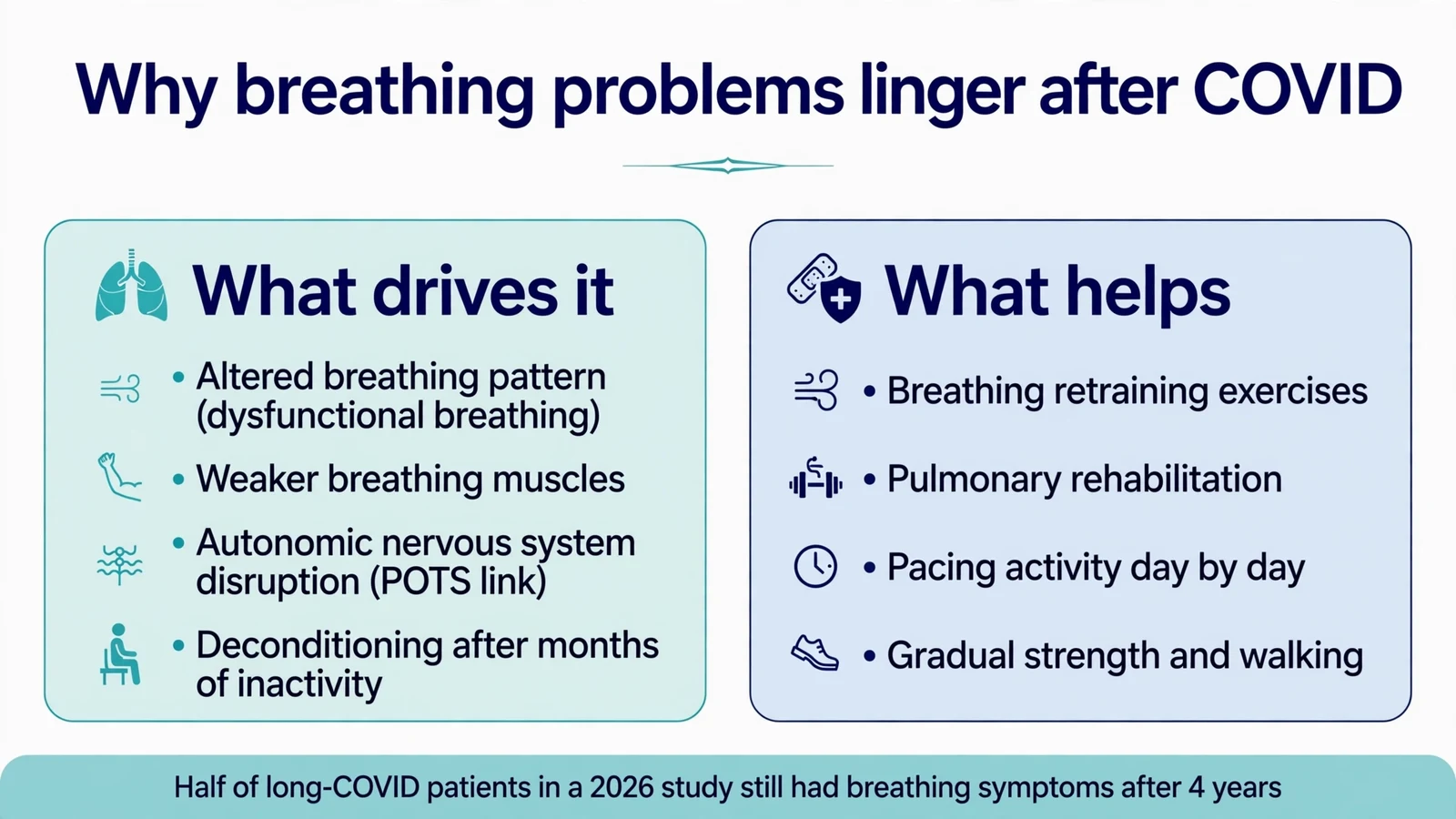
There is no single cause, and researchers describe the picture as multifactorial — several factors feeding into each other. The evidence so far points to four overlapping explanations.
1. Dysfunctional breathing: the pattern itself goes wrong
Dysfunctional breathing is an umbrella term for breathing that has become inefficient: fast, shallow breaths taken mainly with the upper chest, frequent sighing, and a habit of over-breathing. During acute illness, breathlessness is a normal alarm signal. But the rapid, shallow pattern can linger long after the infection clears, and once it becomes automatic it can keep producing breathlessness on its own — a loop in which feeling short of breath triggers faster breathing, which makes the feeling worse. The Swedish researchers suggest these altered patterns were already established within the first year after infection, and then simply persisted.
2. Weaker breathing muscles
A second, related study published in the same journal in October 2026 looked at 270 people nearly four years after being hospitalised with COVID-19. More than a third (34.4%) had clinically relevant breathlessness, and the strongest single factor linked to it was weakness of the inspiratory muscles — the diaphragm and the muscles between the ribs that draw air in. About 23% of participants had inspiratory muscle weakness, and it was associated with nearly nine times the odds of persistent breathlessness (odds ratio 8.86). Crucially, these were people with no identifiable structural heart or lung disease on testing. Their lungs were not scarred or obstructed in any measurable way; the muscles that power breathing had simply lost strength and endurance, much as leg muscles weaken after months of inactivity.
3. A disrupted autonomic nervous system
The strong link with POTS in the Swedish study points to the autonomic nervous system — the part of the nervous system that quietly controls heart rate, blood pressure and breathing. When its regulation is disturbed, standing up can send the heart racing and breathing can become rapid and shallow. The researchers note that breathing-pattern problems and dysautonomia (autonomic disruption) share underlying mechanisms, including altered sensitivity to carbon dioxide and disrupted signals from the lungs, and that the two conditions frequently travel together. Depression was also more common in the high-scoring group, and the authors describe breathing problems, low mood and autonomic symptoms as a linked cluster rather than separate issues.
4. Deconditioning after months of inactivity
Finally, there is simple deconditioning. Months of fatigue, breathlessness and post-exertional malaise — feeling worse after activity — lead many people to move far less, and fitness fades. Weaker legs, a weaker diaphragm and a lower tolerance for effort all make ordinary activity feel breathless, which encourages still more rest. The Swedish study’s weaker six-minute walk distances and sit-to-stand scores in the high-scoring group fit this pattern, and the authors note that people who were not hospitalised may have had fewer chances for early rehabilitation, letting unhelpful breathing habits bed in.
Notably, what the studies did not find matters too. In the Swedish study, standard lung-function tests were similar whether or not people had breathing-pattern symptoms. That helps explain a frustrating experience many patients report: being told their lungs “look fine” while still struggling to breathe. The problem is often in how breathing is controlled and powered, not in the lung tissue itself — which is also why standard inhalers and lung tests may not resolve it.
What does long COVID breathlessness feel like?
People describe it in different ways, and the pattern can vary from day to day:
- Feeling short of breath during everyday tasks — climbing stairs, talking, carrying shopping — that used to be easy.
- A sense of “air hunger”, as if a deep breath never quite satisfies.
- Chest tightness, frequent sighing or yawning, and a need to take big gulps of air.
- Breathlessness that worsens with talking, eating or mild exertion, and sometimes at rest.
- Breathing that feels fast, shallow or irregular, often through the mouth rather than the nose.
- Related symptoms such as dizziness, tingling in the hands or around the mouth, palpitations on standing, and fatigue.
Symptoms often fluctuate. A good day can be followed by a bad one, and overdoing it — physically or mentally — can bring on a flare that lasts hours or days. This unpredictability is one of the hardest parts of living with it.
How is it different from asthma or anxiety breathlessness?
Because the symptoms overlap, long COVID breathing problems are sometimes mistaken for asthma or dismissed as anxiety. The distinctions matter, because they point to different help.
Compared with asthma: asthma involves narrowed, inflamed airways, often with wheezing and a cough, and it usually responds to inhalers. In the Swedish study, people with breathing-pattern symptoms were no more likely to have asthma beforehand than anyone else, and their lung-function tests were not the obstructed pattern typical of asthma. Dysfunctional breathing can also coexist with asthma, which makes careful assessment important — treating the asthma alone may leave the breathing-pattern problem untouched.
Compared with anxiety: anxiety can certainly make breathing faster and shallower, and breathlessness itself is frightening, so the two feed each other. But the Swedish researchers found that anxiety scores did not independently predict who had breathing-pattern symptoms four years on, while physical factors such as weaker breathing muscles and early breathlessness severity did. In other words, this is not “just anxiety”. At the same time, low mood and anxiety are genuinely common alongside long COVID breathing problems, and supporting mental health is part of recovery, not an alternative to treating the breathing.
The key point: long COVID breathlessness is usually diagnosed after other causes have been checked for — heart problems, lung disease, anaemia and thyroid problems among them. If you are breathless, a clinician should rule those out first rather than assuming a breathing-pattern problem.
What helps with long COVID breathing problems?
There is no single proven cure, and anyone offering one should be treated with scepticism. What exists is a set of approaches with growing evidence behind them, best delivered with guidance from a clinician or physiotherapist rather than attempted alone.
Breathing retraining
The most direct treatment for a breathing-pattern problem is retraining the pattern itself. NHS long-COVID services teach techniques that are simple but need practice:
- Nose breathing and slow breathing: breathing in gently through the nose, letting the tummy rise, and breathing out slowly — aiming for a longer out-breath than in-breath, with a short natural pause before the next breath.
- Pursed-lip breathing: breathing out slowly through pursed lips, as if making a candle flicker, which slows the breathing rate and can ease the feeling of breathlessness during effort.
- “Blow as you go”: breathing out during effort — standing up, lifting, climbing a step — rather than holding the breath.
- Positions of ease: leaning forward with forearms resting on the thighs, or sitting leaning forward onto a table with pillows, which puts the breathing muscles in a better position to work.
Breathing retraining delivered by physiotherapists has been shown to improve symptoms and quality of life in people with dysfunctional breathing, and the authors of the Swedish study call for trials of breathing retraining specifically in long COVID. Ask your doctor for a referral to a long-COVID clinic or respiratory physiotherapist rather than trying to retrain breathing from videos alone.
Pulmonary rehabilitation
Pulmonary rehabilitation is a supervised programme combining exercise training, breathing techniques, education and support. It is well established for conditions such as COPD, where it reduces breathlessness and improves exercise capacity and quality of life, and reviews of the long-COVID evidence have found that aerobic and strength training help people with persistent symptoms after COVID-19. A structured programme that includes breathing-pattern work alongside gradual exercise appears to be the most effective approach, according to a systematic review of rehabilitation after COVID-19. A clinician can advise whether a programme is suitable for you and refer you.
Pacing and gradual activity
Pacing means spreading activity through the day, planning rest breaks before you need them, and avoiding the boom-and-bust cycle of overdoing it on a good day and crashing the next. NHS guidance for COVID recovery suggests matching your breathing rhythm to your steps — breathing in for one step and out for the next — and stopping to recover before pushing on. Any increase in activity should be gradual and individual: people with post-exertional malaise need particular care, and exercise programmes should be tailored to them. Talk to a doctor or physiotherapist about what level of activity is safe for you.
Treating the whole picture
Because breathing-pattern problems in long COVID often sit alongside POTS-like symptoms, fatigue and low mood, the best results usually come from treating the whole picture — breathing retraining, gradual strength and walking, support for sleep and mood, and attention to autonomic symptoms — rather than any one intervention alone. If standing makes your heart race and leaves you breathless, mention it to your doctor: it may point to dysautonomia, which has its own management strategies.
Living with it day to day
Small adjustments can make daily life easier while recovery continues:
- Plan the day in advance and break tasks into short stages with rest in between.
- Sit down for tasks where possible, and keep frequently used items within easy reach.
- Use a fan or open a window: cool air moving across the face can reduce the sensation of breathlessness.
- Slow down when speaking, and pause between sentences rather than rushing through them.
- Keep rooms cool and well ventilated, and avoid smoke, strong fragrances and dusty air.
- Track what triggers flare-ups — exertion, heat, poor sleep, stress — and plan around them.
- Be honest with family, friends and employers about what you can and cannot do on a given day.
Recovery is rarely a straight line. In the Swedish study, people with breathing-pattern symptoms improved less over four years than those without them — which is sobering — but improvement did happen, and recognising the problem is the first step towards treating it. If your breathlessness has never been assessed, or if it has been put down to anxiety without further investigation, it is worth asking for a proper assessment. Four years on, this is a recognised, measurable problem — not something to simply put up with.
When to see a doctor
Seek medical advice promptly if your breathing gets worse, if breathlessness is new, or if it is limiting your daily life. A clinician can check for other causes and refer you to a long-COVID service or respiratory physiotherapist. Keep a short note of when breathlessness happens, what you were doing, and what helps — it makes the appointment more useful.
Get urgent help straight away if you have severe or rapidly worsening breathlessness, chest pain or pressure, lips or face turning blue or grey, coughing up blood, or you faint or feel about to faint. In an emergency call 911 (US), 999 (UK) or 112 (EU).
Long COVID breathing problems can be frightening and exhausting, but they are increasingly understood — and increasingly treatable. If you are still breathless years after COVID-19, you are not alone, and it is worth asking for help.
Frequently asked questions
How long can long COVID breathing problems last?
In a Swedish study of 288 adults with long COVID followed for a median of 50 months, half (143) had scores on the Nijmegen Questionnaire suggesting dysfunctional breathing. The key driver is often a disrupted breathing pattern, weaker breathing muscles and autonomic nervous system disruption, rather than damaged lungs.
What is dysfunctional breathing in long COVID?
Dysfunctional breathing means the breathing pattern itself has gone wrong: fast, shallow, upper-chest breathing, frequent sighing and a feeling of air hunger. It can persist after the infection clears because the pattern becomes a habit, and it can cause breathlessness even when lung-function tests look normal.
Is long COVID breathlessness the same as asthma?
Yes. In the four-year Swedish study, people with breathing-pattern symptoms were no more likely to have asthma beforehand, and their lung-function tests were not the obstructed pattern typical of asthma. Asthma and dysfunctional breathing can also coexist, so a clinician should check for both.
What helps long COVID breathing problems?
Breathing retraining with a physiotherapist, pulmonary rehabilitation combining exercise and breathing techniques, and pacing activity through the day are the main approaches with evidence behind them. There is no single proven cure. Ask your doctor for a referral to a long-COVID clinic or respiratory physiotherapist.
When should I see a doctor about breathlessness after COVID?
Seek medical advice if breathlessness is new, worsening or limiting daily life. Get urgent help for severe or rapidly worsening breathlessness, chest pain, blue or grey lips, coughing up blood, or fainting. In an emergency call 911 (US), 999 (UK) or 112 (EU).
Do long COVID breathing problems ever get better?
Recovery is rarely a straight line, and in the Swedish study people with breathing-pattern symptoms improved more slowly over four years. But improvement does happen, and recognising the problem is the first step: breathing retraining and rehabilitation can help, so it is worth asking for an assessment rather than putting up with it.
Sources
- Hallberg et al., Respiratory Research 2026 — Predictors and prevalence of symptoms suggestive of dysfunctional breathing four years after COVID-19 pmc.ncbi.nlm.nih.gov
- CIDRAP — Half of adults in long-COVID study report difficulty breathing 4 years later www.cidrap.umn.edu
- Santana et al., Respiratory Research 2026 — Multimodal physiological determinants of persistent dyspnea nearly four years after COVID-19 hospitalization link.springer.com
- WHO — Post COVID-19 condition (Long COVID) fact sheet www.who.int
- CDC — Long-Term Symptoms Among Adults Tested for SARS-CoV-2, United States (MMWR 2021) www.cdc.gov
- BRFSS 2022 study — Prevalence and Factors Associated with Long COVID Symptoms among U.S. Adults www.mdpi.com
- NHS Rotherham Doncaster and South Humber — Breathlessness after COVID www.rdash.nhs.uk
- Mayo Clinic — Benefits of pulmonary rehabilitation for COPD and other lung conditions newsnetwork.mayoclinic.org

Try the tool
Not sure if it can wait?
Common causes and warning signs for 16 everyday symptoms.
Open the symptom guide