H3N2 Subclade K: The Mutated Flu Strain Behind the Early Surge
H3N2 subclade K emerged in August 2025 and is now driving an early, fast-rising flu season. Here is what it is, what the vaccine does against it, and when to seek help.
- Written by
- Health Daily Advice
- Published
- Reading time
- 8 minutes
- Sources
- 5 cited
In this guide
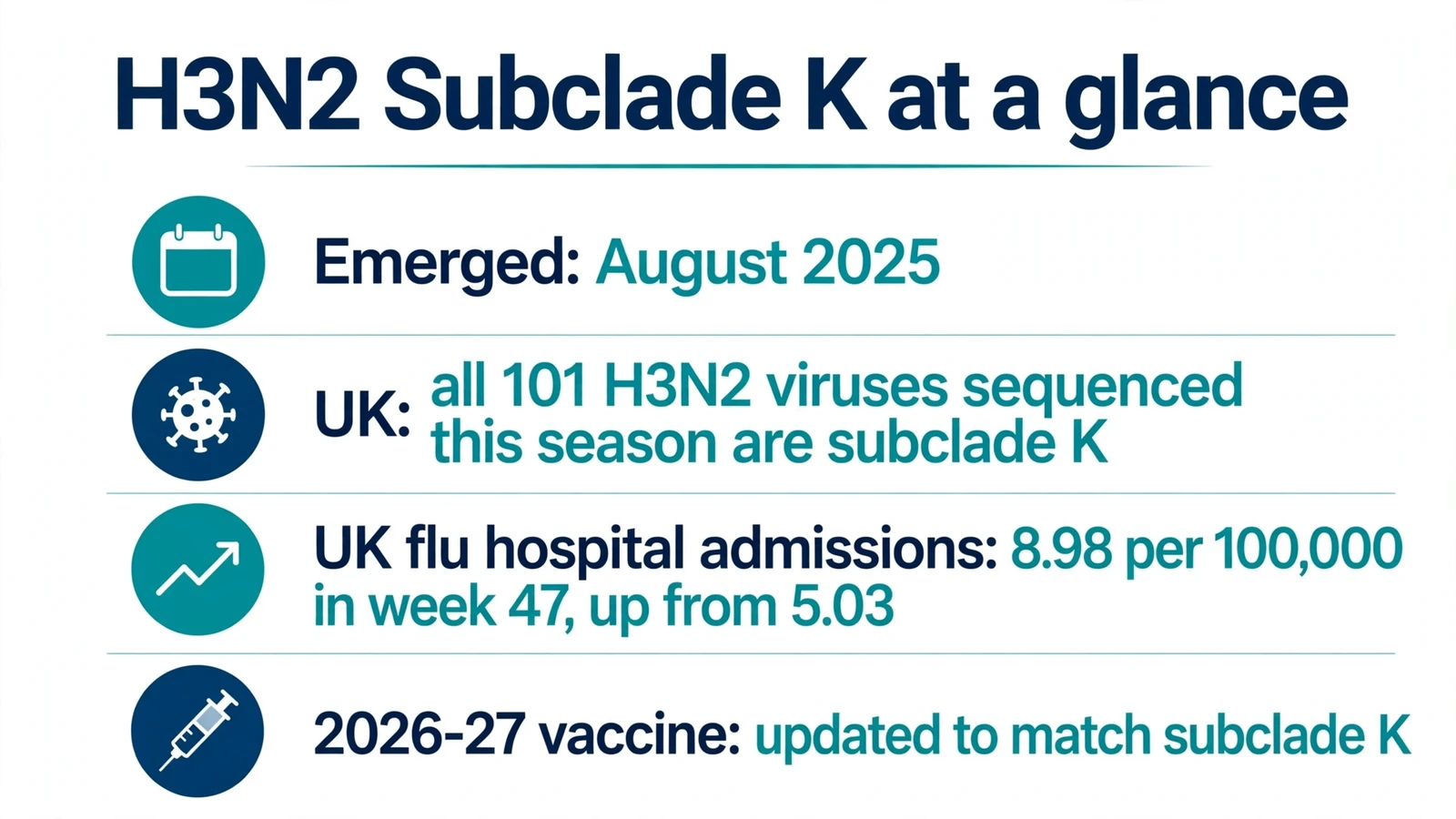
H3N2 subclade K is a mutated form of the influenza A (H3N2) flu virus that appeared in August 2025 and is now driving an unusually early flu season. In England, every H3N2 virus sequenced this season belongs to subclade K, and flu hospital admissions nearly doubled in a single week. The illness itself looks like ordinary flu.
What is H3N2 subclade K?
Subclade K — technically known as J.2.4.1 — is a new branch of the influenza A (H3N2) virus. It picked up several changes in its haemagglutinin protein, the spike on the virus surface that our immune system recognises. Two of the most important changes, known as T135K and S144N, sit in spots that antibodies normally latch onto, which helps the virus partly dodge immunity built up from earlier flu infections and vaccinations.
The World Health Organization (WHO) says subclade K emerged in August 2025 and “spread rapidly across the globe”, going on to account for the majority of flu viruses reported across regions. That speed is what makes it different from the usual slow drift of seasonal flu: it arrived as a distinct new variant rather than a small yearly tweak.
Genetic surveillance backs that up. The UK Health Security Agency (UKHSA) reports that all 101 H3N2 viruses it has sequenced in England this season belong to subclade K. In the United States, the Centers for Disease Control and Prevention (CDC) found that 104 of the 109 H3N2 viruses characterised since May 2026 — 95.4% — were subclade K. H3N2 itself is still a small share of US flu cases so far, where H1N1 dominates, but wherever H3N2 is found, subclade K is now the version circulating.
Why is this flu season starting early — and looking severe?
Flu usually peaks in January or February. This season it arrived weeks early. The WHO links subclade K to “an earlier start to the influenza season in many countries, with several reporting higher-than-usual levels of activity”. The CDC likewise notes that US flu activity is “higher than typically observed at this time of year”.
The numbers from England show how fast things are moving. In week 47 of 2026 (16 to 22 November), UKHSA recorded:
- flu positivity rising to 17.8% of laboratory tests, up from 11.5% the week before;
- flu hospital admissions rising to 8.98 per 100,000 people, up from 5.03 — a jump of almost 80% in one week;
- intensive care admissions rising to 0.28 per 100,000, up from 0.16;
- flu in 21.1% of GP swab samples, up from 14.1% the week before.
Children are carrying much of the early spread: flu positivity was highest among 5- to 11-year-olds, at 32.8%, up from 23.0% the previous week. That pattern — schools seeding the season, hospitals feeling it a few weeks later — is familiar from past H3N2 seasons, which tend to hit older adults hardest once the virus reaches them.
In the United States, the CDC estimates at least 2.6 million flu illnesses, 36,000 hospitalisations and 2,100 deaths so far this season, as of the week ending 7 November 2026, including five deaths in children. The CDC’s early-season severity assessment still classifies overall severity as low, but it cautions that this may change as activity rises. The picture is complicated by the fact that most US flu so far is H1N1, not H3N2 — so subclade K is one of two stories running at once this winter.
Uptake of the flu vaccine is also lower than last season, which leaves more people unprotected. In England, 67.6% of people aged 65 and over had been vaccinated by week 47, compared with 69.6% at the same point last season — and only 34.1% of under-65s in clinical risk groups had taken up the jab.
What are the symptoms of subclade K flu?
There is no sign so far that subclade K causes different symptoms from other flu viruses. It looks and feels like flu. According to NHS inform, the main symptoms include a sudden high temperature, tiredness and weakness, headache, general aches and pains, a dry, chesty cough, sore throat, difficulty sleeping, loss of appetite, diarrhoea or tummy pain, feeling sick, chills, a runny or blocked nose and sneezing. Children get similar symptoms, and may also have ear pain and be less active.
Symptoms usually develop one to three days after infection. Most people feel better within a week, although a cough and tiredness can linger for a few more weeks. The real difference with subclade K is not how the illness feels — it is how many people are catching it, and how early in the winter it is spreading.
Flu, a cold, COVID-19 or RSV — how can you tell?
That is genuinely hard, because the symptoms overlap. NHS inform puts the flu-versus-cold difference plainly: flu comes on quickly, usually includes fever and aching muscles, and is more severe, while a cold comes on gradually, mainly affects the nose and throat, and is mild enough that you can usually still get around.
| Illness | Typical pattern | What the data shows this week (England, week 47) |
|---|---|---|
| Flu (including subclade K) | Sudden onset, high temperature, body aches, dry cough | Positivity 17.8%; hospital admissions 8.98 per 100,000 and rising fast |
| COVID-19 | Similar respiratory symptoms; only a test separates it reliably from flu | Positivity 7.1%; hospital admissions 2.96 per 100,000 — circulating at low levels |
| RSV | Cough and wheeze; hits babies and young children hardest | Positivity 6.9%, but 35.1% in children under 5; admissions 2.34 per 100,000 |
| Common cold | Gradual onset, mainly nose and throat, fairly mild | Rhinovirus positivity 10.5% — colds are around, as usual |
Only a test can tell flu, COVID-19 and RSV apart with confidence. If you need to know which virus you have — for example, because you are in a high-risk group or care for someone who is — ask a doctor or pharmacist about testing.
Does this year’s flu vaccine still help?
This is where the story needs care, because the answer changed between last season and this one.
Subclade K emerged in August 2025, months after the strains for the 2025–26 vaccine had been chosen in February 2025. That season’s jab was built around an older H3N2 strain, and the mismatch showed: a study of nine European vaccine-effectiveness studies found all-age protection against flu of only 25–45%, with the best results in children (47–72%) and protection against H3N2 itself of 38–50%. Those figures are similar to other H3N2 seasons, but they are well below what a well-matched vaccine achieves.
For the 2026–27 season, the WHO updated the H3N2 part of the vaccine to a subclade K virus — A/Darwin/1454/2025 in egg-based vaccines and A/Darwin/1415/2025 in cell-based ones. Early laboratory checks are encouraging: the CDC found that all 35 H3N2 viruses it tested were well recognised by antibodies raised against the new vaccine component. In other words, this season’s jab was designed with subclade K in mind.
That does not make the vaccine perfect. No flu vaccine is 100% effective, protection builds over time after the jab, and UKHSA has noted that some circulating H1N1 viruses also show reduced reactivity with this season’s H1N1 vaccine component. But vaccination remains the best protection available, and it is especially important for people at higher risk. The CDC recommends the annual flu vaccine for everyone aged six months and older, and the NHS offers it free to people at risk of flu and its complications. If you have not had this season’s jab yet, it is still worth getting — flu activity is rising, and the season has a long way to run.
Who is most at risk?
Flu can affect anyone, but NHS inform lists the groups in which it is more common and more serious: babies and young children, older people, pregnant women (or up to two weeks after giving birth), people with health conditions such as asthma or heart, kidney or liver disease, and people with a weakened immune system — for example, because of chemotherapy or HIV. People in these groups are more likely to need hospital treatment or antiviral medicine.
H3N2 seasons have a long record of hitting older adults hardest, and the UK data already shows the pressure building in hospitals. The low vaccine uptake among under-65s in clinical risk groups — only about a third vaccinated so far — is a particular worry, because these are the people most likely to become seriously ill.
What should I do if I catch it?
Most people recover at home. NHS inform advises rest, plenty of sleep, keeping warm, drinking lots of water to avoid dehydration, and staying off work or school until you feel better. A pharmacist can advise on treating the symptoms. The CDC notes that prescription flu antiviral drugs can treat flu illness, should be started as early as possible, and are especially important for patients at higher risk — so if you are in a risk group, contact a doctor promptly rather than waiting to see how it goes.
Antibiotics do not help flu, because flu is caused by a virus. Do not take paracetamol and flu remedies that contain paracetamol at the same time, and ask a pharmacist if you are unsure what is safe for you.
How can I avoid catching it?
Start with the vaccine if you are eligible. Beyond that, the basics still work. Flu spreads in germs from coughs and sneezes, which can live on hands and surfaces for 24 hours. NHS inform recommends washing your hands regularly with soap and warm water, cleaning surfaces such as keyboards, telephones and door handles, covering your mouth and nose with a tissue when you cough or sneeze, binning used tissues straight away, and avoiding unnecessary contact with other people while you are infectious.
When to see a doctor
Contact your GP practice urgently — or call 111 in the UK if the practice is closed — if you are more short of breath than usual, have pain when breathing in or coughing, feel confused, dizzy or lightheaded, cannot keep food or fluids down, are coughing up blood, have heart palpitations, are peeing less than usual, or have a very high or low temperature. Get medical advice the same day if you are 65 or over, pregnant, have a long-term health condition or a weakened immune system, or if your symptoms have not improved after a week.
In an emergency call 911 (US), 999 (UK) or 112 (EU)
Flu that seems to improve and then comes back worse, or breathing that gets harder after a few days, also needs prompt medical attention — complications such as pneumonia usually develop after a few days of symptoms. If you are worried about a baby or a child with flu symptoms, seek advice the same day.
Frequently asked questions
What is H3N2 subclade K?
Subclade K, also called J.2.4.1, is a mutated branch of the influenza A (H3N2) flu virus that emerged in August 2025. Changes in its surface protein help it partly dodge immunity from earlier flu infections and vaccines. It spread rapidly worldwide and now accounts for most H3N2 viruses — in England, all 101 H3N2 viruses sequenced this season belong to subclade K, according to UKHSA.
Is subclade K more dangerous than ordinary flu?
There is no evidence so far that subclade K causes different or more severe symptoms than other flu viruses — the illness looks like ordinary flu. The concern is its spread: it arrived weeks earlier than a normal flu season, and UK flu hospital admissions nearly doubled in a single week in November 2026. H3N2 seasons also have a record of hitting older adults hardest, so the pressure on hospitals is the main worry.
Does the flu vaccine protect against H3N2 subclade K?
This season's vaccine was designed with subclade K in mind: the WHO updated the H3N2 component to a subclade K virus, and CDC laboratory tests found circulating H3N2 viruses were well recognised by antibodies against it. Last season was different — the vaccine was chosen before subclade K appeared, and European studies found protection of only 25–45%. No flu vaccine is 100% effective, but this year's jab is the best protection available.
What are the symptoms of subclade K flu?
They match ordinary flu: a sudden high temperature, tiredness and weakness, headache, general aches and pains, a dry, chesty cough, sore throat, difficulty sleeping, loss of appetite, nausea, chills and a runny or blocked nose. Symptoms usually start one to three days after infection, and most people feel better within a week, although a cough and tiredness can linger. Only a test can tell flu apart from COVID-19 or RSV.
When should I see a doctor for flu?
Get urgent help if you are more short of breath than usual, have pain when breathing or coughing, feel confused or dizzy, cannot keep food or fluids down, cough up blood, have heart palpitations or are peeing less than usual. See a doctor the same day if you are 65 or over, pregnant, have a long-term condition or a weakened immune system, or your symptoms have not improved after a week.
Sources
- UKHSA: National flu and COVID-19 surveillance report, 26 November 2026 (week 48) www.gov.uk
- CDC: Weekly US Influenza Surveillance Report, Week 44 ending November 7, 2026 www.cdc.gov
- WHO: Recommendations for influenza vaccine composition for the 2026-2027 northern hemisphere season www.who.int
- NHS inform: Flu www.nhsinform.scot
- Lucaccioni H, et al. Influenza vaccine effectiveness from nine studies during drifted A(H3N2) subclade K predominance, Europe, September 2025 to January 2026. Euro Surveill. 2026 pmc.ncbi.nlm.nih.gov

Try the tool
Not sure if it can wait?
Common causes and warning signs for 16 everyday symptoms.
Open the symptom guide