Bundibugyo Ebola: Symptoms, Spread and the Vaccine Trial
The DR Congo outbreak has passed 12,000 cases, making it the second-largest Ebola outbreak on record. Symptoms, how it spreads, and the Tumaini trial testing three vaccine candidates.
- Written by
- Health Daily Advice
- Published
- Reading time
- 6 minutes
- Sources
- 6 cited
In this guide
The Bundibugyo Ebola outbreak in the Democratic Republic of Congo has passed 12,000 confirmed cases, making it the second-largest Ebola outbreak on record. There is still no approved vaccine or treatment for this strain, but a landmark trial called Tumaini began in October 2026 to test three vaccine candidates.
The outbreak was declared on 15 May 2026, and six months on it is still spreading. Health teams are racing to trace contacts, care for patients and test vaccines — while armed violence and fragile health services make the work harder. Here is what is known so far, and what the trial could change.
How big is the outbreak now?
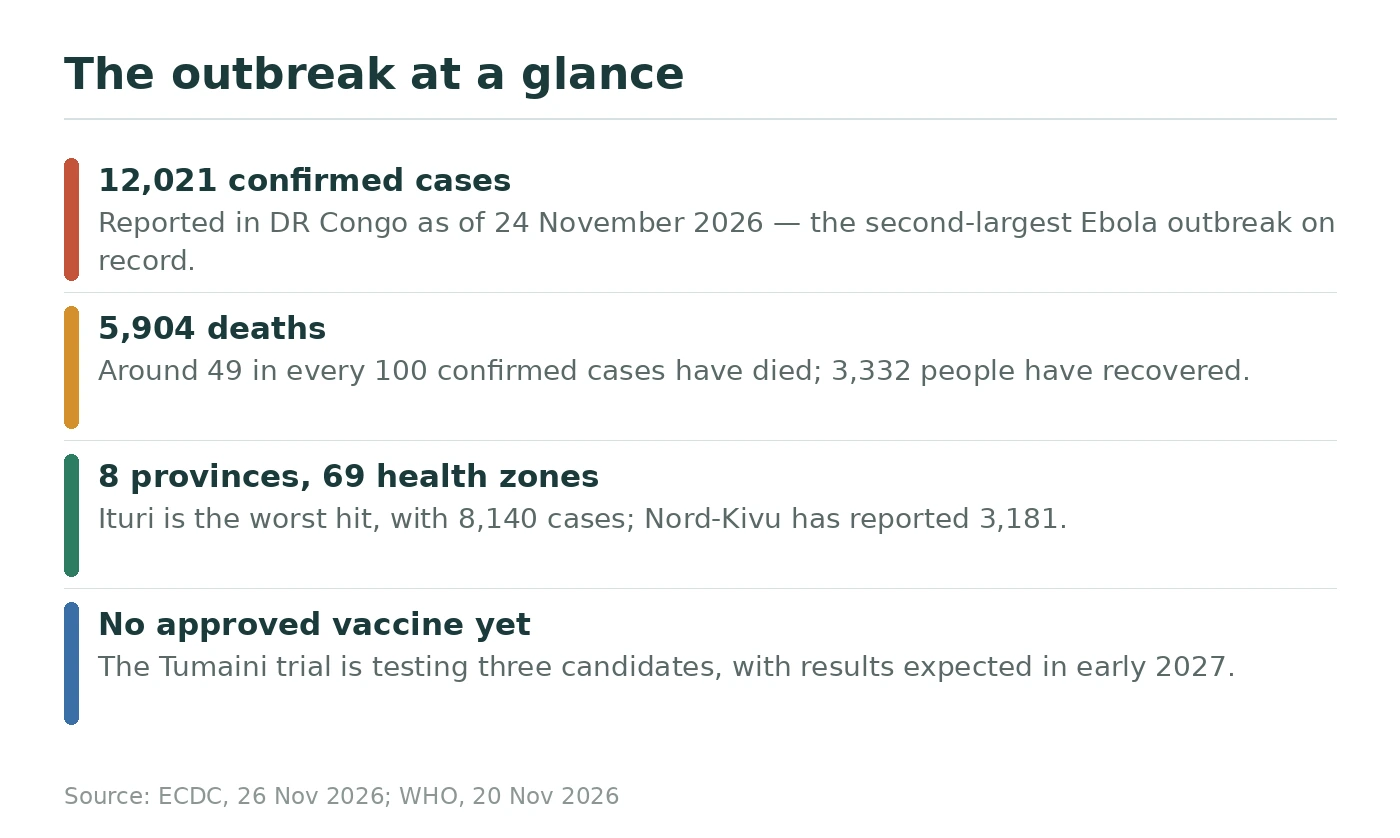
As of 24 November 2026, the Democratic Republic of Congo (DRC) has reported 12,021 confirmed cases and 5,904 deaths, according to the European Centre for Disease Prevention and Control (ECDC). That is a case fatality rate of around 49% — roughly one death for every two confirmed cases. Another 3,332 people have recovered, and 1,092 patients were being cared for in isolation.
The outbreak has reached 69 of the country’s 178 health zones across eight provinces. Ituri, in the north-east, remains the worst hit, with 8,140 cases and 3,843 deaths, followed by Nord-Kivu with 3,181 cases and 1,779 deaths. The World Health Organization (WHO) reported on 20 November that 1,417 new cases had been confirmed in the previous three weeks, and that the outbreak remains a public health emergency of international concern — a status it has held since May.
This is the largest Ebola outbreak ever recorded in the DRC, whatever the virus strain, and the second-largest Ebola outbreak anywhere, behind only the 2014–2016 West African epidemic. It is also the second Bundibugyo outbreak in the DRC, after one in 2012.
What is Bundibugyo Ebola?
Bundibugyo Ebola is a severe viral illness caused by Bundibugyo virus, one of three viruses in the Ebola family known to cause large outbreaks — the others being Ebola virus (the Zaire strain) and Sudan virus. It was first identified in Bundibugyo district, Uganda, in 2007, where it killed about 30% of confirmed cases, and it appeared again in the DRC in 2012, with a fatality rate of about 50%.
Like other Ebola diseases, it is rare but often fatal. The WHO puts the average Ebola case fatality rate at around 50%, with a range of 25% to 90% across past outbreaks. Fruit bats are thought to be the natural hosts of the virus, and infection is believed to reach people first through close contact with infected wildlife.
What are the symptoms?
Symptoms usually appear 2 to 21 days after infection and can start suddenly. The WHO lists the early symptoms as fever, fatigue, muscle pain, headache and a sore throat. These are followed by vomiting, diarrhoea, stomach pain and a rash, and by problems with the kidneys and liver as the illness progresses.
Some patients develop bleeding — in vomit or faeces, from the nose, gums or vagina — but the WHO notes this is less common than many people expect and tends to come later in the illness. Confusion, irritability and aggression can also occur. Because the early symptoms look like malaria, typhoid or other fevers common in the region, diagnosis needs laboratory testing, and delays in spotting cases are one reason so many deaths in this outbreak have happened in communities rather than in treatment centres.
How does it spread?
Bundibugyo Ebola spreads only through direct contact — with the blood or body fluids of a person who is sick or has died, or with surfaces and materials contaminated with those fluids. Burial ceremonies that involve touching the body of someone who has died can also spread it, as can caring for patients without proper protective equipment.
Importantly, people cannot pass the virus on before they develop symptoms, and they stay infectious only while the virus remains in their blood. It does not spread through the air like flu or measles. Outbreak control therefore relies on finding cases fast, isolating and caring for patients, tracing and monitoring contacts for 21 days, and safe burials — alongside community trust, which the WHO says is critical.
Why is there no approved vaccine yet?
The two licensed Ebola vaccines — Ervebo and Zabdeno/Mvabea — were designed for Ebola virus, the Zaire strain behind the 2014–2016 epidemic. They are not approved for Bundibugyo, and the antibody treatments recommended by the WHO for Ebola virus disease are likewise not approved for it. There is no approved specific treatment for Bundibugyo Ebola at all.
That does not mean patients are untreatable. Early intensive supportive care — rehydration and treatment of symptoms — improves survival, and the WHO says seeking care early can be lifesaving. A separate treatment trial, called PARTNERS, began in July 2026 and is testing an experimental antibody, the antiviral remdesivir, and a combination of the two.
The Tumaini vaccine trial
The most hopeful development is Tumaini — Swahili for “hope” — a Phase 2/3 trial that gave its first vaccination on 23 October 2026 in Bunia, the capital of Ituri province and the centre of the outbreak. It is an adaptive platform trial, meaning several vaccine candidates can be tested inside a single framework, using ring vaccination: immunising the contacts of confirmed cases and others at high risk.
The first candidate being tested is Ervebo, to see whether the existing Zaire-strain vaccine offers any cross-protection against Bundibugyo. In November 2026 the WHO’s advisory group recommended adding two Bundibugyo-specific candidates to the trial: ChAdOx1 BDBV, developed by the University of Oxford with the Serum Institute of India, and mRNA-1469, an mRNA vaccine from Moderna. These will be the first vaccines built for Bundibugyo ever tested during an outbreak.
The trial is co-led by the DRC’s National Institute of Biomedical Research and the University of Antwerp, and it includes pregnant women and children aged 12 and older — groups often left out of trials. Early results are expected in early 2027. As the WHO’s director-general put it, “vaccines alone will not end this outbreak, but they could become a powerful new tool for bringing it under control.”
Has it spread beyond Congo?
Cases have been reported in five countries since May 2026, but the outbreak is overwhelmingly concentrated in the DRC. Kenya reported nine cases, including two deaths, all linked to one imported case; its last patient was discharged on 11 November and the country is counting down 42 days — two maximum incubation periods — to declare its outbreak over. Nigeria reported a single imported case in October; the patient was evacuated to Switzerland, recovered and was discharged on 11 November. Outbreaks in France and Uganda were controlled in August.
A British health worker who caught the virus while working in the DRC was evacuated to the UK in early November, treated in a high-level isolation unit and discharged on 19 November. For people in the UK, US or Europe who have not travelled to the affected areas, the risk is very low. Travellers to the region should check current government travel health advice before going.
When to see a doctor
If you have recently been in an area of the DRC affected by the outbreak and develop a fever, severe headache, muscle pain, vomiting or diarrhoea within 21 days of leaving, seek medical help immediately and tell the clinician where you have travelled — do not just turn up at a clinic or GP surgery without calling first, so staff can prepare. The same applies if you have had close contact with someone known or suspected to have Ebola.
Call 999 immediately if someone collapses, becomes confused or unresponsive, or shows signs of severe bleeding. Do not drive yourself to hospital. In an emergency call 911 (US), 999 (UK) or 112 (EU).
Frequently asked questions
What is Bundibugyo Ebola?
Bundibugyo Ebola is a severe viral illness caused by Bundibugyo virus, one of three viruses in the Ebola family known to cause large outbreaks. It was first seen in Uganda in 2007 and in DR Congo in 2012. The current outbreak, declared in May 2026, is the second in DR Congo and the largest Bundibugyo outbreak ever recorded.
What are the symptoms of Bundibugyo Ebola?
Symptoms usually appear 2 to 21 days after infection and start suddenly with fever, fatigue, muscle pain, headache and a sore throat. They are followed by vomiting, diarrhoea, stomach pain and a rash, and in severe cases by kidney and liver problems. Some patients develop bleeding later in the illness, but this is less common than many people expect.
Is there a vaccine for Bundibugyo Ebola?
Not yet. The two licensed Ebola vaccines, Ervebo and Zabdeno/Mvabea, protect against Ebola virus (the Zaire strain), not Bundibugyo. The Tumaini trial, which began in Bunia in October 2026, is testing Ervebo for cross-protection plus two new Bundibugyo-specific candidates from Oxford and Moderna. Results are expected in early 2027.
How does Bundibugyo Ebola spread?
It spreads through direct contact with the blood or body fluids of a person who is sick or has died, or with surfaces and materials contaminated with those fluids. Unsafe burial practices and caring for patients without protective equipment also spread it. People cannot pass it on before symptoms appear, and the virus is thought to reach people first from fruit bats.
How deadly is Bundibugyo Ebola?
About half of confirmed cases in the current outbreak have died: 5,904 deaths among 12,021 cases, a fatality rate of around 49%. Past Bundibugyo outbreaks killed 30% of cases in Uganda in 2007 and 50% in DR Congo in 2012. Early intensive supportive care, including rehydration, improves the chance of survival, according to the WHO.
Is Bundibugyo Ebola a risk in the UK or US?
The risk is very low. Cases have been reported in five countries since May 2026, but the outbreak is concentrated in DR Congo, and imported cases in Kenya, Nigeria, France and Uganda were contained. A British health worker evacuated to the UK in November was treated and discharged. Travellers to affected areas should follow Foreign Office and CDC advice.
Sources
- ECDC: Ebola disease outbreak caused by Bundibugyo virus – Multi-country – 2026 www.ecdc.europa.eu
- WHO: Ebola disease caused by Bundibugyo virus – Disease Outbreak News, 20 Nov 2026 www.who.int
- WHO: Ebola disease fact sheet www.who.int
- CEPI: First participant vaccinated in pivotal Phase 2/3 Bundibugyo vaccine trial in DRC cepi.net
- MedicalXpress: Ebola vaccine trial begins in DR Congo, 24 Oct 2026 medicalxpress.com

Try the tool
Not sure if it can wait?
Common causes and warning signs for 16 everyday symptoms.
Open the symptom guide