Can You Get Flu Twice in One Season? Yes, You Can
Yes — you can catch flu twice in one season if a different strain comes along. Three strains are circulating this winter, so here is why it happens and how to protect yourself.
- Written by
- Health Daily Advice
- Published
- Reading time
- 7 minutes
- Sources
- 8 cited
In this guide
Yes, you can get flu twice in one season. Influenza A and B are different viruses, and even within influenza A, the H1N1 and H3N2 subtypes offer little protection against each other. If you recover from one strain and catch another, you can fall ill again — which is why vaccination is still advised after a bout of flu.
This winter it is more than a theoretical one. Three influenza strains are circulating at the same time in parts of Asia, flu admissions in England are running higher for this point in November than at any time this decade, and the US hospitalisation rate is the highest for this point in the season since 2010–11.
Why can you get flu twice in one season?
Flu is caused by influenza viruses, and the ones that make people ill each winter are mainly influenza A and influenza B. These are genuinely different viruses, and catching one does not give you lasting protection against the other.
The US Centers for Disease Control and Prevention (CDC) has been clear about this for years. During a 2018 briefing, Dr Anne Schuchat, then the CDC’s principal deputy director, said: “The idea that a person can get infected with A and during the same season get infected with B definitely happens.” The agency also notes that it is possible to catch both at the same time, and that second waves of influenza B activity during a season are “not uncommon”.
The picture is the same within influenza A itself. The two subtypes that circulate most often, H1N1 and H3N2, are different enough that recovering from one leaves you open to the other. Chinese experts quoted in the Seoul Economic Daily on 28 November 2026 put it plainly: cross-protection between different flu viruses is weak, so a person who recovers from influenza A can still contract influenza B, and even someone who has had H3N2 can be infected again with H1N1.
Immunity after flu is largely strain-specific: your immune system learns the virus that made you ill, but a different strain can slip past those defences. Having had flu once does not make you immune to flu in general — only, for a time, to that one strain.
The three strains circulating this season
This winter is unusual because three strains are circulating at once in some countries. China CDC figures for flu-positive samples collected between 16 and 22 November 2026 showed influenza A H1N1 at 65.0%, influenza B of the Victoria lineage at 25.3%, and influenza A H3N2 at 9.7%. Cluster outbreaks of suspected flu totalled 212 that week, up about 47% from 144 the week before.
South Korea is seeing a similar surge. In week 47 of 2026 (15–21 November), flu-like cases reached 41.1 per 1,000 outpatients, up from 37.0 the previous week — the fifth consecutive weekly increase and the first time the figure has passed 40 this season. A flu-like case means a fever of 38°C or higher with a cough or sore throat. Weekly flu admissions at hospital-level sentinel facilities rose from 460 in week 44 to 970 in week 47. Children aged 7 to 12 had the highest flu-like rate, at 100.5 per 1,000, while people aged 65 and over made up 53% of hospitalised patients.
The trend is not confined to Asia. In England, flu admissions stood at 9.0 per 100,000 last week, up from 5.0 the previous seven days, compared with 4.9 per 100,000 in the equivalent week in 2025, according to UK Health Security Agency figures reported by the Press Association. The rate has not been at such a high level at this point in November in any previous year this decade.
In the United States, the CDC’s FluView report for week 45 (the week ending 14 November 2026) recorded at least 3.7 million flu illnesses, 50,000 hospitalisations and 2,800 deaths so far in the 2026–27 season. The cumulative hospitalisation rate of 12 per 100,000 is the highest for this point in the season since 2010–11, and seven children have died of flu this season, two of them in the latest week, both with H1N1.
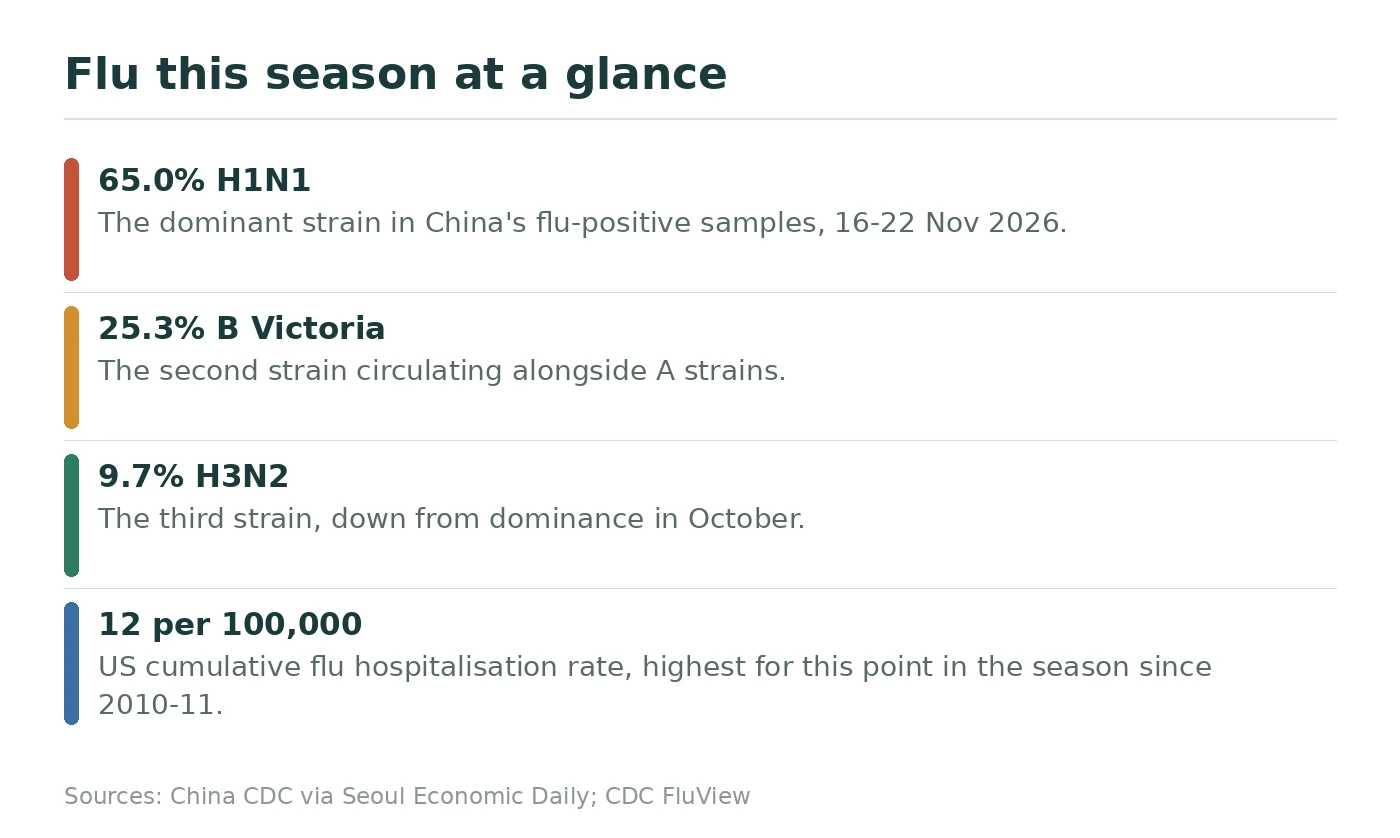
All three strains in circulation in China are covered by the 2026–27 vaccine. The World Health Organization’s recommended composition for the northern hemisphere vaccine includes A/Missouri/11/2025 (H1N1)pdm09-like, A/Darwin/1454/2025 (H3N2)-like and B/Tokyo/EIS13-175/2025 (B/Victoria lineage)-like viruses. Of 182 H1N1 viruses tested by the CDC, 170 (93.4%) were well recognised by antibodies against this season’s vaccine reference virus — a sign the shot is a good match so far.
How long does immunity last after flu?
There is no fixed number of weeks or months after which your protection runs out. What the CDC does say is that protective antibody levels decline over the course of a year after vaccination and infection, particularly in older people.
The same gradual decline applies to the vaccine. That is one reason the CDC recommends a flu vaccine for everyone aged 6 months and older, every year, rather than relying on protection from a previous season’s jab or illness. It usually takes two to four weeks for sufficient immunity to develop after vaccination, so the sooner you are vaccinated, the sooner you are protected.
Is the second bout worse than the first?
There is no reliable evidence that a second bout of flu in the same season is usually milder, and you should not count on it being so. Each infection is a fresh illness, and how ill you become depends on the strain, your general health, your age and whether you have any underlying conditions.
Chinese experts quoted in the Seoul Economic Daily warned that repeated infections can compound respiratory damage, and that older adults and people with chronic conditions should be alert to the risk of complications.
Some people develop complications such as pneumonia, which can be life-threatening. That risk does not disappear just because you have already had flu once this winter.
Flu or a cold? How to tell
Flu and the common cold share symptoms, but they feel very different. The NHS explains that flu appears quickly, within a few hours, affects more than just your nose and throat, and “makes you feel exhausted and too unwell to carry on as normal”. A cold, by contrast, appears gradually over one to two days and mainly affects your nose and throat.
That speed of onset is a useful clue if you fall ill again a few weeks after recovering. A sudden fever, aching muscles, exhaustion and a dry cough arriving within hours is much more likely to be flu than a cold.
Flu is also highly contagious. The NHS notes that you are most likely to pass it on to others in the first five days after becoming infected, and that flu germs can live on hands and surfaces for 24 hours.
Who is most at risk?
Flu can make anyone seriously ill, but some people face a much higher risk of complications. The CDC lists adults aged 65 and over, children under two (with the highest risk in children under five), people with asthma or chronic lung disease, neurological conditions, blood disorders, diabetes, heart, kidney or liver disease, a body mass index of 40 or higher, a weakened immune system, and pregnant women, including up to two weeks after the end of pregnancy. People living in nursing homes are also at higher risk.
9 out of 10 people hospitalised with flu had at least one underlying health condition, according to the CDC, and people aged 65 and over made up more than half of hospitalised flu patients in Korea in week 47.
Is the vaccine still worth it if you have already had flu?
Yes. Having had flu does not mean the vaccine is pointless. The CDC advises vaccination even after having flu in the same season, “because it could protect you against the other strain”. South Korea’s disease control agency, the KDCA, says the same: vaccination is still needed even for people who have already had flu, as other subtypes may circulate.
If you have not yet been vaccinated, it is not too late. The CDC’s season outlook, updated on 23 November 2026, expects a moderate season peaking between mid-December and early January, with a median projected peak of about 28,000 weekly hospitalisations. With the peak still ahead, vaccination now still leaves time for immunity to build. If you have recently recovered from flu, talk to a doctor or pharmacist about the right time to be vaccinated.
When to see a doctor
Most people recover from flu at home with rest and fluids, but some symptoms need prompt medical attention. The NHS advises seeking an urgent GP appointment or calling NHS 111 if you have flu symptoms and you are worried about your baby’s or child’s symptoms, are 65 or over, are pregnant or have recently given birth, have a long-term medical condition, have a weakened immune system, feel very unwell, are short of breath, or your symptoms do not improve after seven days.
Call 999 or go to A&E straight away if you have sudden chest pain, severe difficulty breathing, or you are coughing up blood.
The CDC adds further warning signs: a persistent high fever, difficulty breathing, a rapid heartbeat, significant tiredness or confusion — and if you start to get better and then suddenly feel much worse, that could indicate a secondary bacterial infection such as pneumonia, so seek care immediately. Antivirals work best when started within two days of getting sick, so do not delay if you are in a high-risk group.
In an emergency call 911 (US), 999 (UK) or 112 (EU).
So, can you get flu twice in one season? Yes — and this winter, with three strains circulating and admissions climbing, it is worth taking seriously. Get vaccinated even if you have already had flu, watch for symptoms returning after you recover, and seek help promptly if you are in a high-risk group or your symptoms worsen. One bout of flu does not make you immune to the next.
Frequently asked questions
Can you get flu twice in one season?
Yes. Influenza A and B are different viruses, and even within influenza A, the H1N1 and H3N2 subtypes offer little protection against each other. If you recover from one strain and catch another, you can fall ill again in the same season. The CDC confirms that infection with influenza A followed by influenza B in the same season definitely happens.
Can you catch flu twice in a month?
It is possible, though uncommon. A second illness so soon after the first is usually a different strain, since immunity to the strain you just had is still fresh. Three strains are circulating this winter, which makes a second infection more likely than in a single-strain season. If symptoms return suddenly after you recovered, treat it as a new illness and rest at home.
Should I get the flu vaccine if I have already had flu this year?
Yes. The CDC advises vaccination even after having flu in the same season, because it could protect you against the other strain. South Korea's KDCA gives the same advice, as other subtypes may circulate. All three strains circulating this season are covered by the 2026–27 vaccine. Talk to a doctor or pharmacist about the right time to be vaccinated after recovery.
How long does immunity last after having flu?
There is no fixed number of weeks or months. The CDC says protective antibody levels decline over the course of a year after vaccination and infection, particularly in older people. Protection is also largely strain-specific, so even fresh immunity to one strain offers little defence against a different one. That is why annual vaccination is recommended.
Is a second bout of flu milder than the first?
There is no reliable evidence that a second bout is usually milder, so do not count on it. Each infection is a fresh illness, and how ill you become depends on the strain, your age, your general health and any underlying conditions. Experts warn repeated infections can compound respiratory damage, especially in older adults and people with chronic conditions.
How can I tell flu from a cold?
Flu appears quickly, within a few hours, affects more than just your nose and throat, and makes you feel exhausted and too unwell to carry on as normal, according to the NHS. A cold appears gradually over one to two days and mainly affects your nose and throat. A sudden fever with aching muscles and exhaustion is much more likely to be flu.
Sources
- CDC: Flu update briefing (2018) archive.cdc.gov
- Seoul Economic Daily: Three flu strains spread at once in China en.sedaily.com
- Seoul Economic Daily: Flu-like cases rise for fifth straight week in Korea en.sedaily.com
- Doctors.net.uk: Flu hospital admissions at highest for this time of year www.doctors.net.uk
- Medical Daily: US flu season — CDC Thanksgiving travel hospitalizations www.medicaldaily.com
- WHO: Recommended composition of influenza virus vaccines 2026–27 www.who.int
- NHS: Flu www.nhs.uk
- CDC: People at increased risk for flu complications www.cdc.gov

Try the tool
Not sure if it can wait?
Common causes and warning signs for 16 everyday symptoms.
Open the symptom guide