What Is Powassan Virus? Symptoms, Risks and the New Study
A rare tick-borne virus that can reach the brain — and a new study found signs of it in 1 in 12 children with Lyme disease.
- Written by
- Health Daily Advice
- Published
- Reading time
- 4 minutes
- Sources
- 8 cited
In this guide
Powassan virus is a rare virus spread by infected deer ticks, which also carry Lyme disease. Most people infected have no symptoms or a mild flu-like illness, but the virus can inflame the brain and is fatal in about 1 in 10 severe cases. A November 2026 study found signs of it in 1 in 12 children with Lyme disease.
What is Powassan virus?
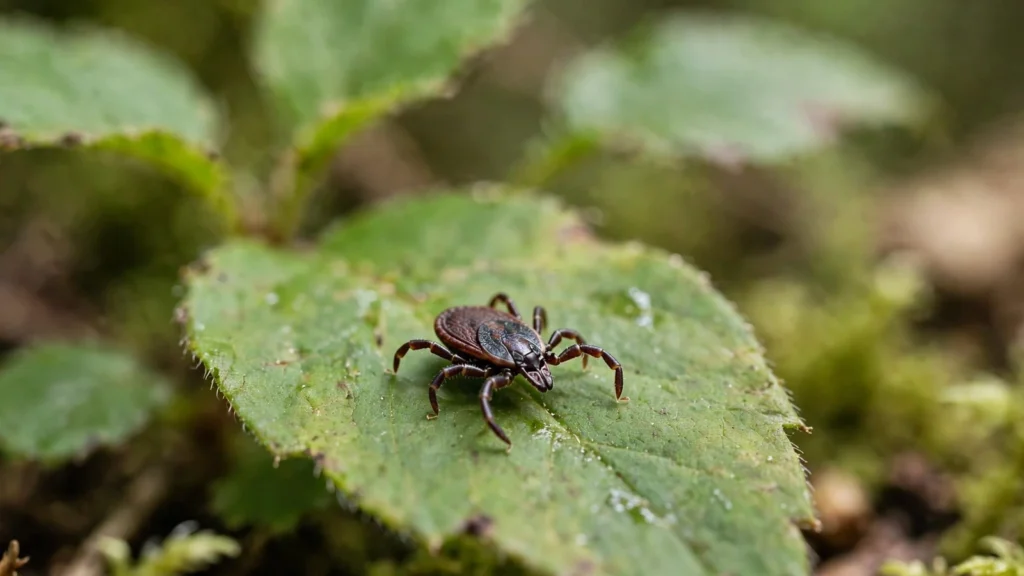
Powassan virus is a rare virus carried by ticks. It belongs to the flavivirus family, a group of viruses usually spread by mosquitoes and ticks, and it was first identified in 1958 in Powassan, Ontario, in Canada. Three kinds of Ixodes tick can carry it: the blacklegged or deer tick, the groundhog tick and the squirrel tick. The deer tick is the one that most often bites people, and it is the same tick that spreads Lyme disease.
The illness is uncommon, but reported cases have been increasing in recent years, according to the CDC. Most cases in the United States occur in the Northeast and Great Lakes regions, from late spring through mid-fall, when ticks are most active. About 239 cases were reported in the United States over the past 10 years, according to the New York State Department of Health.
The new study: 1 in 12 children with Lyme also had Powassan
A study published on 18 November 2026 in Clinical Infectious Diseases suggests Powassan infection is far more common than the official case counts imply, at least among children being checked for Lyme disease. Researchers led by Boston Children’s Hospital looked at blood samples from 600 children under 21 who had been evaluated for Lyme disease at eight emergency departments between 2015 and 2024. They compared 305 children with early Lyme disease against 295 children with similar symptoms who tested negative for Lyme; the median age was 9.
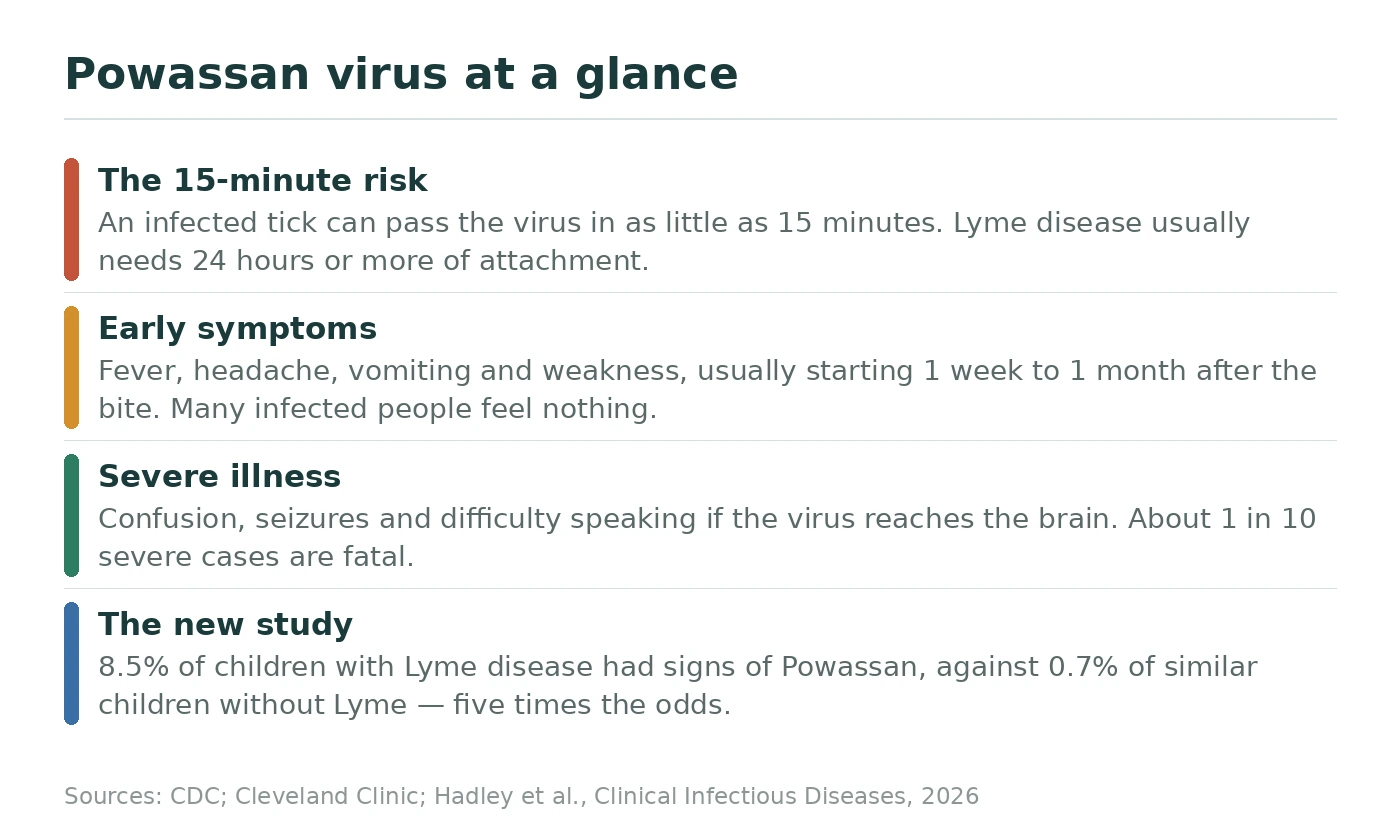
Antibody tests found evidence of a recent Powassan infection in 26 of the children with Lyme disease (8.5%), compared with just 2 of the comparison group (0.7%). After adjusting for other factors, children with Lyme disease had five times the odds of testing positive for Powassan antibodies. None of the Powassan infections had been recognised by the doctors treating the children.
The result needs care in reading. Only 11 of the 28 positive antibody results were confirmed by a second, more specific test, and no child had detectable viral genetic material in their blood, so some results may have been false positives. Even so, the authors say doctors should consider Powassan testing in children with suspected Lyme disease, especially when symptoms are unusual or recovery is slower than expected — and they call for faster, more accurate tests that can catch the virus early.
What are the symptoms of Powassan virus?
Many people infected with Powassan virus never feel ill at all. For those who do, symptoms usually begin one week to one month after the bite of an infected tick.
Early symptoms
- Fever
- Headache
- Vomiting
- Weakness
Severe illness
Powassan virus can cause severe illness, including inflammation of the brain (encephalitis) or the membranes around the brain and spinal cord (meningitis). Symptoms of severe illness include confusion, loss of coordination, difficulty speaking and seizures.
The outlook for severe illness is serious: about 1 in 10 people with severe illness die, and about half of those who survive have long-term health problems, such as recurring headaches, loss of muscle mass and strength, or memory problems, according to the CDC.
How Powassan spreads — and why 15 minutes matters
Powassan virus spreads to people through the bite of an infected tick. Ticks pick up the virus when they feed on small animals such as mice and other small mammals. The virus does not spread directly from person to person, although the CDC notes it can rarely spread through a blood transfusion.
The detail that worries doctors most is speed. An infected tick can transmit Powassan virus in as little as 15 minutes after attaching. Lyme disease, by contrast, usually needs a tick to stay attached for at least 24 hours before the bacteria pass across. That is why experts stress removing any tick as soon as you find it, rather than waiting until later in the day.
How is Powassan diagnosed and treated?
Doctors diagnose Powassan virus disease from a person’s symptoms, a history of possible tick exposure and laboratory tests on blood or spinal fluid, which look for antibodies the immune system makes against the virus. There is no vaccine to prevent it and no specific medicine to treat it — antibiotics do not work against viruses. Treatment is supportive care: rest, fluids and over-the-counter pain relief for mild illness. People with severe disease often need hospital care, which can include help with breathing, intravenous fluids and treatment to reduce swelling in the brain.
How to protect yourself from tick bites
Preventing tick bites is the only protection against Powassan virus. The Cleveland Clinic and the CDC recommend:
- Use an EPA-registered insect repellent on exposed skin.
- Wear light-coloured, long-sleeved clothing and long trousers, tucking trousers into socks.
- Stay on clear paths in woods and avoid brushing through tall grass and bushy areas.
- Check your body, clothing and pets for ticks after being outdoors, and shower within two hours of coming inside.
- Remove any attached tick promptly with fine-tipped tweezers, gripping close to the skin and pulling steadily upward, then clean the bite area.
When to see a doctor
See a doctor if a tick has bitten you and you develop fever, headache, vomiting or weakness in the following weeks, or if you have been in an area where ticks are common and feel unwell — even if you do not remember being bitten. A doctor can advise whether you need testing or treatment for Powassan or for other tick-borne illnesses such as Lyme disease.
Get emergency help straight away if you or someone near you develops confusion or other mental changes, seizures, trouble speaking or paralysis after a possible tick bite. In an emergency call 911 (US), 999 (UK) or 112 (EU).
Frequently asked questions
What is Powassan virus?
Powassan virus is a rare virus carried by ticks, mainly the blacklegged (deer) tick, in the northeastern and Great Lakes regions of the United States. It was first identified in 1958 in Powassan, Ontario, in Canada. The virus can cause a mild flu-like illness or, more rarely, inflammation of the brain or the membranes around it. There is no vaccine and no specific medicine for it.
What are the first symptoms of Powassan virus?
The first symptoms usually appear one week to one month after a tick bite and can include fever, headache, vomiting and weakness, according to the CDC. Many infected people never feel ill at all. Severe illness is different: confusion, loss of coordination, difficulty speaking and seizures can develop if the virus reaches the brain or the membranes around it.
How fast can a tick transmit Powassan virus?
An infected tick can pass Powassan virus to a person in as little as 15 minutes after attaching, the CDC and state health departments say. That is far faster than Lyme disease, which usually needs a tick to stay attached for at least 24 hours. It is one reason experts stress removing any tick as soon as you find it, using fine-tipped tweezers and pulling steadily upward.
Can Powassan virus be cured?
There is no specific medicine that cures Powassan virus, and antibiotics do not help because it is a virus, not a bacterium. Treatment is supportive: rest, fluids and over-the-counter pain relief for mild illness. People with severe disease often need hospital care, which can include help with breathing, intravenous fluids and treatment to reduce swelling in the brain.
How common is Powassan virus?
Powassan virus disease is rare. About 239 cases were reported in the United States over the past 10 years, according to the New York State Department of Health, although reported cases have been rising. Most cases occur in the Northeast and Great Lakes regions from late spring through mid-fall, when ticks are most active. Many infections probably go unrecognised.
Should children with Lyme disease be tested for Powassan?
The November 2026 study suggests doctors should consider Powassan testing in children with suspected Lyme disease, especially when symptoms are unusual or recovery is slower than expected. In the study, none of the Powassan infections had been spotted by the treating clinicians. Parents should raise the possibility with their child's doctor rather than ordering tests themselves.
Sources
- CDC: About Powassan Virus www.cdc.gov
- CDC: Symptoms of Powassan www.cdc.gov
- Cleveland Clinic: Powassan Virus my.clevelandclinic.org
- Hadley SM, et al. Prevalence of Powassan Virus Infection in Children with Suspected Lyme Disease. Clinical Infectious Diseases, 2026 doi.org
- CIDRAP: 1 in 12 children with Lyme disease show signs of Powassan virus co-infection www.cidrap.umn.edu
- New York State Department of Health: Powassan Virus Disease Fact Sheet www.health.ny.gov

Try the tool
Not sure if it can wait?
Common causes and warning signs for 16 everyday symptoms.
Open the symptom guide