What Is Lenacapavir? The Twice-Yearly HIV Prevention Injection
Two injections a year can now prevent HIV almost completely. Lenacapavir's story — from trial results to a $40-a-year generic reaching Zambia in November 2026.
- Written by
- Health Daily Advice
- Published
- Reading time
- 7 minutes
- Sources
- 7 cited

In this guide
Lenacapavir is a twice-yearly injection that prevents HIV. It blocks the virus’s capsid, the shell around its genetic material, and one dose protects for six months. In trials it prevented almost all infections, and in November 2026 the first low-cost generic version reached Zambia, bringing the price down to about $40 a year.
What is lenacapavir?
Lenacapavir is a medicine used as pre-exposure prophylaxis — PrEP — which means it is taken by people who do not have HIV to stop them acquiring it. Unlike daily PrEP pills, it is given as an injection under the skin just twice a year. It is the first twice-yearly injectable PrEP product, and the World Health Organization (WHO) calls it a transformative step for people who struggle with daily pills, stigma or access to healthcare.
The drug is sold under the brand name Yeztugo for prevention in the United States, and Sunlenca when used as part of treatment for people who already have HIV. The US Food and Drug Administration (FDA) approved it for prevention on 18 June 2025, for adults and adolescents weighing at least 35 kg, and the WHO recommended it as an additional PrEP option on 14 July 2025. The European Medicines Agency has also approved it.
Why does it matter now? Because 1.3 million people acquired HIV in 2024, according to the WHO, and an estimated 40.8 million people were living with HIV by the end of that year. Daily PrEP works well when taken consistently, but in practice many people miss doses or stop altogether — and that is the gap a twice-yearly injection is designed to close.
How does lenacapavir work?
Lenacapavir is a first-in-class HIV capsid inhibitor — the first drug of its kind. Most HIV medicines target viral enzymes; lenacapavir instead binds to the capsid, the protective protein shell that surrounds the virus’s genetic material. By latching onto the capsid, it disrupts several stages of the virus’s life cycle at once: it interferes with the virus entering the cell nucleus, with the proper assembly of new virus particles, and with their release. The result is malformed, non-infectious virus.
The long gap between doses comes from how the injection behaves in the body. The drug is injected under the skin, where it forms a slow-dissolving depot that releases the medicine gradually, keeping blood levels above the protective threshold for six months or more. Because the mechanism is new, lenacapavir shows minimal cross-resistance with existing HIV drug classes — an important feature if resistance ever develops.
Starting treatment involves more than one injection: the approved schedule begins with injections plus oral tablets on the first two days, to reach protective levels quickly while the depot forms, and then continues with one injection every six months. A negative HIV test is required before starting and before each injection — using PrEP while HIV infection is undiagnosed can lead to drug resistance, so testing is part of the routine.
How well does it work?
The evidence comes mainly from two large phase 3 trials, PURPOSE 1 and PURPOSE 2, both published in 2024 and 2025.
PURPOSE 1 enrolled 5,338 adolescent girls and young women aged 16 to 25 in South Africa and Uganda, a group at very high risk of HIV. As reported in the New England Journal of Medicine, none of the 2,134 participants who received lenacapavir acquired HIV over 52 weeks — 0 infections, against a background rate of 2.41 infections per 100 person-years in the screened population. By comparison, 39 of 2,136 people on daily oral F/TAF and 16 of 1,068 on daily F/TDF became infected. Adherence to the daily pills was low, which is part of why the injection performed so much better in practice.
PURPOSE 2 tested the same schedule in 4,366 cisgender men who have sex with men, transgender women and men, and gender-nonbinary people across the USA, South Africa, Peru, Brazil, Argentina, Mexico and Thailand. There were just 2 infections among 2,183 people on lenacapavir — 0.10 per 100 person-years — a 96% reduction against the background rate of 2.37, and an 89% reduction compared with daily oral F/TDF. A 2026 review in Drugs in Context concludes that the two trials together demonstrate near-complete protection across diverse populations.
It is worth being precise about “100% effective”. Zero infections in 2,134 women is a remarkable result, but it is a small-number estimate: the statistical upper bound was 0.19 infections per 100 person-years, not proof of perfect protection. What the trials do show is that lenacapavir is among the most effective HIV prevention tools ever tested.
Who can get it, and how is it given?
Lenacapavir for PrEP is approved for adults and adolescents weighing at least 35 kg who are at risk of sexually acquired HIV and who test negative for HIV. The WHO recommends it as an additional PrEP choice alongside daily oral PrEP, injectable cabotegravir given every two months, and the dapivirine vaginal ring. Guidelines from the US CDC and the International Antiviral Society-USA also recommend it as a first-line PrEP option.
The injections are given by a healthcare professional, usually in the abdomen, and the WHO has paired its recommendation with simplified HIV rapid testing, so that long-acting PrEP can be delivered through pharmacies, clinics and telehealth rather than only in specialist centres. Lenacapavir does not protect against other sexually transmitted infections or pregnancy, so condoms and other protection are still needed. Availability varies by country: it is approved in the United States and Europe and in several African countries, with more national approvals under way. Anyone interested should talk to a doctor or a sexual health clinic — the right PrEP option depends on individual circumstances, and this article cannot advise on that.
What are the side effects?
The most common side effects are reactions where the injection goes in — mild pain, redness and small lumps under the skin called nodules. In PURPOSE 1, injection-site reactions occurred in 68.8% of people on lenacapavir, against 34.9% of those given placebo injections, and nodules developed in 63.8%. The lumps are thought to be the body’s reaction to the drug depot under the skin; they usually shrink or disappear before the next injection, and very few people stopped treatment because of them — 0.2% in PURPOSE 1 and about 1.2% in PURPOSE 2.
No safety concerns were found in the trials beyond these local reactions. Because the drug stays in the body for months after the last injection — up to nine months — anyone who stops lenacapavir and remains at risk of HIV should talk to a doctor about switching to another form of PrEP, and should be tested for HIV. As with any medicine, the full list of possible side effects and interactions is in the patient information leaflet and should be discussed with a healthcare professional.
The 2026 generic rollout
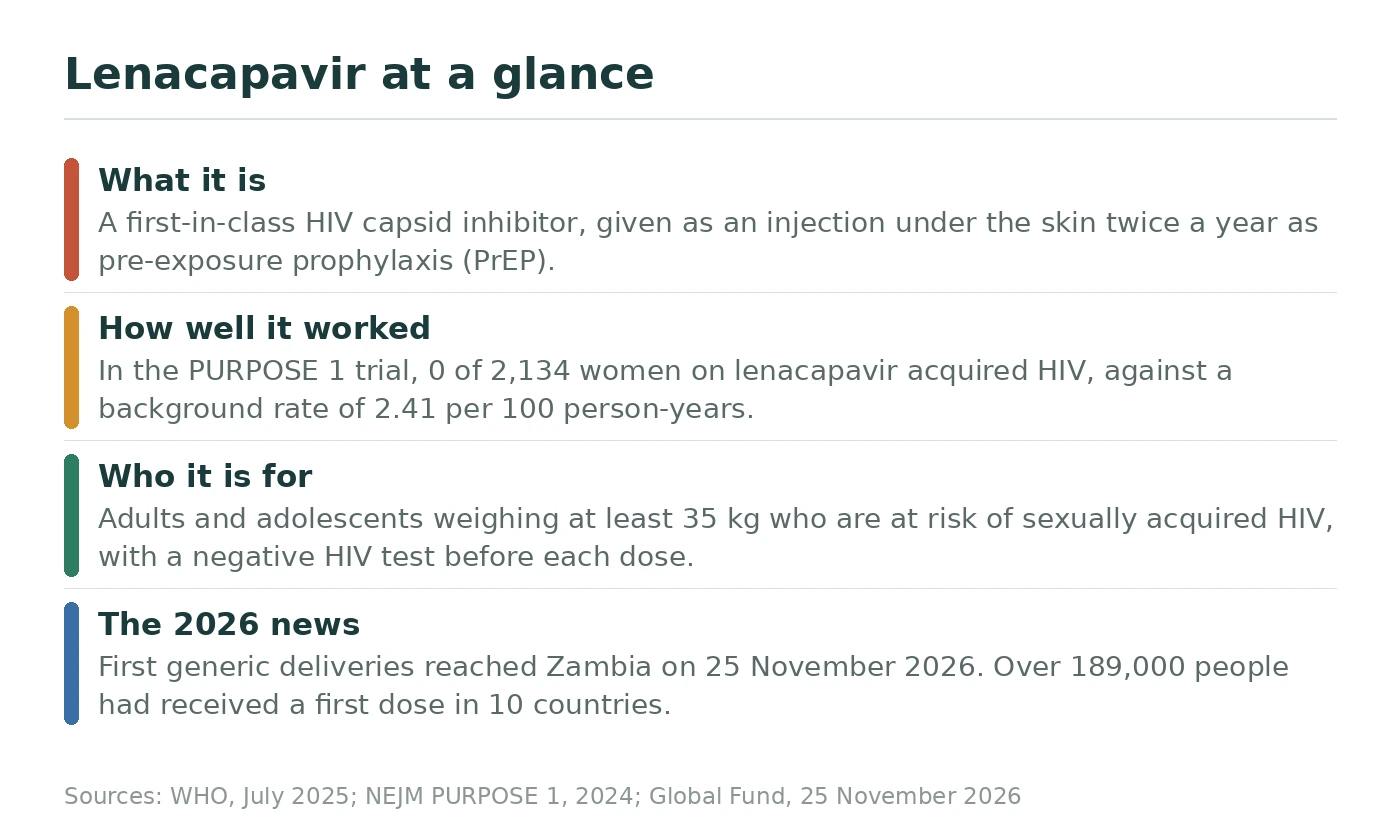
The biggest HIV prevention story of November 2026 is not the science — that was settled in 2024 — but access. On 25 November 2026 the Global Fund announced that the world’s first deliveries of generic lenacapavir had arrived in Zambia, with another delivery to Uganda expected within days and Zimbabwe to follow in early 2027. It is the first time a generic version of the drug has reached countries, just a year after the originator product arrived in sub-Saharan Africa.
The generic was made possible by a rapid regulatory path: on 2 November 2026 the FDA gave tentative approval to a generic version from Dr. Reddy’s Laboratories, only 16 months after approving the originator — one of the fastest timelines for a major HIV innovation. Under a partnership agreement between Unitaid, Wits RHI, the Clinton Health Access Initiative and Dr. Reddy’s, the generic will be supplied at about $40 per person per year in the 120 low- and middle-income countries covered by Gilead’s voluntary licence, in line with the cost of oral PrEP.
Uptake is already under way. The Global Fund says more than 189,000 people have received a first dose across 10 early-adopter countries, and 24 countries are expected to have lenacapavir by the end of 2026, with a joint ambition to reach at least 3 million people by the end of 2028. The first generic supplies are expected to reach countries before the end of 2026, with much larger shipments in the first quarter of 2027.
How does it compare with other PrEP?
Daily oral PrEP has been available since 2012 and reaches about 3 million people worldwide — far short of the UN goal of 21 million. Injectable cabotegravir, given every two months, was the first long-acting option, but it has reached only about 15,000 people worldwide four years after approval. Lenacapavir’s six-month interval is the longest yet, and its trial results are the strongest. The challenge now is delivery: clinics, supply chains and community programmes must be ready to give injections twice a year to millions of people, and funding for HIV programmes remains under pressure. As Unitaid put it, an affordable drug alone is not enough — health systems, providers and communities all have to be ready.
For readers who want background on how HIV spreads and how it is tested, see our earlier article on how HIV is transmitted.
When to see a doctor
Anyone who thinks they may have been exposed to HIV, or who is at ongoing risk, should contact a doctor or a sexual health clinic promptly — HIV testing and advice about prevention, including post-exposure prophylaxis, are time-sensitive. PrEP is a medical decision: a clinician needs to confirm a negative HIV test, check kidney function where relevant, and discuss which option fits. Lenacapavir is not a treatment for HIV and cannot be used by people who already have the virus without other antiretroviral medicines.
In an emergency call 911 (US), 999 (UK) or 112 (EU).
Frequently asked questions
What is lenacapavir?
Lenacapavir is a long-acting medicine that prevents HIV, given as an injection under the skin twice a year. It is a first-in-class capsid inhibitor: it blocks the protein shell around the virus's genetic material, stopping the virus from multiplying. It is sold as Yeztugo for prevention and is approved in the US and Europe for adults and adolescents weighing at least 35 kg.
How effective is lenacapavir at preventing HIV?
Very effective in trials. In PURPOSE 1, none of the 2,134 women given lenacapavir acquired HIV over a year, against a background rate of 2.41 infections per 100 person-years. In PURPOSE 2, there were 2 infections among 2,183 men and gender-diverse people — a 96% reduction against the background rate. Real-world effectiveness is still being measured as rollout continues.
Who can get lenacapavir?
It is approved for adults and adolescents weighing at least 35 kg who are at risk of sexually acquired HIV and who test negative for HIV before starting and before each injection. Availability varies by country: it is approved in the US and Europe and in several African countries, with more approvals under way. A doctor or sexual health clinic can advise whether it is the right option for you.
What are the side effects of lenacapavir?
The most common side effects are reactions at the injection site — mild pain, redness and small lumps under the skin. In the trials, nodules developed in about 64% of people on lenacapavir; they usually shrink before the next injection and very few people stopped treatment because of them. No other safety concerns were found. Anyone worried about a reaction should contact their doctor.
How much does lenacapavir cost?
It depends where you are. The generic version from Dr. Reddy's, which reached Zambia in November 2026, will be supplied at about $40 per person per year in the 120 lower-income countries covered by the voluntary licence. In higher-income countries the branded product costs far more, and prices and availability vary — check with local health services.
Sources
- WHO: WHO recommends injectable lenacapavir for HIV prevention www.who.int
- Bekker LG, et al. Twice-Yearly Lenacapavir or Daily F/TAF for HIV Prevention in Cisgender Women. N Engl J Med, 2024 www.nejm.org
- Anderson SL. Emerging concepts in HIV pre-exposure prophylaxis: focus on twice-yearly lenacapavir. Drugs Context, 2026 pmc.ncbi.nlm.nih.gov
- The Global Fund: First Deliveries of Generic Lenacapavir for HIV Prevention Arrive in Countries www.theglobalfund.org
- Unitaid: U.S. FDA approves first generic injectable lenacapavir for HIV prevention unitaid.org

Try the tool
Not sure if it can wait?
Common causes and warning signs for 16 everyday symptoms.
Open the symptom guide