Mpox Clade Ib Surge in the Americas: What Has Changed
PAHO warned on 24 November that mpox cases are climbing in the Americas, driven by Brazil and the clade Ib strain. Here is what is different this time — and what to do about it.
- Written by
- Health Daily Advice
- Published
- Reading time
- 6 minutes
- Sources
- 8 cited
In this guide
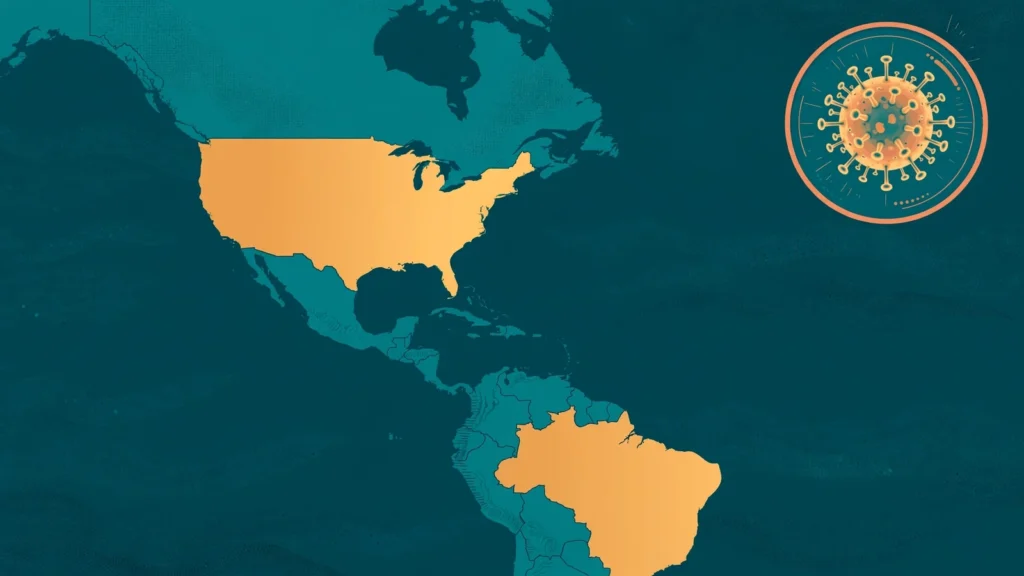
Mpox is rising again in the Americas, driven by a different strain. On 24 November 2026 the Pan American Health Organization warned that cases have climbed since late September, with growing detection of mpox clade Ib — a strain that spreads through household and close community contact, not only sexual networks. Thirteen countries reported 3,269 cases in 2026.
What is clade Ib, and why are health officials watching it?
Mpox, previously known as monkeypox, is a viral illness caused by the monkeypox virus. There are two distinct branches, or clades, of the virus: clade I (with subclades Ia and Ib) and clade II (with subclades IIa and IIb). The global outbreak that began in 2022 was caused by clade IIb and spread largely through sexual networks, mainly among gay, bisexual and other men who have sex with men.
Clade Ib is newer. It was first identified in the Democratic Republic of the Congo in 2023, where it spread from person to person and fuelled a large outbreak across Central and Eastern Africa. What sets it apart, according to the World Health Organization, is that it has shown a broader capacity to spread through household contact and close, non-sexual community contact — sharing bedding or towels, caring for someone who is ill, or prolonged face-to-face contact. That is the shift PAHO is warning about: a strain that once moved mainly through one network can now move through everyday close contact as well.
PAHO recorded more than 380 clade Ib cases across 11 countries in the Americas between late 2024 and mid-November 2026, with over 360 of those in 2026 alone. Early cases were mostly linked to international travel, but there is now evidence of local transmission: in the United States, more than 200 clade I cases have been found across at least 31 states and Puerto Rico, with infections in people with no recent travel history reported in at least 16 jurisdictions since August 2026. In Brazil, health officials confirmed 43 clade Ib infections in Rio de Janeiro, and São Paulo state reported 103 clade Ib cases as of 13 November.
The 2026 numbers so far
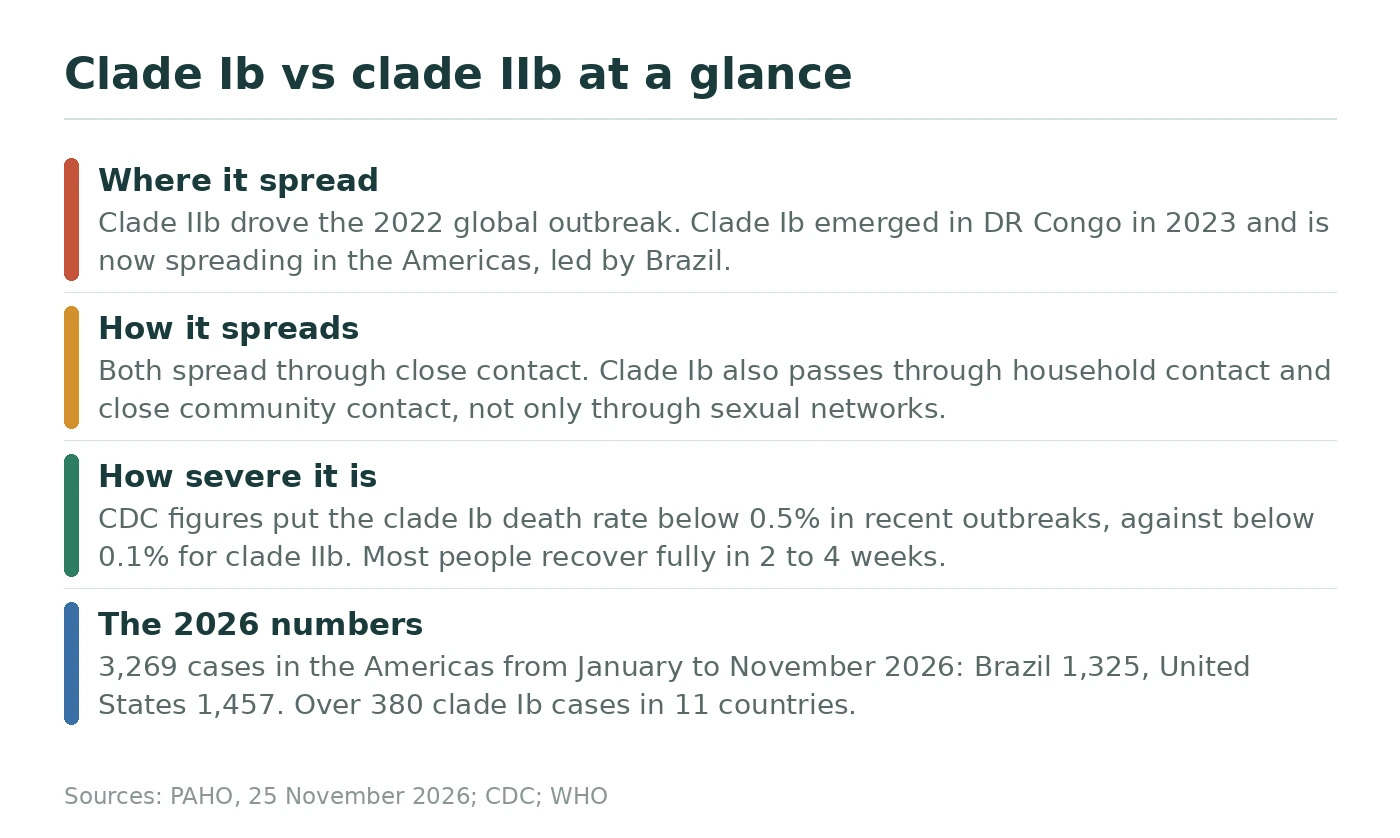
From January to November 2026, the Americas reported 3,269 confirmed mpox cases and four deaths across 13 countries. Brazil accounted for 1,325 cases, including one death, with a sharp rise since epidemiological week 39 (late September). The United States reported 1,457 cases. Other countries reporting cases included Chile, Canada, Colombia, Mexico, Argentina and Bolivia. Since 2022, the region has recorded 76,084 cases and 202 deaths across 31 countries and territories.
Those numbers are almost certainly an underestimate. PAHO notes that mild cases may go untested or be mistaken for common skin conditions, and that testing and reporting vary between countries. Case counts can also rise simply because a country is looking harder.
How severe is clade Ib?
Most people who catch mpox recover fully within two to four weeks with rest and care for their symptoms. But clade I has historically caused more severe disease than clade II. The CDC’s current figures put the death rate at under 0.5% for clade Ib in recent outbreaks, against under 0.1% for clade IIb. The risk is not spread evenly: children, pregnant people and people with weakened immune systems, including people living with HIV that is not well controlled, are at higher risk of serious illness.
The link with HIV is stark in PAHO’s data. Of the 202 mpox deaths recorded in the Americas since 2022, HIV status was known for 114 people — and 111 of those 114 (97%) were people living with HIV. Advanced HIV, with a low CD4 count, sharply raises the risk of severe, prolonged or fatal mpox. PAHO now recommends routinely offering confidential HIV testing alongside mpox testing, and keeping up antiretroviral treatment.
Complications can include bacterial infection of the skin, pneumonia, eye infection with loss of vision, and infections of the blood, brain or other organs. Mpox can be fatal in some cases, which is why early care matters.
What are the symptoms?
Symptoms usually begin within a week of exposure, but can start anywhere from 1 to 21 days afterwards, and typically last two to four weeks. The WHO lists a skin rash or sores, fever, sore throat, headache, muscle aches, back pain, low energy and swollen lymph nodes. For some people the rash is the first symptom; for others, fever or aches come first.
The rash often begins on the face and spreads over the body, including the palms of the hands and the soles of the feet, but it can start wherever contact happened, including the genitals. It starts as a flat sore, develops into a blister filled with liquid that may be itchy or painful, then dries up, crusts over and falls off. Some people have one or a few sores; others have hundreds. A person can pass the virus on until all sores have healed and a new layer of skin has formed.
Mpox can look like chickenpox, measles, herpes, syphilis or a bacterial skin infection, so testing matters. The preferred test is a PCR test on a swab taken directly from the rash. If you develop an unexplained rash, contact a healthcare provider or a sexual health clinic, and mention any close contact with someone who has mpox or recent travel.
How to protect yourself
- Vaccination: there are vaccines for mpox, and the CDC and PAHO recommend them for people at higher risk, including health workers at risk of exposure, people in the same household as someone with mpox, and people with multiple sexual partners. In the UK, the NHS offers the smallpox (MVA) vaccine to people most likely to be exposed. The vaccine can also be given after contact — ideally within 4 days, and up to 14 days if no symptoms have developed.
- Avoid close contact: avoid skin-to-skin contact with anyone who has a rash that looks like mpox, and do not share their towels, bedding, clothing or eating utensils.
- If you are ill: stay at home, in your own well-ventilated room if possible, wash your hands often, wear a mask and cover sores when around other people, and do not scratch or pop blisters. Isolate until all scabs have fallen off and new skin has formed. Use condoms for 12 weeks after recovery.
- If you were exposed: watch for symptoms for 21 days and avoid sexual activity during that time; seek advice promptly if a rash appears.
There is no proven antiviral treatment specific to mpox yet, though some antivirals are being evaluated in trials. Care focuses on managing pain and fever, keeping hydrated, caring for the skin and treating any second infection. If you have HIV and mpox, keep taking your antiretroviral therapy.
What this means in the UK and Europe
The risk of catching mpox in the UK remains low for most people, and the NHS notes it is rare here. But clade Ib is no longer only an African story. In October 2025 the UK Health Security Agency urged gay, bisexual and other men who have sex with men to come forward for vaccination after cases of locally acquired clade Ib mpox were identified in Europe for the first time, suggesting community transmission. The Pharmaceutical Journal reports that those European cases were a reminder that the strain can now spread outside its original networks.
That is also the message of PAHO’s alert: the WHO lifted the global emergency over mpox on 5 September 2025, but lifting an emergency is not the same as the virus going away. PAHO is urging countries to strengthen surveillance, laboratory testing and genomic sequencing so new clusters are caught early — and for the public, the practical advice is unchanged from 2022: know the rash, avoid close contact with it, and get tested quickly. Our earlier guide to mpox symptoms covers what the rash looks like in more detail.
When to see a doctor
Seek medical advice promptly if you develop an unexplained rash with blisters or sores, especially after close contact with someone who has or might have mpox, after a new sexual partner, or after travel to an area with active transmission. In the UK, call your GP, a sexual health clinic or NHS 111 first and tell them you suspect mpox before visiting. Get urgent help if you have trouble breathing or swallowing, severe pain, a rash affecting the eyes, or signs of a spreading skin infection. In an emergency call 911 (US), 999 (UK) or 112 (EU).
Frequently asked questions
What is mpox clade Ib?
Clade Ib is a sub-branch of the mpox virus first identified in the Democratic Republic of the Congo in 2023. It is part of clade I, which has historically caused more severe disease than the clade IIb strain behind the 2022 global outbreak. Clade Ib has now been detected in the Americas, with more than 380 cases in 11 countries.
How does mpox clade Ib spread?
Through close contact with someone who has mpox — skin-to-skin contact, including sex and kissing, face-to-face contact, and contact with contaminated bedding, towels or clothing. What is new about clade Ib is that it also spreads through household contact and close community contact, not only through sexual networks.
What are the symptoms of mpox clade Ib?
Symptoms usually start within a week of exposure, but can take up to 21 days. They include a rash that turns into painful blisters, fever, sore throat, headache, muscle aches, back pain, low energy and swollen lymph nodes. Symptoms typically last two to four weeks, and a person can spread the virus until all sores have healed.
Is mpox clade Ib more dangerous than the 2022 strain?
It appears somewhat more severe. The CDC puts the clade Ib death rate below 0.5% in recent outbreaks, against below 0.1% for clade IIb. Most people still recover fully in two to four weeks. The highest risk is for children, pregnant people and people with weakened immune systems, especially advanced HIV.
Who should get the mpox vaccine?
The CDC and PAHO recommend the vaccine for people at higher risk — health workers who may be exposed, people in the same household as someone with mpox, and people with multiple sexual partners. In the UK, the NHS offers it to people most likely to be exposed. It can also be given within 4 days of contact, and up to 14 days.
Sources
- PAHO: PAHO calls for stronger surveillance amid increase in mpox cases in the Americas www.paho.org
- WHO: Mpox fact sheet www.who.int
- CDC: About Monkeypox www.cdc.gov
- Health and Family: Mpox Cases Surge Across the Americas as Clade Ib Spread Prompts Urgent PAHO Warning healthandfamily.in
- Pharmaceutical Journal: Everything you need to know about mpox pharmaceutical-journal.com
- NHS North East London: Advice about Mpox northeastlondon.icb.nhs.uk

Try the tool
Not sure if it can wait?
Common causes and warning signs for 16 everyday symptoms.
Open the symptom guide