Holiday Heart Syndrome: Alcohol, AFib and the Festive Season
A racing, fluttering heartbeat after a big festive night out has a name: holiday heart syndrome. Here is why alcohol can throw your heart out of rhythm, what the research shows and when it is an emergency.
- Written by
- Health Daily Advice
- Published
- Reading time
- 7 minutes
- Sources
- 7 cited
In this guide
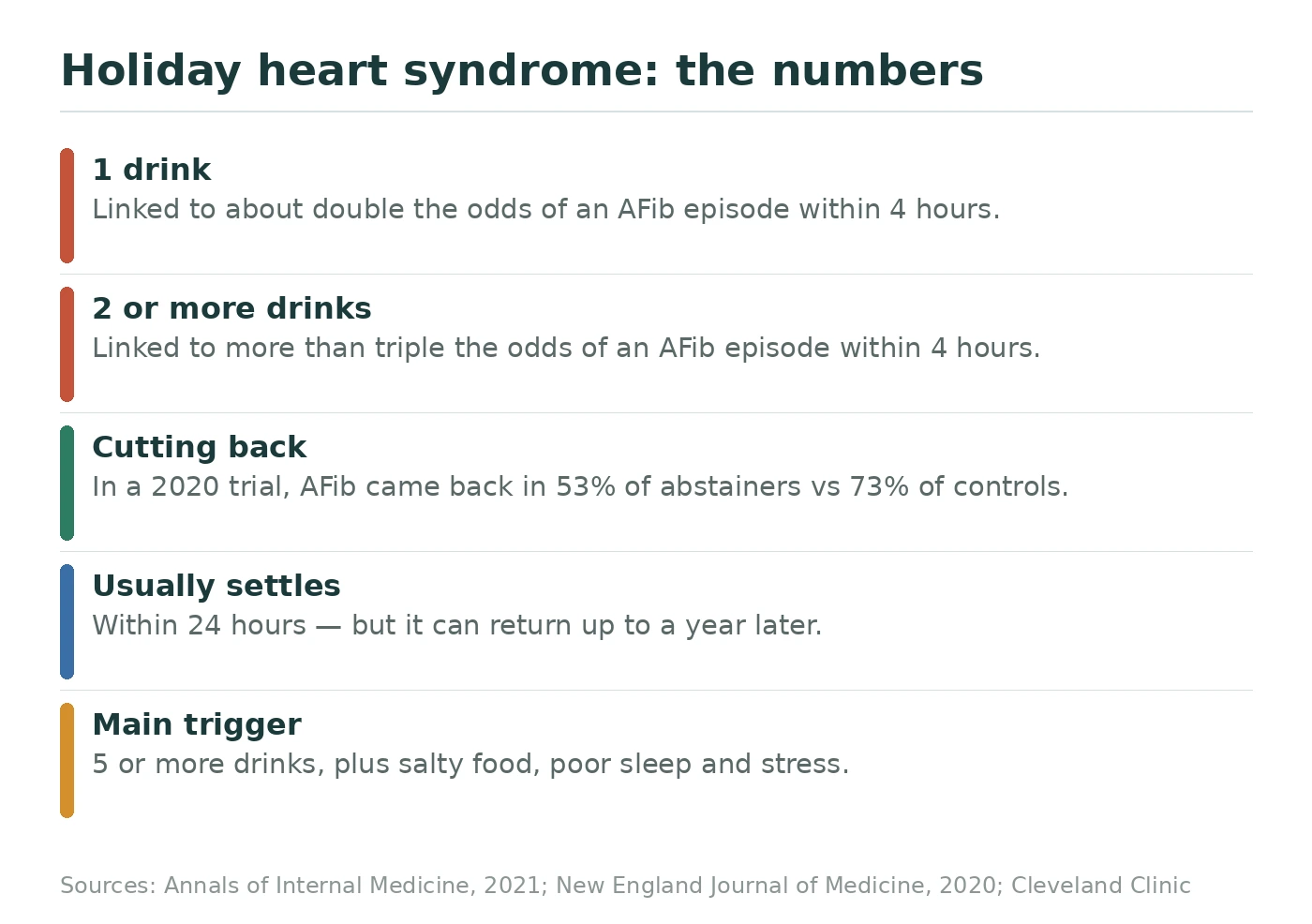
Holiday heart syndrome is a short spell of abnormal heart rhythm, usually atrial fibrillation, that follows heavy drinking — often around Christmas, New Year or Thanksgiving. The rhythm usually settles within a day, but it can be dangerous: it raises the risk of stroke and can return months later.
What is holiday heart syndrome?
Holiday heart syndrome is the name doctors give to an episode of abnormal heart rhythm that follows a stretch of heavy drinking, big salty meals, short sleep and stress. The most common rhythm is atrial fibrillation (AFib), in which the heart’s upper chambers quiver instead of beating in a steady, coordinated way, so the heartbeat turns fast and irregular.
Researchers gave the syndrome its name when they noticed more alcohol-related AFib cases in December and January. It is not only a Christmas problem: the same pattern shows up around Thanksgiving, New Year and any holiday weekend built around drinking. Emergency departments see a jump in people with a racing, fluttering or irregular heartbeat every festive season, and hospitals and heart doctors were warning about it again in Thanksgiving week 2026.
AFib itself is the most common heart rhythm disorder. According to the New England Journal of Medicine, it affects more than 33 million people worldwide, and over time it can lead to heart failure, stroke and dementia if it is not treated. Holiday heart is usually a one-off episode in someone who has never had a rhythm problem — but it can also trigger a flare in someone who already has AFib.
What does holiday heart feel like?
The symptoms usually start hours after drinking, often the morning after a heavy night. Cleveland Clinic lists the main ones as:
- Heart palpitations — a pounding, fluttering, racing or skipping feeling in the chest
- Fatigue and weakness
- Shortness of breath, even with light activity
- Chest pain or tightness
- Feeling lightheaded or dizzy
The NHS adds that the heartbeat may be faster than 100 beats per minute, and that some people feel very tired or find it harder to exercise. Some people feel nothing at all, and the rhythm problem is only picked up on a routine check or a test for something else.
It is easy to mistake holiday heart for a hangover: tiredness, a thumping chest and feeling washed out are common to both. The difference is the rhythm. If your pulse feels jumpy, uneven or much faster than usual — or a home blood pressure machine flags an irregular heartbeat — it is worth paying attention to, and worth getting checked the same day.
Why does alcohol upset the heart’s rhythm?
Alcohol disturbs the heart’s electrical system in several ways at once. It is toxic to heart muscle, it makes you pass more urine (which washes electrolytes such as potassium and magnesium out of the body — and the heart needs the right balance of electrolytes to beat steadily), and it disrupts sleep and raises blood pressure in the hours after drinking. Holidays then stack extra triggers on top: salty food that pushes blood pressure up and makes the body hold fluid, huge meals, late nights, travel, stress, and medicines taken late or skipped altogether.
Cleveland Clinic says drinking five or more alcoholic drinks is the main cause, although the number varies from person to person — some people are sensitive to far less. You can develop holiday heart even if you are young and have no heart condition, but the risk is higher if you have high blood pressure, diabetes, obesity, sleep apnoea, a heart valve problem, or are over 65.
What does the research show?
The link between alcohol and AFib is no longer just something patients report — it has been measured in real time. In a 2021 study published in the Annals of Internal Medicine, researchers at the University of California, San Francisco, fitted 100 people with paroxysmal AFib with a wearable heart monitor and an ankle sensor that objectively measured alcohol intake, and followed them for four weeks. Just one standard drink was associated with about double the odds of an AFib episode in the next four hours, and two or more drinks with more than triple the odds. Every 0.1% rise in blood alcohol concentration over the previous 12 hours was linked to roughly 40% higher odds of an episode. The effect was strongest three to four hours after drinking and lasted almost nine hours.
Cutting back helps, too. In a 2020 randomised trial published in the New England Journal of Medicine, 140 regular drinkers with AFib — averaging about 17 drinks a week — were assigned either to abstain from alcohol or to carry on as usual for six months. Those aiming for abstinence cut their intake by 87.5%, to about two drinks a week. AFib came back in 53% of them, compared with 73% of those who kept drinking, and they spent less of the time in AFib overall (a median of 0.5% of the time, versus 1.2%).
The American Heart Association’s 2025 scientific statement on alcohol and cardiovascular disease pulls the wider evidence together. Its conclusions are blunt: heavy drinking (two to four drinks a day) and binge drinking are consistently associated with worse outcomes across every cardiovascular condition studied, including high blood pressure, stroke, arrhythmias, cardiomyopathy and heart failure. It also found no proven cause-and-effect link between small amounts of red wine and better heart health, and it does not recommend drinking alcohol to protect the heart. If you do not drink, the advice is simple: do not start.
How much alcohol is too much?
There is no threshold below which alcohol is proven safe for the heart’s rhythm — the risk rises with the amount. But the definitions doctors use are a useful guide:
- A standard drink in the US is 12 ounces of regular beer (5% alcohol), 5 ounces of wine (12%), or 1.5 ounces of 80-proof spirits such as vodka, gin, rum or whiskey.
- Binge drinking means five or more drinks for men, or four or more for women, within about two hours.
- The American Heart Association’s limit for people who choose to drink is no more than two drinks a day for men and one a day for women.
- Holiday heart’s main trigger, according to Cleveland Clinic, is five or more drinks — but some people develop it after far fewer.
It is also worth remembering that the festive season is not only about alcohol. A huge salty meal, dehydration, poor sleep and stress all add strain, and together they can tip a borderline rhythm over the edge.
How is it diagnosed and treated?
If a doctor suspects AFib, the key test is an electrocardiogram (ECG), which records the heart’s electrical activity. The NHS says a GP will usually refer you to a heart specialist, who may also arrange an echocardiogram (an ultrasound of the heart), a chest X-ray and blood tests.
In most cases of holiday heart, the rhythm returns to normal on its own within 24 hours. While it is being monitored, treatment may include fluids through a drip, electrolytes and vitamins, medicines to slow the heart rate (such as beta-blockers) or to prevent blood clots that could cause a stroke (anticoagulants), and, if the rhythm does not settle, a procedure to reset it with a controlled electric shock (cardioversion). Your doctor may advise you to avoid alcohol and not to exert yourself until the rhythm has settled, and you can usually return to normal physical activity within a few days.
The outlook is good if you have no underlying heart problem — but the episode can come back, sometimes as much as a year later. Avoiding alcohol reduces the chance of it returning, and drinking heavily over the long term makes it more likely that AFib progresses from occasional episodes to a persistent problem.
A heart-smart plan for the festive season
A few simple habits lower the odds considerably:
- Decide your limit before the party starts — and alternate each alcoholic drink with water or sparkling water.
- Eat before you drink, and go easy on the salty sides: ham, gravy, stuffing, crisps and dips all push blood pressure up.
- Protect your sleep. Aim for a regular bedtime, even on days off, and do not drive or travel exhausted.
- Keep your medicines on schedule. Set a phone alarm, and pack them in your carry-on if you travel.
- Keep moving. A walk after the big meal helps digestion, clears your head and steadies your heart rate.
- Know your pulse. If your heartbeat feels irregular, check it at your wrist — a jumpy, uneven or unusually fast beat is worth a same-day call to your doctor.
None of this requires giving up the celebration. It is about keeping the season’s excesses from turning into a medical emergency.
When to see a doctor
See a GP promptly — the same day — if you notice palpitations that keep happening or are getting worse, or if you think you may have symptoms of atrial fibrillation. Do not wait for an appointment if the symptoms are severe.
Call 999 (UK), 911 (US) or 112 (EU) immediately — do not drive yourself — if you have a fast or irregular heartbeat together with chest pain, shortness of breath, sweating, feeling or being sick, fainting or feeling dizzy, a severe headache, weakness or numbness on one side of your face or body, blurred vision, or confusion or difficulty speaking.
In an emergency call 911 (US), 999 (UK) or 112 (EU).
Frequently asked questions
What is holiday heart syndrome?
Holiday heart syndrome is a short spell of abnormal heart rhythm, usually atrial fibrillation (AFib), that follows heavy drinking — often around Christmas, New Year or Thanksgiving. The heart's upper chambers quiver instead of beating steadily, so the heartbeat turns fast and irregular. Doctors named it after noticing more alcohol-related AFib cases in December and January.
How long does holiday heart syndrome last?
In most cases the rhythm returns to normal on its own within 24 hours. But it can come back — sometimes as much as a year later — and drinking heavily over the long term makes it more likely that AFib becomes a persistent problem. If your heart is still racing or irregular after a day, or the episodes keep happening, see a doctor promptly rather than waiting it out.
Can one drink trigger atrial fibrillation?
In people who already have AFib, yes — the evidence is striking. In a 2021 study of 100 patients wearing heart monitors and alcohol sensors, one standard drink was linked to about double the odds of an AFib episode in the next four hours, and two or more drinks to more than triple the odds. The study only covered people with existing AFib, so the figures do not apply directly to everyone.
Can holiday heart syndrome happen to healthy people?
Yes. It most often happens in people with no previous heart condition, including young adults. That said, the risk is higher if you have high blood pressure, diabetes, obesity, sleep apnoea, a heart valve problem, or are over 65. It can also trigger a flare in people who already have AFib, so anyone with a known rhythm problem should be extra careful at holiday gatherings.
How can I avoid holiday heart syndrome?
The most reliable step is to limit alcohol: the American Heart Association advises no more than two drinks a day for men and one for women, and if you do not drink, do not start. Decide your limit before the party, alternate drinks with water, eat before drinking, go easy on salty food, protect your sleep and keep your medicines on schedule.
When should I call an ambulance for a racing heart?
Call 999, 911 or 112 immediately — and do not drive yourself — if a fast or irregular heartbeat comes with chest pain, shortness of breath, sweating, feeling or being sick, fainting or dizziness, a severe headache, weakness or numbness on one side, blurred vision, or confusion or difficulty speaking. These can be signs of a heart attack or stroke.
Sources
- Cleveland Clinic: Holiday Heart Syndrome: Symptoms & Treatment my.clevelandclinic.org
- NHS: Atrial fibrillation www.nhs.uk
- American College of Cardiology: Alcohol May Have Immediate Effect on Atrial Fibrillation Risk, Events www.acc.org
- American Heart Association: Alcohol Use and Cardiovascular Disease (2025 scientific statement) newsroom.heart.org
- Voskoboinik A, et al. Alcohol Abstinence in Drinkers with Atrial Fibrillation. N Engl J Med, 2020 www.nejm.org

Try the tool
Not sure if it can wait?
Common causes and warning signs for 16 everyday symptoms.
Open the symptom guide