Are Nicotine Pouches Bad for You? Zyn, FDA Rules and Risks
Nicotine pouches such as Zyn are not safe, despite FDA authorisation. We explain what the clearance really means, the health risks, and who should avoid pouches.
- Written by
- Health Daily Advice
- Published
- Reading time
- 6 minutes
- Sources
- 10 cited
In this guide
Nicotine pouches such as Zyn are not safe, even though the Food and Drug Administration has authorised some for sale. Authorisation means the products met a public-health standard for adult smokers who switch completely — not that they are harmless or help anyone quit. They still deliver addictive nicotine, and their long-term effects are not yet known.
What are nicotine pouches?
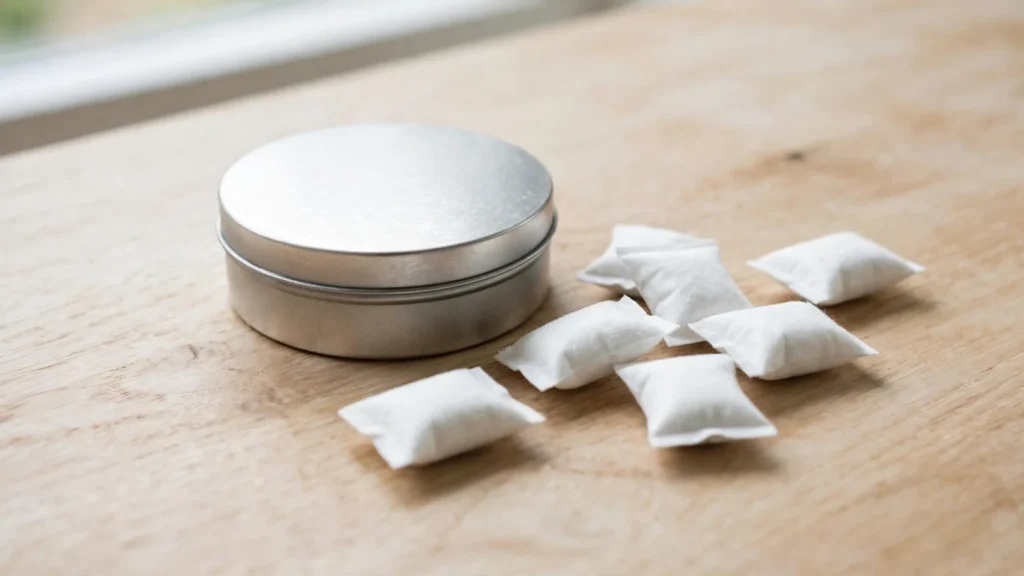
A nicotine pouch is a small white pouch of nicotine powder, flavourings and other ingredients. It sits between the upper lip and gum, where the nicotine dissolves and is absorbed through the lining of the mouth. There is no smoke, no vapour and no spitting — which is why the products look harmless, and why they are easy to use unnoticed, including at school.
Unlike snus, pouches contain no tobacco leaf. The nicotine may come from tobacco plants or be made in a laboratory, but as the CDC explains, there is little chemical difference between the two. The best-known brand is Zyn; others include VELO and on!.
What has the FDA actually authorised?
On 16 January 2025, the FDA authorised the marketing of 20 ZYN nicotine pouch products — ten flavours, each in 3 mg and 6 mg strengths. It was the first time the agency had authorised any nicotine pouch, and the decision came through the premarket tobacco product application (PMTA) pathway.
Since then the list has grown. The FDA’s authorised nicotine pouch list now names 67 products across just three brands — and the agency stresses that these are the only nicotine pouch products that may lawfully be sold in the United States.
| Brand | Authorised products | Strengths |
|---|---|---|
| ZYN | 31 (20 original, 11 ZYN ULTRA) | 3 mg, 6 mg, 9 mg, 11 mg |
| VELO Mini Pouch | 24 | 4 mg |
| on! and on! PLUS | 12 | 2 mg, 4 mg, 6 mg, 9 mg |
| Total | 67 | — |
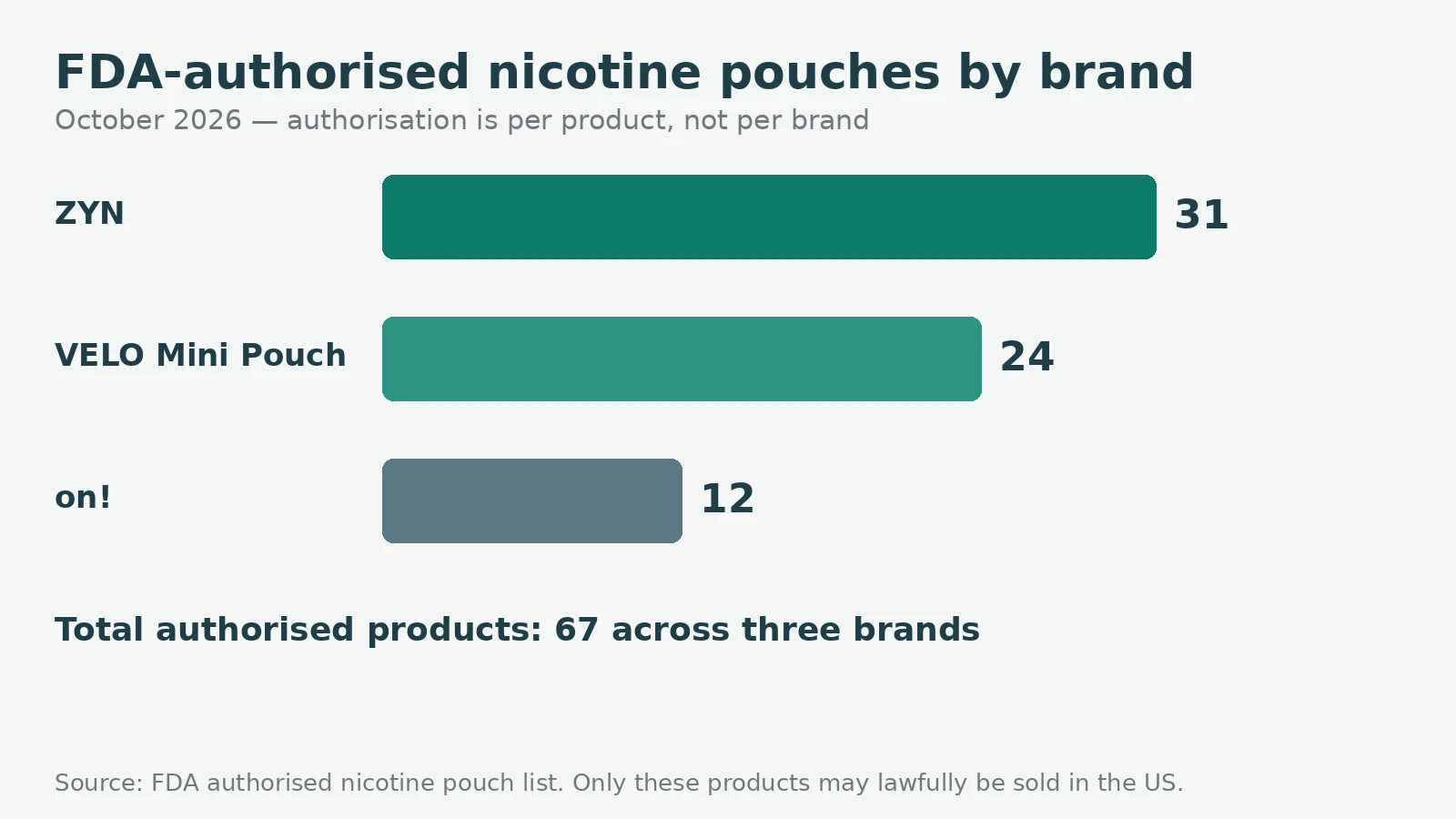
Authorisation is granted product by product, not brand by brand. A familiar name on the tin tells you very little: most flavours and strengths sold under the Zyn, VELO and on! names are not on the list, and brands such as Rogue and Lucy have none authorised.
Does FDA authorisation mean Zyn is safe?
No — and the FDA says so in plain terms: authorisation “does not mean these tobacco products are safe, nor are they ‘FDA approved'”, and “there is no safe tobacco product”. It is a permission to sell, granted because the agency judged the products met a legal public-health standard, weighing the benefit to adults who switch completely against the risks, including to young people.
What the FDA did find was that the authorised ZYN products contain substantially lower amounts of harmful constituents than cigarettes and most smokeless tobacco, and so pose a lower risk of cancer and other serious conditions, with evidence that a substantial proportion of adults who smoked switched completely. But lower risk than cigarettes is a long way from safe — and the benefit only applies to adults who switch completely.
What are the health risks of nicotine pouches?
Pouches have only been sold in the US since 2016, so the long-term evidence is thin. The CDC is clear that more research is needed on their short- and long-term health effects. A 2022 study of 44 pouch products, cited by the American Lung Association, found that 26 contained cancer-causing chemicals.
Are nicotine pouches addictive?
Yes. Nicotine is a highly addictive chemical, and pouches can contain high levels of it. The American Heart Association notes that some pouches contain more nicotine than cigarettes, and using them all day can make them even more addictive. Stopping brings withdrawal — cravings, anxiety, irritability, restlessness, poor concentration, low mood and trouble sleeping, as described by Mayo Clinic. The American Lung Association reports that 73% of young people who have tried nicotine pouches are still using them.
What do pouches do to the heart?
Nicotine raises heart rate, raises blood pressure and narrows blood vessels, according to the American Heart Association. Over time, that extra strain can increase the risk of heart attack and stroke. The association also warns that pouches can harm teeth and gums, disrupt memory and attention, and contribute to anxiety and depression, with some users reporting nausea.
Why are pouches a particular worry for young people?
The brain keeps developing until around the age of 25, and nicotine can harm the parts of the brain that control attention, learning, mood and impulse control. Young people can show signs of addiction quickly, even without using tobacco regularly. That is why the FDA restricted marketing of the authorised products to adults aged 21 and older, and why it may suspend or withdraw authorisation if youth use rises notably.
Use among teenagers is already significant. In 2025, 1.7% of US middle and high school students — about 460,000 young people — reported currently using oral nicotine pouches, according to Truth Initiative. Of those, more than one in four had used pouches on at least 20 of the previous 30 days, and more than one in six used them daily.
Who should not use nicotine pouches?
The CDC’s advice is straightforward: young people, young adults and pregnant women should not use nicotine pouches, and people who do not currently use tobacco products should not start. Nicotine is toxic to developing fetuses, so anyone who is pregnant, or planning a pregnancy, should talk to a doctor or midwife about quitting nicotine in any form.
Children face a separate danger. Truth Initiative reports that accidental ingestions of nicotine pouches by children younger than six surged by about 763% between 2020 and 2023, which is why the FDA has urged manufacturers to use child-resistant packaging. Keep pouches stored safely, out of children’s reach, and seek urgent medical help if a child swallows one.
Can pouches help you stop smoking?
No nicotine pouch has been approved by the FDA as a way to quit smoking — the CDC states this explicitly. Pouches are not a quit medication, and there is not yet good evidence they help people stop. In fact, the American Lung Association found that of the US adults currently using pouches, only about 35% had previously smoked, and of those only 10% had stopped smoking and switched completely.
The FDA has approved seven medications to help people quit, and the CDC notes that combining medication with behavioural counselling can more than double a person’s chances of quitting. If you want to stop, talk to a doctor or pharmacist about the proven options.
What about the new “lower risk” claim?
On 30 June 2026, the FDA went a step further for the original 20 ZYN products, issuing modified risk granted orders allowing them to be marketed with the claim: “Using ZYN instead of cigarettes puts you at a lower risk of mouth cancer, heart disease, lung cancer, stroke, emphysema, and chronic bronchitis.” The orders last five years, and the FDA can withdraw them if youth use rises significantly.
Read the claim carefully. It compares Zyn with cigarettes — it does not say Zyn is safe, and it does not apply to any other brand or product. The FDA adds that fully quitting all tobacco would most benefit an adult smoker’s health. “May reduce exposure” is not the same as “risk-free”.
When to see a doctor
Talk to a doctor or pharmacist if you use nicotine pouches and want to stop, if you notice cravings or withdrawal symptoms when you try to cut down, or if you develop mouth soreness, gum problems or a racing heartbeat. Seek urgent help straight away if a child swallows a pouch, or if anyone develops vomiting, a very fast heartbeat, confusion, shaking or difficulty breathing after using nicotine — these can be signs of nicotine poisoning.
In an emergency call 911 (US), 999 (UK) or 112 (EU).
The bottom line
Nicotine pouches are a mixed picture: less harmful than cigarettes for an adult smoker who switches completely, but addictive, not approved to help anyone quit, and far from safe. The FDA’s clearance is a narrow permission to sell specific products to adults — not a safety stamp. For anyone who does not already use tobacco, the healthiest choice is not to start.
Frequently asked questions
Are nicotine pouches bad for you?
Yes — nicotine pouches are not safe. They deliver addictive nicotine, which raises heart rate and blood pressure, can harm developing brains, and may damage teeth and gums. Some products also contain cancer-causing chemicals. The FDA has authorised 67 pouches for sale in the US, but authorisation is not approval, and the long-term health effects are still unknown.
Is Zyn FDA approved?
No. Zyn is authorised for sale, not approved. In January 2025 the FDA authorised 20 ZYN products for marketing, and the list has since grown to 31 ZYN products out of 67 authorised pouches in total. Authorisation means the products met a public-health standard for adult smokers who switch completely. The FDA states clearly that authorisation does not mean the products are safe or 'FDA approved'.
Can nicotine pouches help you quit smoking?
No nicotine pouch is approved by the FDA as a quit-smoking aid, and there is no good evidence that pouches help people stop smoking. The FDA has approved seven medications to help people quit, and combining medication with behavioural counselling can more than double the chances of success. If you want to quit, talk to a doctor or pharmacist about those proven options.
Are nicotine pouches safer than cigarettes?
For an adult smoker who switches completely, authorised pouches expose them to far fewer harmful chemicals than cigarettes, and the FDA has allowed 20 ZYN products to carry a 'lower risk' claim versus cigarettes. But that does not make pouches safe — they still deliver addictive nicotine, and the long-term effects are unknown. Fully quitting all tobacco is the healthiest choice.
How much nicotine is in a Zyn pouch?
The FDA-authorised ZYN products contain 3 mg or 6 mg of nicotine per pouch, while the newer ZYN ULTRA range contains 9 mg or 11 mg. Other brands differ: authorised VELO Mini Pouch products contain 4 mg, and authorised on! products range from 2 mg to 9 mg. Some unauthorised pouches sold in shops contain far more, so the strength on the tin is worth checking.
Are nicotine pouches bad for your gums?
They can be. The American Heart Association warns that nicotine pouches can harm teeth and gums, and users report mouth soreness and irritation where the pouch sits. Because pouches have only been sold in the US since 2016, the long-term effects on oral health are still being studied. If you notice gum pain, soreness or white patches, talk to a dentist or doctor.
Sources
- FDA: FDA Authorizes Marketing of 20 ZYN Nicotine Pouch Products after Extensive Scientific Review www.fda.gov
- FDA: Nicotine Pouch Products Authorized by the FDA www.fda.gov
- FDA: FDA Authorizes 20 ZYN Nicotine Pouches to Be Marketed with Specific Modified Risk Claim www.fda.gov
- CDC: Nicotine Pouches www.cdc.gov
- Truth Initiative: What is Zyn and what are oral nicotine pouches? truthinitiative.org
- American Lung Association: ZYN 101: What to Know About Big Tobacco's Latest Addiction www.lung.org
- American Heart Association: What to Know About Smoking, Nicotine and Vaping www.heart.org
- Mayo Clinic: Nicotine dependence — Symptoms and causes www.mayoclinic.org

Try the tool
Not sure if it can wait?
Common causes and warning signs for 16 everyday symptoms.
Open the symptom guide