Ibuprofen Recall November 2026: Lot, Risks and What to Do
One lot of prescription ibuprofen 800 mg tablets has been recalled in the US over possible aluminium particles on the tablet surfaces. Here is how to check your bottle, what the risks are, and what to do if yours matches.
- Written by
- Health Daily Advice
- Published
- Reading time
- 5 minutes
- Sources
- 10 cited
In this guide
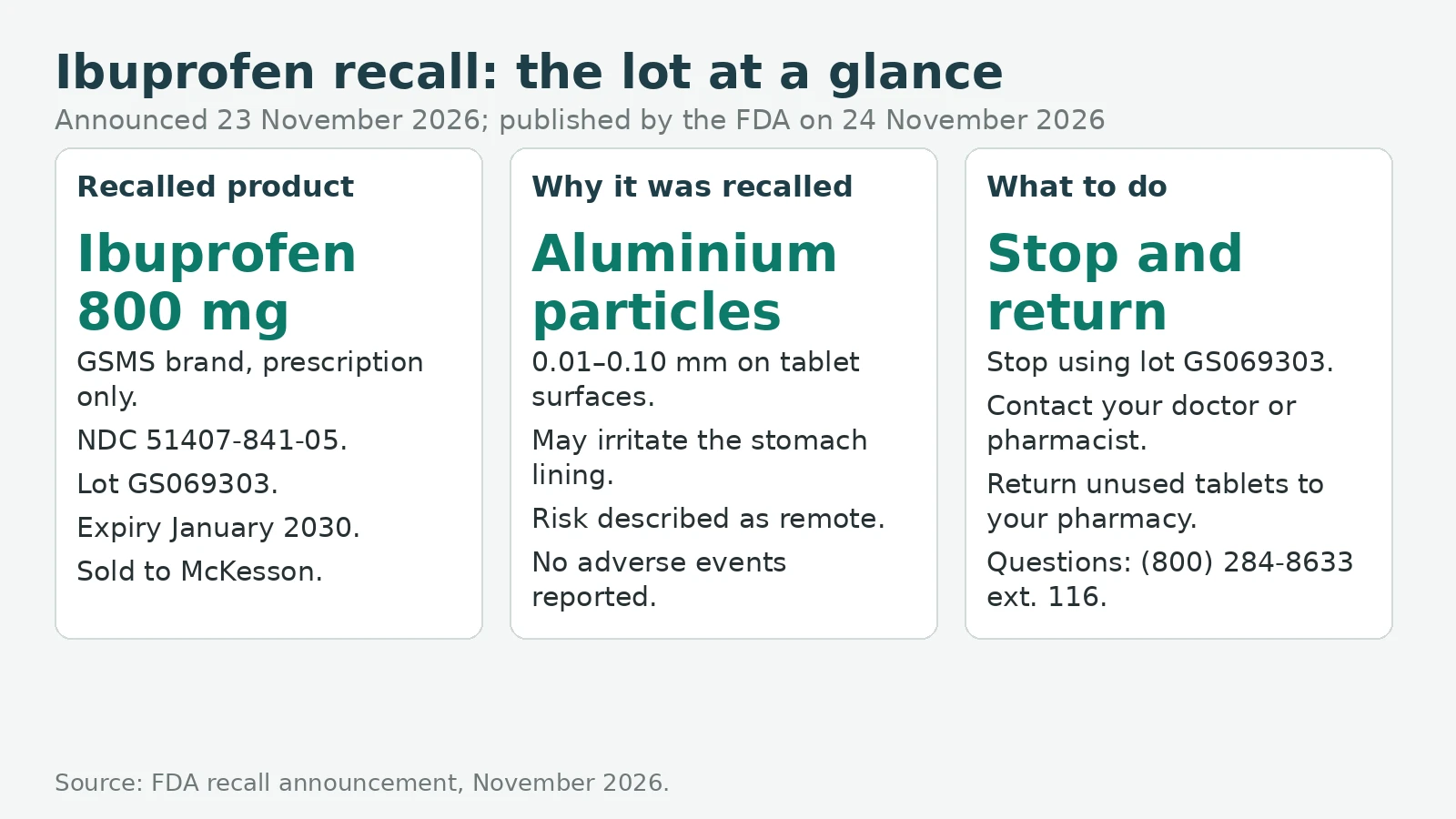
Golden State Medical Supply has recalled one lot of prescription ibuprofen 800 mg tablets, lot GS069303, because aluminium particles may be on the tablet surfaces. The FDA published the recall on 24 November 2026. Stop using tablets from this lot, return them to your pharmacy, and ask your doctor or pharmacist for advice.
Which ibuprofen tablets have been recalled?
The recall covers a single lot of ibuprofen 800 mg tablets made by Golden State Medical Supply, Inc. (GSMS) of Camarillo, California. The company announced the voluntary recall on 23 November 2026, and the US Food and Drug Administration (FDA) published the announcement the following day. A tablet is only part of this recall if every detail below matches:
| Detail | Recalled product |
|---|---|
| Product | Ibuprofen 800 mg tablets (brand GSMS) |
| National Drug Code (NDC) | 51407-841-05 |
| Lot number | GS069303 |
| Expiry date | 01/2030 (January 2030) |
The recalled lot was sold to McKesson, one of the largest medicine distributors in the United States. McKesson sites have been told to stop distributing it at once, quarantine whatever stock they still hold, and send it back to GSMS, and to pass the recall notice on to the pharmacies and patients they supply.
Why were these ibuprofen tablets recalled?
The problem is possible contamination with tiny aluminium particles on the surface of the tablets. According to the company’s announcement, the particles measure between 0.01 and 0.10 millimetres across — far too small to see without magnification. The contamination is described as localised to the surface, a quality problem with the finished tablets rather than something wrong with the medicine itself.
Continued use of tablets from the affected lot may cause minor irritation and abrasion of the lining of the stomach or intestines. The company puts the likelihood of a related adverse event as remote, given the tiny size of the particles, and states that it is not aware of any adverse events linked to this lot. That is reassuring, but it is not a reason to keep taking tablets you know are recalled.
Is my ibuprofen affected by the recall?
Most people’s ibuprofen is not affected. This is a narrow recall: a bottle is involved only if it is the 800 mg strength, carries the GSMS brand and NDC 51407-841-05, and comes from lot GS069303. Other lots and other strengths are not listed.
The 800 mg strength is available only on prescription. The official drug label for ibuprofen 800 mg tablets marks them “Rx Only”, while the 200 mg tablets sold over the counter as Advil, Motrin or a supermarket own-brand are not part of this recall. If the ibuprofen in your medicine cabinet came from a shop shelf rather than a prescription, it is not the product being recalled.
To check a prescription bottle, look at the pharmacy label. If the lot number is GS069303 and the expiry is 01/2030, the bottle matches. If you cannot find a lot number, take the bottle to the pharmacy that filled the prescription and ask them to check — pharmacies keep dispensing records, so they can usually confirm whether your supply came from the recalled lot.
What should I do if I have the recalled tablets?
Stop using tablets from the affected lot and contact your doctor, pharmacist or healthcare provider straight away. Do not simply switch to a different painkiller on your own — your doctor or pharmacist can advise on a suitable replacement, especially if you take ibuprofen regularly for a long-term condition such as arthritis.
Return any unused tablets to the pharmacy where you obtained them, and keep the bottle and its label, because the pharmacy will need the lot number and expiry date to process the return. If you have already taken tablets from the recalled lot and you feel unwell, contact your doctor or pharmacist and tell them the lot number.
Questions about the recall can go to Golden State Medical Supply on (800) 284-8633, extension 116, Monday to Friday between 7:30 a.m. and 4:00 p.m. Pacific time, or by email to recalls@gsms.us. You can also report any problem to the FDA’s MedWatch programme, which collects reports of adverse events and quality problems with medicines.
What is ibuprofen used for?
Ibuprofen is a non-steroidal anti-inflammatory drug (NSAID). It reduces the production of substances in the body that cause pain, fever and inflammation. The 800 mg prescription tablets are used for rheumatoid arthritis and osteoarthritis, mild to moderate pain, and period pain.
Because the 800 mg tablets are a prescription strength, they are typically given to people who need stronger or longer-term pain relief than the 200 mg shop-bought tablets provide. That is why this recall matters most to people with arthritis or ongoing pain: they are the ones most likely to have a bottle of the higher-strength tablets at home, and the ones who most need a replacement arranged promptly.
What are the side effects of ibuprofen?
Like all medicines, ibuprofen can cause side effects, although not everyone gets them. The NHS lists the common ones as indigestion and stomach aches, feeling or being sick, headaches, a rash, dizziness, and diarrhoea or constipation. These are usually mild and settle once the medicine is stopped, but speak to a pharmacist or doctor if a side effect bothers you or does not go away.
Serious side effects are rarer but need prompt attention. Ibuprofen and other NSAIDs can raise the risk of a heart attack or stroke, and can cause ulcers, bleeding or holes in the stomach or intestines — problems that can develop without warning, according to MedlinePlus. The Mayo Clinic warns that serious skin reactions can also occur, and that stomach bleeding is more likely if you have had a stomach ulcer before, smoke or drink alcohol regularly, are over 60, or take a steroid or blood thinner alongside it.
When to see a doctor
Contact your doctor or pharmacist promptly if you have been taking tablets from the recalled lot, or if you develop stomach pain, heartburn, vomit that looks like blood or coffee grounds, or black and tarry stools. These can be signs of bleeding in the stomach or intestines. Also seek help quickly for chest pain, shortness of breath, weakness on one side of the body, slurred speech, swelling of the face or throat, or difficulty breathing. Stop taking the tablets and get medical advice before taking another dose.
If you are pregnant, have asthma, a stomach ulcer, or heart, liver or kidney problems, or you take blood thinners, steroids or antidepressants, talk to your doctor or pharmacist before using any replacement painkiller. Ibuprofen is not suitable for everyone, and it should be avoided during pregnancy unless a doctor or pharmacist advises otherwise.
In an emergency call 911 (US), 999 (UK) or 112 (EU).
How can I stay informed about medicine recalls?
Recalls like this one are announced by the manufacturer and published by the FDA, and the FDA’s MedWatch programme publishes safety alerts for prescription and over-the-counter medicines. Keep the original packaging and pharmacy label until you finish a prescription, and check the lot number whenever a recall is in the news — a two-minute check is all it takes to know whether the story applies to you.
Frequently asked questions
Is all ibuprofen recalled in November 2026?
No. Only one lot of one product is recalled: GSMS ibuprofen 800 mg tablets, NDC 51407-841-05, lot GS069303, expiring January 2030. Other lots, other strengths and other brands are not affected, and the 200 mg tablets sold over the counter as Advil, Motrin or own-brand products are not part of the recall. Check the lot number on your bottle to be sure.
How do I check if my ibuprofen is part of the recall?
Look at the pharmacy label and the manufacturer's packaging for three details: the strength, the NDC and the lot number. Your tablets are recalled only if they are ibuprofen 800 mg, NDC 51407-841-05, lot GS069303, with an expiry of January 2030. If any detail differs, your tablets are not affected. If you cannot find the lot number, ask the pharmacy that filled the prescription to check its records.
What should I do if I have taken a recalled ibuprofen tablet?
Stop taking tablets from lot GS069303 and contact your doctor or pharmacist, telling them the lot number. Return any unused tablets to the pharmacy where you got them. The company says the chance of harm is remote and it knows of no adverse events linked to this lot, but seek medical advice promptly if you develop stomach pain, vomiting blood, black stools, chest pain or shortness of breath.
Is Advil or Motrin affected by the ibuprofen recall?
No. The recall covers only prescription ibuprofen 800 mg tablets made by Golden State Medical Supply, lot GS069303. Advil and Motrin are over-the-counter brands sold at 200 mg, and no 200 mg ibuprofen product is named in the recall. The same applies to own-brand 200 mg tablets. If your tablets are 200 mg and bought from a shop shelf, they are not affected.
What are the aluminium particles in the recalled ibuprofen?
The company found possible aluminium particulate, measuring 0.01 to 0.10 millimetres, on the surface of tablets in lot GS069303. Swallowing such particles could cause minor irritation and abrasion of the stomach or intestinal lining. The company describes the likelihood of an adverse event as remote because the particles are so small, and it reports no adverse events linked to this lot so far.
How do I report a problem with a recalled medicine?
If you had a problem after taking a recalled tablet, tell your doctor or pharmacist first, especially if you have symptoms that worry you. You can also report it to the FDA's MedWatch programme online, by post or by fax, or call 1-800-332-1088 for a reporting form. In the UK, suspected side effects can be reported through the MHRA Yellow Card scheme.
Sources
- FDA: Golden State Medical Supply, Inc. Issues a Voluntary Nationwide Recall of Ibuprofen 800mg Tablets Due to Potential Aluminum Particulate Contamination www.fda.gov
- DailyMed: Ibuprofen Tablets, USP (800 mg) Rx Only dailymed.nlm.nih.gov
- MedlinePlus: Ibuprofen medlineplus.gov
- NHS: Ibuprofen for adults www.nhs.uk
- Mayo Clinic: Ibuprofen (oral route) www.mayoclinic.org
- FDA: MedWatch — The FDA Safety Information and Adverse Event Reporting Program www.fda.gov

Try the tool
Not sure if it can wait?
Common causes and warning signs for 16 everyday symptoms.
Open the symptom guide