HIV Infections Could Rise Again, UN Warns
New HIV infections hit a record low in 2025 — but UNAIDS warns the gains are fragile. Funding cuts, closing clinics and falling testing could push infections up again from 2027.
- Written by
- Health Daily Advice
- Published
- Reading time
- 5 minutes
- Sources
- 6 cited
In this guide
HIV infections could start rising again from 2027, the UN’s AIDS agency warned on 24 November 2026. New infections fell to a record low of 1.2 million in 2025, but international funding dropped 18% in a year, prevention clinics are closing and testing is falling — and UNAIDS says the data will soon show the reversal.
What UNAIDS warned
UNAIDS published its World AIDS Day report, Ending AIDS Starts with Access, on Tuesday 24 November 2026, a week before World AIDS Day on 1 December. Its executive director, Winnie Byanyima, told Reuters that new HIV infections could begin rising from historic lows next year because of funding cuts and campaigns rolling back rights.
“We are on the cusp of ending AIDS – this has been the greatest story of global health – and just when we should finish it, cuts and the rolling back of human rights is threatening to take away our gains,” she said. “We haven’t got the data yet, but we see the signs. We see all the signs of reversals,” she added, predicting that data released in 2027 would start reflecting rising infections. She also said numbers were already increasing in parts of South America.
The progress at stake
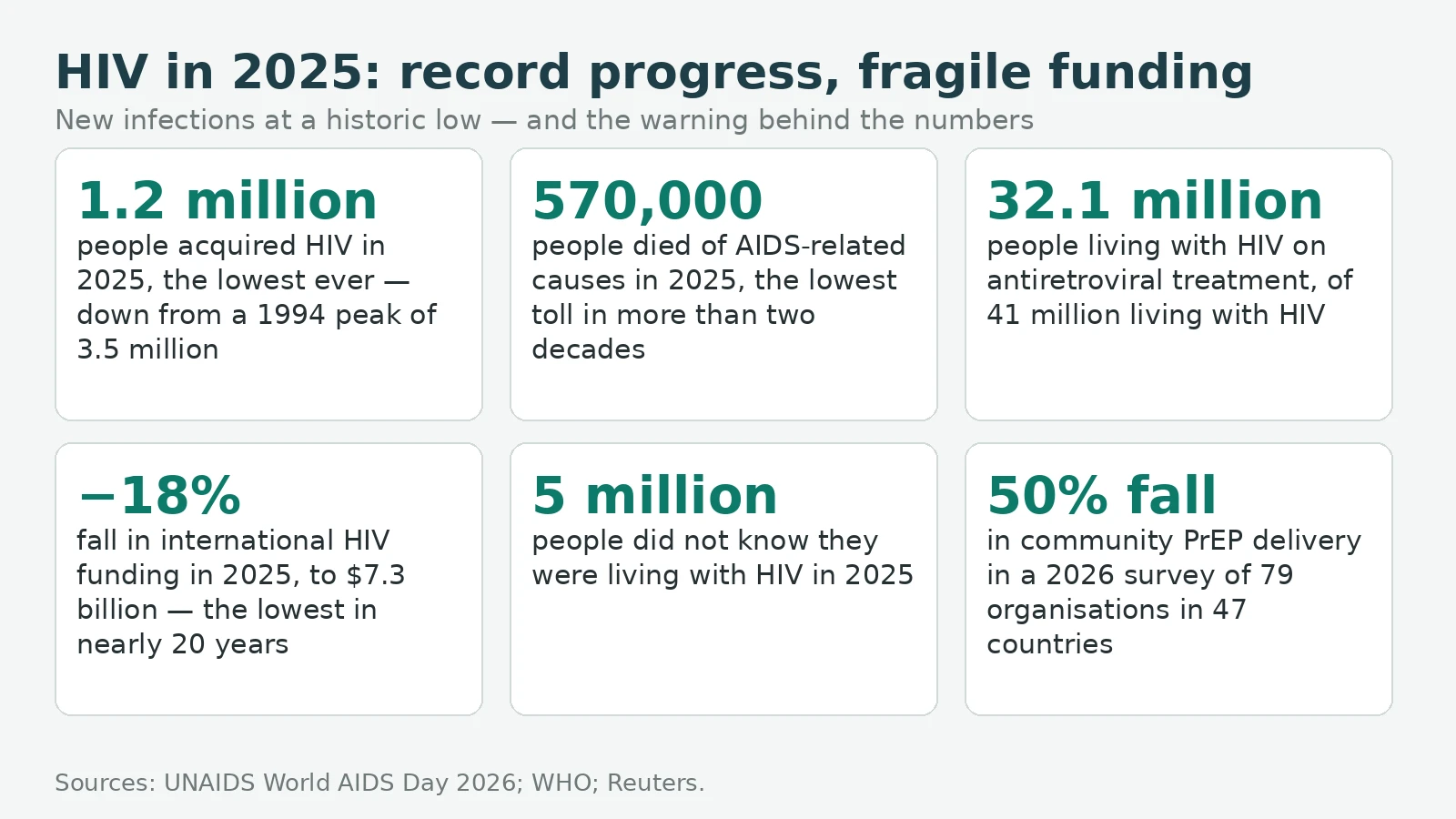
The warning lands at a moment of real success. According to UNAIDS, about 1.2 million people acquired HIV in 2025 — the lowest annual figure ever recorded, down from 1.3 million in 2024 and from a peak of 3.5 million in 1994. AIDS-related deaths fell to 570,000 in 2025, or almost 1,600 a day, the lowest toll in more than two decades and down from 1.3 million in 2010.
Around 41 million people were living with HIV in 2025, and 32.1 million of them — 78% — were on antiretroviral treatment. The World Health Organization (WHO) reports that 88% of people living with HIV knew their status, 89% of those were receiving treatment, and 95% of those on treatment had suppressed viral loads — close to the global “95-95-95” targets. Yet the picture is uneven: 5 million people did not know they were living with HIV, nearly 9 million had no access to treatment, and new infections rose in three regions and 21 countries in 2025.
Why infections could rise again
The core problem is money. International financing for HIV programmes fell from US$8.8 billion in 2024 to US$7.3 billion in 2025 — an 18% drop, the largest in almost two decades and the lowest level in nearly 20 years. US contributions fell 26% between 2024 and 2025, although the United States remains the largest international donor, and Global Fund disbursements dropped 13%.
The cuts are already biting. UNAIDS says prevention clinics are closing and staff numbers are being cut as countries struggle to fill the gap. HIV testing fell 22% in high-burden countries covered by one major bilateral programme, and funding for condoms was cut by more than 90% in some places. A 2026 survey of 79 community-led organisations in 47 countries found that delivery of PrEP — medicine taken by people without HIV to reduce their risk — had fallen by half, with services for gay men down 85% and services for sex workers down 82%. In Cameroon, Nigeria and Zambia, the number of people receiving PrEP fell by more than half between 2024 and 2025.
UNAIDS also points to the rollback of rights. In 2026, sex work was criminalised in 168 countries, possession of small amounts of drugs in 152 countries, and same-sex sexual acts in 66 countries — laws that push the people most at risk away from testing and care.
What HIV is and how it spreads
HIV is a virus that attacks the body’s immune system. AIDS is the most advanced stage of the infection. There is no cure, but with effective treatment HIV has become a manageable long-term condition, and most people with HIV can live a long and healthy life, according to the NHS. HIV has claimed an estimated 44.2 million lives to date, the WHO says.
HIV spreads through body fluids — blood, breast milk, semen and vaginal fluids — most often through sex without a condom or by sharing needles. It cannot be caught from kissing, hugging, shaking hands, toilet seats, food, drinks or household items. A mother can also pass HIV to her baby, though treatment during pregnancy greatly reduces that risk.
Testing, treatment and prevention
Antiretroviral treatment (ART) reduces the virus in the blood to an undetectable level. People living with HIV who take ART and have an undetectable viral load will not pass HIV to their sexual partners — known as undetectable equals untransmittable, or U=U. That is why testing matters: you cannot benefit from treatment you do not know you need.
PrEP is medicine taken by people without HIV to lower the chance of acquiring it. The WHO recommends oral tenofovir-based PrEP, the dapivirine vaginal ring, and long-acting injectable cabotegravir and lenacapavir. Lenacapavir, given as two injections a year, had reached more than 50,000 people in nine sub-Saharan African countries by the end of June 2026, and its price for lower-income countries is set to fall to US$40 per person per year from 2027.
If you think you may have been exposed to HIV, PEP is a 28-day course of HIV medicines that must be started within 72 hours. In the UK it is available from sexual health clinics and A&E departments — the sooner it is started, the better it works.
Early signs and when to get tested
Some people develop a short flu-like illness about 2 to 6 weeks after infection — a sore throat, high temperature, swollen glands, muscle aches, tiredness and a skin rash. But many people have no symptoms at all for years, which is why so many people with HIV do not know they have it.
The CDC advises everyone aged 13 to 64 to be tested for HIV at least once, and people with higher risk factors at least once a year. Get tested sooner if you have had sex without a condom with a new partner, shared needles, or had a flu-like illness a few weeks after a possible exposure. Tests use blood from a finger or saliva; clinic results usually take a few days, while home test kits often give results within minutes. Note that most people develop antibodies within 28 days of infection, and during this “window period” many rapid tests cannot yet detect HIV — a confirmatory test by a trained health worker is needed for a diagnosis.
When to see a doctor
See a GP or a sexual health clinic if you think you may have been exposed to HIV, if you have had sex without a condom with a new partner, or if you develop a flu-like illness a few weeks after a possible exposure. If you think you were exposed in the last 72 hours, go to a sexual health clinic or A&E straight away to ask about emergency PEP — after 72 hours it is too late to start.
Without treatment, HIV can lead to serious illnesses such as tuberculosis, pneumonia or cancer. With treatment started early, most people live long, healthy lives — so testing early is the single most important step.
In an emergency call 911 (US), 999 (UK) or 112 (EU). For confidential advice, sexual health clinics offer free, non-judgmental testing and support.
Frequently asked questions
Why does UNAIDS think HIV infections will rise again?
Because the funding that drove infections down is being cut. International HIV financing fell 18% in 2025, US contributions fell 26%, and prevention clinics are closing while staff numbers are cut. Testing fell 22% in high-burden countries and community PrEP delivery halved in a 47-country survey. UNAIDS says these are the early signs of a reversal, and expects 2027 data to show infections rising.
How many people get HIV each year now?
About 1.2 million people acquired HIV in 2025, according to UNAIDS — the lowest annual number ever recorded, down from a peak of 3.5 million in 1994. Around 41 million people were living with HIV, and 32.1 million of them were on antiretroviral treatment. But 5 million people did not know they had HIV, and nearly 9 million had no access to treatment.
Can HIV be treated?
Yes. There is no cure, but antiretroviral treatment (ART) can reduce the virus in the blood to an undetectable level. With effective treatment, most people with HIV can live a long and healthy life, according to the NHS. People on treatment with an undetectable viral load cannot pass HIV to sexual partners — known as undetectable equals untransmittable, or U=U.
How can I protect myself from HIV?
Condoms, regular testing and talking openly with partners all reduce risk. PrEP — medicine taken by people without HIV — lowers the chance of acquiring it, and a long-acting injection given twice a year is now available in some countries. If you think you may have been exposed, PEP is a 28-day course of medicines that must start within 72 hours — ask a sexual health clinic or A&E.
When should I get an HIV test?
The CDC advises everyone aged 13 to 64 to be tested at least once, and people with higher risk factors at least once a year. Get tested sooner if you have had sex without a condom with a new partner, shared needles, or had a flu-like illness a few weeks after a possible exposure. If you think you were exposed in the last 72 hours, go to a sexual health clinic straight away for emergency PEP.
What is the goal for ending AIDS?
The United Nations aims to end AIDS as a public health threat by 2030. A political declaration adopted in June 2026 commits countries to having 40 million people on treatment and 20 million using antiretroviral-based prevention by 2030. UNAIDS says meeting those commitments could avert 3.2 million new infections and 1.3 million AIDS-related deaths — but only if funding is restored.
Sources
- UNAIDS: World AIDS Day 2026 — Ending AIDS starts with access unaids.org
- Reuters: HIV infections could rise from historic lows starting next year, UN says www.devdiscourse.com
- WHO: HIV/AIDS fact sheet www.who.int
- NHS: HIV and AIDS www.nhs.uk
- CDC: HIV testing www.cdc.gov
- NIH HIVinfo: Basics of HIV prevention hivinfo.nih.gov

Try the tool
Not sure if it can wait?
Common causes and warning signs for 16 everyday symptoms.
Open the symptom guide