Breakfast Biscuit Recall: Listeria Risk and What to Check
Four Lunch Box breakfast biscuits were recalled in November 2026 over possible Listeria contamination. Which products are affected, how to check your pack, and the symptoms to watch for.
- Written by
- Health Daily Advice
- Published
- Reading time
- 6 minutes
- Sources
- 9 cited
In this guide
Four Lunch Box breakfast biscuit sandwiches were recalled on 19 November 2026 because the biscuits may be contaminated with Listeria, a germ that can cause serious illness in pregnant women, older adults and people with weak immune systems. No illnesses have been reported. Check the UPC and date code on the pack, and do not eat a recalled sandwich.
Which biscuits were recalled?
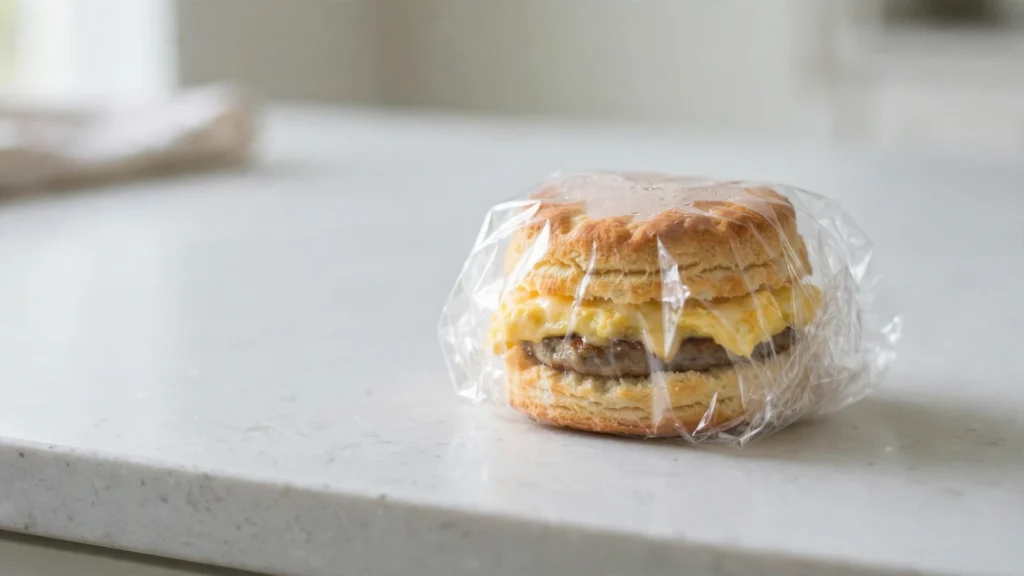
Grand Strand Sandwich Company, of Longs, South Carolina, recalled four Lunch Box breakfast biscuit sandwiches after its supplier, Dot Foods, warned on 11 November that the biscuits supplied may be contaminated with Listeria monocytogenes. The FDA posted the company’s announcement on 19 November 2026.
The sandwiches were distributed between 2 March and 10 November 2026, packaged in clear plastic and sold mainly in retail convenience stores, vending machines and prison canteens in North Carolina, South Carolina and Virginia. Check the product name, size, UPC and the five-digit Julian date code printed on the package:
| Product | Size | UPC | Julian date codes |
|---|---|---|---|
| Lunch Box Bacon Egg and Cheese Biscuit | 4 oz | 0 67068 21400 8 | 07026, 07526, 08326, 09626, 12526, 13226, 14026, 16826, 17526, 23726 |
| Lunch Box Chicken Sausage Biscuit | 3.75 oz | 0 67068 21404 6 | 06126 |
| Lunch Box Jumbo Sausage Biscuit | 4 oz | 0 67068 21407 7 | 11126, 11826, 19526 |
| Lunch Box Sausage Egg & Cheese Biscuit | 5 oz | 0 67068 21402 2 | 11126, 15426, 18226, 20226, 25826, 26426, 29926 |
If you have one of these sandwiches, do not eat it. Return it to the place of purchase for a full refund or throw it away. Questions can go to Grand Strand Sandwich at 843-399-2999, Monday to Thursday 8 a.m. to 4 p.m. and Friday 8 a.m. to noon Eastern.
The wider biscuit recall
The Lunch Box recall is the latest step in a wider chain of recalls tied to biscuits that may carry Listeria. It unfolded over two weeks:
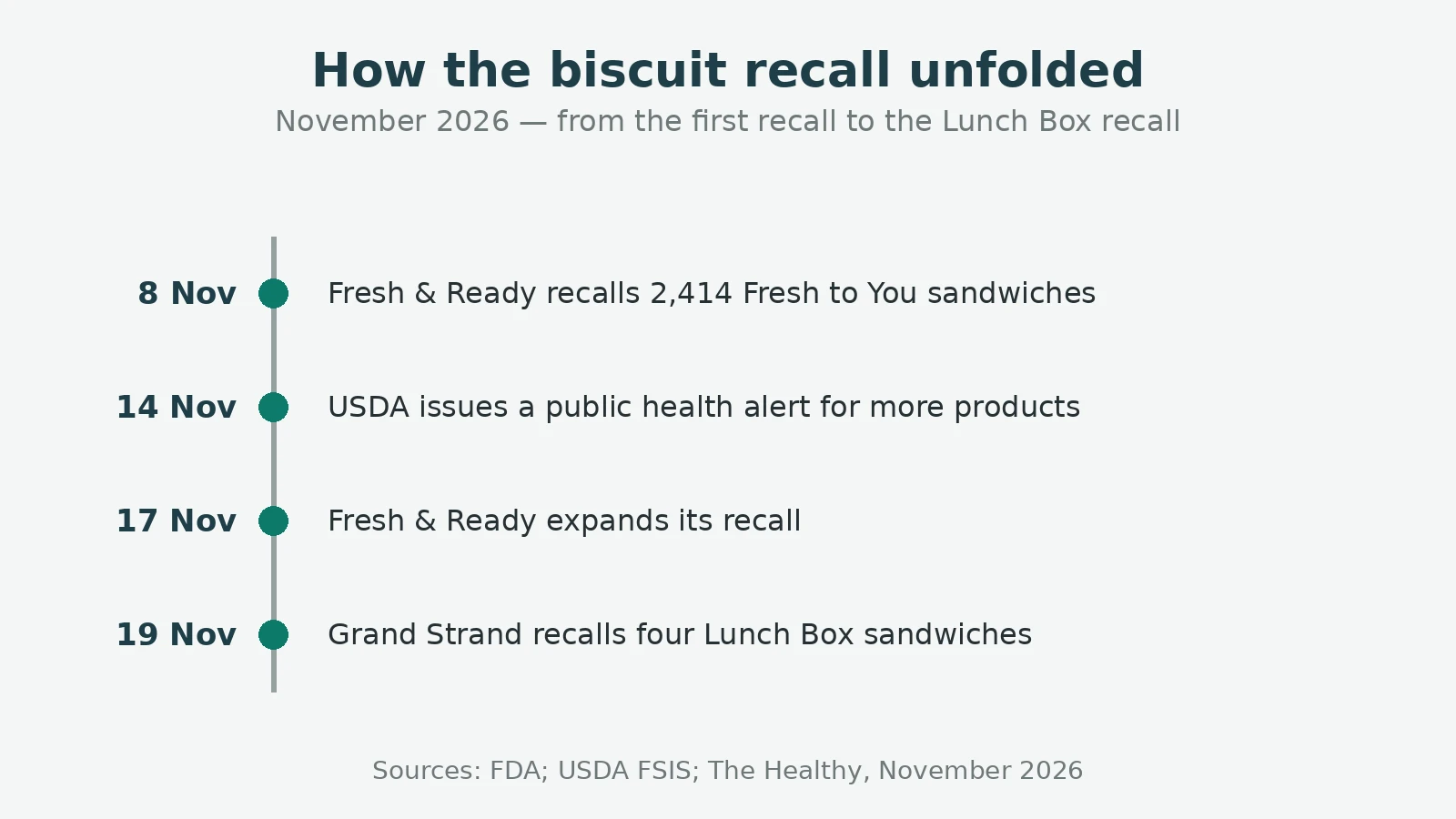
- 8 November: Fresh & Ready Foods recalled 2,414 Fresh to You sausage, egg and cheese biscuit sandwiches, because they contained biscuits previously recalled by C.H. Guenther & Son over possible Listeria contamination.
- 14 November: The USDA’s Food Safety and Inspection Service (FSIS) issued a public health alert for ready-to-eat meat products containing the recalled biscuits, including Mmm! Meals Made in Minutes Biscuit & Sausage Gravy, sold in Arkansas, Louisiana, Mississippi, Oklahoma, Tennessee and Texas.
- 17 November: Fresh & Ready Foods expanded its recall to cover more Fresh to You sandwiches and the Mmm! Meals biscuit and sausage gravy.
- 19 November: Grand Strand Sandwich Company recalled its four Lunch Box biscuit sandwiches in North Carolina, South Carolina and Virginia.
The USDA alert also covers other ready-to-eat meals made with the recalled biscuits, including Granna’s frozen meals delivered to senior nutrition sites. FSIS has said more products may be added as the ingredient recall progresses, and it updates its list online. Note that the Grand Strand notice does not name C.H. Guenther & Son — it names only its supplier, Dot Foods — so the two recalls should not be assumed to share a source.
What is Listeria and listeriosis?
Listeria monocytogenes is a bacterium found in soil, water and animal waste that can contaminate food during processing or handling. Eating contaminated food can cause listeriosis, the illness it triggers. The CDC calls the infection rare but serious: it estimates 1,250 people are infected in the United States each year and 172 die from it, making it the fourth leading cause of death from foodborne illness in the country.
Listeria is unusually hard to control because it can grow in refrigerated, packaged, ready-to-eat food without changing the taste or smell, and it can survive refrigeration and even freezing. That is why the risk concentrates in foods eaten cold or with no further cooking: deli meats, cold cuts, hot dogs, soft cheeses, cold-smoked fish, unpasteurized milk and juices, raw sprouts and cut melon.
Most healthy adults who eat contaminated food have mild symptoms or none at all. The danger is concentrated in a few groups, which is why recalls like this one are taken seriously even when no illnesses have been reported.
What does a Listeria infection feel like?
Symptoms depend on where the infection takes hold. The Mayo Clinic explains that if it affects the gut, you may have diarrhoea, an upset stomach and vomiting. These symptoms often start within a day of eating tainted food and tend to go away within a few days.
If the bacteria spread beyond the gut — invasive listeriosis — the picture is more serious: fever and chills, muscle aches and fatigue, headache, stiff neck, confusion, loss of balance and seizures. These symptoms often start within two weeks of eating tainted food, but the Mayo Clinic notes it can take up to two months. The Cleveland Clinic adds that symptoms can start a few days to two weeks after eating contaminated food.
In pregnancy, the infection may cause only mild symptoms in the pregnant person, or none at all — but it can still pass to the baby, with risks including miscarriage, stillbirth, premature birth and a life-threatening infection in the newborn. In newborns the signs can be subtle: little interest in feeding, crankiness, fever or low temperature, vomiting, trouble breathing and low energy.
Who is most at risk?
Listeriosis can affect anyone, but the CDC names four groups at highest risk of severe illness:
- Pregnant women and their unborn or newborn babies
- Newborns
- Adults aged 65 or older
- People with weakened immune systems — including people with cancer, diabetes, kidney or liver disease, HIV or AIDS, people having chemotherapy, and people taking medicines that suppress the immune system
That is why the advice for these groups is stricter: avoid unpasteurized milk and soft cheeses, reheat hot dogs and deli meats until steaming hot, and avoid cold-smoked fish, raw sprouts and cut melon left at room temperature.
What should you do if you bought a recalled biscuit?
- Check the pack. Match the product name, size, UPC and Julian date code against the table above. The date code is a five-digit number printed on the package.
- Do not eat it. Even if it looks and smells fine, Listeria does not change the taste or smell of food. Return the sandwich for a full refund or throw it away.
- Check the freezer too. FSIS warns that some affected products may still be in consumers’ or retailers’ refrigerators and freezers, and the USDA alert list is being updated as more products are identified.
- Clean up. Wash your hands with warm, soapy water for at least 20 seconds after handling the product, and clean any surfaces or containers it touched with hot, soapy water.
- Keep the fridge cold. The FDA advises keeping the refrigerator at 40°F (4°C) or below and the freezer at 0°F (−18°C) to slow Listeria growth.
- Watch for symptoms. If you ate a recalled product, watch for fever, muscle aches, upset stomach or loose stools over the next two weeks — and up to two months. Tell your healthcare professional what you ate.
For food safety questions, the USDA Meat and Poultry Hotline is 888-674-6854, or email MPHotline@usda.gov.
When to see a doctor
Call your healthcare professional if you ate a recalled food and develop a fever, muscle aches, an upset stomach or loose stools. The same applies after eating any food that might be tainted, such as unpasteurized milk or poorly heated hot dogs or deli meats. Let the doctor know exactly what you ate and when.
Get emergency care straight away if you have a high fever, a very bad headache, a stiff neck, confusion, or discomfort from light — these can be signs of bacterial meningitis, a life-threatening complication of listeriosis. Pregnant women, people over 65 and people with weakened immune systems should seek advice promptly even with mild symptoms. In an emergency call 911 (US), 999 (UK) or 112 (EU).
Frequently asked questions
Which breakfast biscuits were recalled for Listeria?
Grand Strand Sandwich Company recalled four Lunch Box sandwiches on 19 November 2026: Bacon Egg and Cheese Biscuit (4 oz), Chicken Sausage Biscuit (3.75 oz), Jumbo Sausage Biscuit (4 oz) and Sausage Egg & Cheese Biscuit (5 oz). They were sold in North Carolina, South Carolina and Virginia. Check the UPC and the five-digit Julian date code on the pack against the official list — only the listed date codes are affected.
What should I do if I bought a recalled biscuit sandwich?
Do not eat it, even if it looks and smells fine — Listeria does not change the taste or smell of food. Return it to the place of purchase for a full refund, or throw it away. Wash your hands and any surfaces the sandwich touched with hot, soapy water. If you already ate one, watch for fever, muscle aches or stomach upset over the next two weeks, and tell a doctor what you ate.
What are the symptoms of a Listeria infection?
If it affects the gut, symptoms are diarrhoea, an upset stomach and vomiting, often starting within a day. If the bacteria spread beyond the gut, symptoms can include fever, chills, muscle aches, headache, a stiff neck, confusion, loss of balance and seizures. In pregnancy the infection may cause few symptoms but can still harm the baby, so pregnant women should seek advice promptly if they ate a recalled food.
How long after eating contaminated food do Listeria symptoms start?
It varies. Gut symptoms such as diarrhoea and vomiting often start within a day of eating tainted food and usually pass within a few days. Invasive symptoms — fever, headache, stiff neck and confusion — often start within two weeks, but the Mayo Clinic notes it can take up to two months. That long delay is one reason to note what you ate and when, and to tell your doctor.
Can Listeria grow in the fridge?
Yes. Listeria is unusual among food-poisoning germs because it can grow in refrigerated, packaged, ready-to-eat food and can survive freezing. That is why the FDA advises keeping the refrigerator at 40°F (4°C) or below and the freezer at 0°F (−18°C). Chilling slows the bacteria but does not kill them, so recalled foods must be thrown away rather than kept, and high-risk foods should be eaten promptly.
Has anyone become ill from the recalled biscuits?
No illnesses have been reported to date, according to the FDA recall announcement and the USDA public health alert. The recall is precautionary: the biscuits may be contaminated, not confirmed to be. That can change, so FSIS says it will update its list as the investigation progresses. Anyone who ate an affected product should still watch for symptoms and seek medical advice if they appear.
Sources
- FDA: Grand Strand Sandwich Company recalls Lunch Box biscuits www.fda.gov
- CDC: About Listeria Infection www.cdc.gov
- Mayo Clinic: Listeria infection — symptoms and causes www.mayoclinic.org
- Cleveland Clinic: Listeriosis my.clevelandclinic.org
- The Healthy: More Recalled Breakfast Foods Affected by Listeria Concerns www.thehealthy.com
- Food Safety News: USDA issues alert for biscuit and sausage gravy products www.foodsafetynews.com

Try the tool
Not sure if it can wait?
Common causes and warning signs for 16 everyday symptoms.
Open the symptom guide